
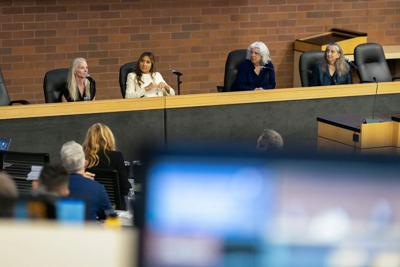


Jennie Skelton, partner and co-founder at Politicom Law LLP, far left, talks during a panel discussion at an event marking the 50th anniversary of the creation of California's Fair Political Practices Commission at McGeorge School of Law in Sacramento on Sept. 11, 2024. Photo by Jungho Kim for CalMatters
A $1,044 outing at a glitzy Hollywood nightclub. A $1,316 meal at a Los Angeles steak and seafood restaurant. A $4,500 experience to see the L.A. Dodgers. Isaac Galvan paid for them all — with campaign cash, a state probe found.
In his nine years on the Compton City Council, Galvan frequently spent campaign donations for personal purposes, kept shoddy financial records and repeatedly failed to disclose donors and expenditures accurately and on time, if at all, the California Fair Political Practices Commission concluded in its investigation.
But the probe lasted six years — so long that voters reelected Galvan twice and he left office before those violations were made public in July 2022. During the investigation, he continued to miss filing deadlines, allegedly participated in a bribery scheme that led to his indictment, and was tossed out of office by a judge in May 2022 for election fraud.
“What took them so long?” asked lifelong Compton resident Gilda Blueford, who only learned of Galvan’s campaign finance violations from CalMatters. “If we could have known what was going on … perhaps he would not have been re-elected.”
Historically plagued by what some staff called an “enormous” backlog, California’s campaign watchdog has sometimes taken years to resolve cases — exposing violations or exonerating politicians only after they left office or won an election, a CalMatters analysis has found. While the agency has worked to expedite enforcement, advocates, officials and past and current commissioners say delayed actions can diminish public trust in the state’s ability to prosecute corruption effectively.
“If the FPPC doesn’t really clamp down on those obvious abuses quickly, then it’s a toothless watchdog,” said state Sen. Steve Glazer, an Orinda Democrat who has championed laws to tighten campaign ethics regulations.
The lag in enforcement could leave some voters in the dark in upcoming elections. As of last week:
- On the November ballot, 20 of the 305 candidates for the state Legislature, U.S. House and U.S. Senate have an open case against them, commission data shows.
- Two of the state’s eight constitutional officers are now under investigation — Gov. Gavin Newsom for late filings and Insurance Commissioner Ricardo Lara for allegations of “laundered campaign contributions” — and both won re-election as their cases were pending.
- Seven of the eight top constitutional officers — all but Lt. Gov. Eleni Kounalakis — have had past violations, ranging from improper disclosures to illegal campaign contributions, according to commission enforcement records.
The commission, created by California voters through a 1974 ballot measure following the Watergate scandal, has policed campaign and ethics violations statewide and in local races for 50 years. The backlog was an open secret among staffers and commissioners, with some senior counsels arguing in 2022 the problem had existed for “at least 20 years.”
Over the past decade, the agency has seen its caseload wax and wane, peaking in April 2020 at 1,874 unresolved cases, staff reports show. Among cases resolved between 2017 and 2023, 15% took more than two years to close, with the longest lasting almost seven years, according to a CalMatters analysis of data obtained through a public records request.
The agency has added staff, expanded programs to educate political candidates and streamlined enforcement of minor cases while freeing up resources for more serious violations, said commission Chairperson Adam E. Silver. In 2022, it adopted a policy directive to cap the carryover caseload at 625 each year and mandated a 75% reduction in cases opened before 2023, causing the backlog to plunge, he said.
“So long as that continues, then I would say the problem of cases building up and having a ‘backlog’ that grows and grows and grows, that’s resolved,” Silver said in an interview.
But some were concerned the agency may have become more lenient as it closed cases more quickly. Last year, the commission issued the lowest dollar amount of penalties and the highest percentage of warning letters — a method reserved for low-level offenses with minimal public harm — in the past decade, according to commission reports. Four in five cases where violations were found resulted in a letter.







(0) comments
Welcome to the discussion.
Log In
Keep it Clean. Please avoid obscene, vulgar, lewd, racist or sexually-oriented language.
PLEASE TURN OFF YOUR CAPS LOCK.
Don't Threaten. Threats of harming another person will not be tolerated.
Be Truthful. Don't knowingly lie about anyone or anything.
Be Nice. No racism, sexism or any sort of -ism that is degrading to another person.
Be Proactive. Use the 'Report' link on each comment to let us know of abusive posts.
Share with Us. We'd love to hear eyewitness accounts, the history behind an article.