
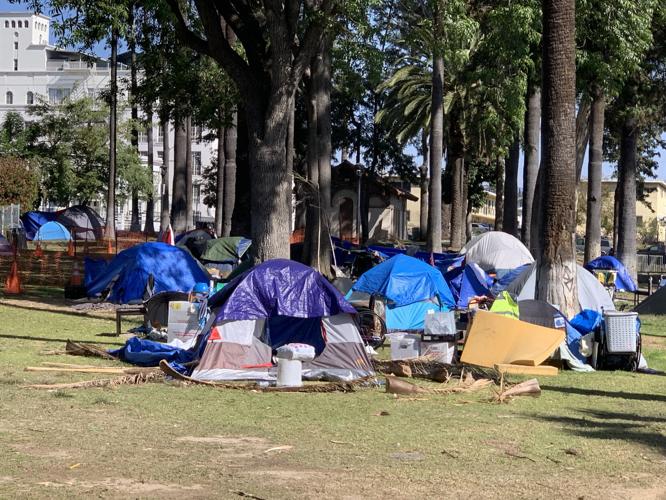


Homeless encampments are a commonplace sighting in many major cities across California. Photo provided by Getty Images
Yesica Prada is a 31-year-old Latina living out of her RV in Berkeley, California. The Berkeley graduate originally migrated from Mexico City and lived in Chicago throughout most of her childhood, but eventually moved to San Francisco in 2014 to pursue opportunities in higher education.
Prada attended the UC Berkeley Graduate School of Journalism while working night shifts at Whole Foods to support herself. Towards the end of her first semester of “J-School,” Prada worked the night shift at Whole Foods and attended classes during the day. “When my roommate decided to move to L.A. she told me the month of December, which left me to pay $1500 for her half of the rent.”
As an undocumented student, she had virtually no access to state or federal funding for students, and the university offered her few resources. Prada began living out of her car, and for a while, she rented an artist studio to crash in. However, she was eventually evicted and decided that a recreational vehicle was the most consistent and stable housing option for her.

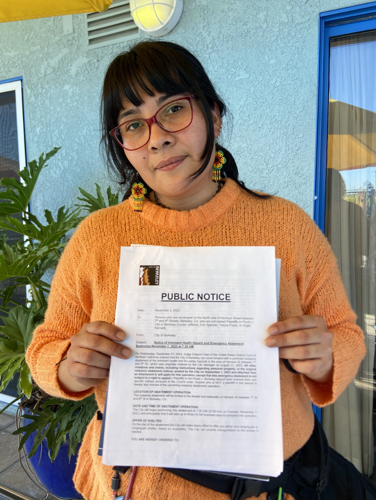
Yesica Prada, 33, holds up the notice from the city of Berkeley. Photo credit: Michelle Zacarias
The impact of the housing equity crisis in California has had a significant effect on various marginalized communities, with Latinos being among the hardest hit. Despite the increasing number of Latino households facing difficulties in maintaining stable housing, research shows that they are less likely to utilize housing equity resources and are underrepresented in HUD programs. The National Low Income Housing Coalition's data reveals that although "Hispanics" make up 29% of the poverty population, they only constitute 5% of HUD-assisted households on average.
Although it is clear that Latino households are being severely impacted by the pandemic, many of these issues existed long before. During a summit held by the Association of Healthcare Journalists in Oakland in November of 2023, representatives from multiple advocacy groups for the homeless discussed this problem and identified the factors that contribute to Latinos being at a higher risk of experiencing homelessness and displacement.
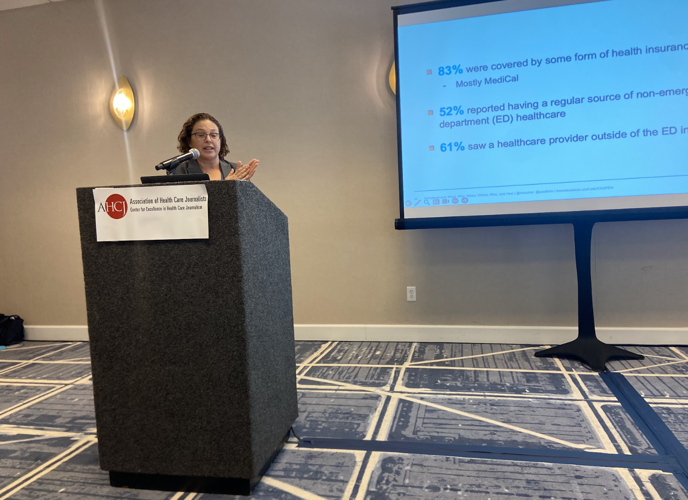
Summit keynote speaker Margot Kushel, M.D., shared key findings from the California Statewide Study on People Experiencing Homelessness (CASPEH) which was released in June 2023. According to the study approximately 35% of all homeless individuals interviewed for the study identified as “Latino/x.”

Margot Kushel, M.D., shares key findings from the CASPEH report at the Association of Healthcare Journalists Summit. Photo credit: Michelle Zacarias
Homelessness is often caused by economic disruptions in an individual's life, but it can also be a result of structural conditions that create and perpetuate inequalities. As indicated by the findings of the CASPEH report, the housing affordability crisis for Latinos in California has been exacerbated by a lack of affordable housing, income inequality, and structural racism.
CALÓ NEWS asked Kushel about the reasons behind the disparities of Latinos utilizing housing resources. According to her, services for unhoused individuals are generally not designed to cater to the cultural and linguistic needs of various communities of color. She also observed a significant difference in the barriers faced by English-speaking Latinx populations and those who only speak Spanish. “What we saw in our qualitative research a lot is that many service providers don't speak Spanish and if you are Spanish-speaking, it's hard to access it,” she said. Kushel also suggested that the pandemic had a higher impact on Latinos due to their ineligibility for relief from the CARES Act, which the 2.2 trillion economic stimulus bill passed in 2020.
Even now Prada continues to face displacement again. She received another notice from the city of Berkeley for “Imminent Health Hazard and Emergency Abatement.” The abatement, which was scheduled for 7:30 a.m. on Tuesday, Nov. 7, was addressed to all people encamped on “the North side of Harrison Street between 7th and 8th streets in Berkeley, CA.” Although the city is framing this as routine cleanup, Prada says she’s previously seen this tactic utilized against people in encampments and RV communities.
Although 78% of homeless people are unsheltered (living outside) many others live out of vehicles and transitory housing (shelters). Prada eventually found a community with other RV residents near the Berkeley Marina. She said it initially shocked her how many of the displaced people she encountered were families, “I couldn't make sense of how many families were out here. There were like at least five families in my community and they all had at least three kids each,” she said. Eventually, Prada along with 70 others were forcibly removed from the location. “The city of Berkeley made us leave, but we gave them a fight, you know,” she said.
California is estimated to have around 2.6 million undocumented individuals, according to the Public Policy Institute of California (PPIC). Due to the ongoing migration crisis, this number is anticipated to rise. The state's large coastal metropolitan areas have a significant concentration of immigrant populations. In 2021, data released by PPIC indicated at least one-third of the population in Santa Clara (40%), San Mateo (35%), San Francisco (34%), Los Angeles (33%), and Alameda (34%) counties are made up of foreign-born residents.
Without a comprehensive approach to tackling homelessness, advocates may continue to struggle with implementing solutions. Prada says at the end of the day, unhoused people just want to be treated with dignity and offered long-term affordable housing solutions. “You can’t have people saying you don't belong here and you also don't belong over there either,” said Prada, “because we have to exist somewhere.”












(0) comments
Welcome to the discussion.
Log In
Keep it Clean. Please avoid obscene, vulgar, lewd, racist or sexually-oriented language.
PLEASE TURN OFF YOUR CAPS LOCK.
Don't Threaten. Threats of harming another person will not be tolerated.
Be Truthful. Don't knowingly lie about anyone or anything.
Be Nice. No racism, sexism or any sort of -ism that is degrading to another person.
Be Proactive. Use the 'Report' link on each comment to let us know of abusive posts.
Share with Us. We'd love to hear eyewitness accounts, the history behind an article.