
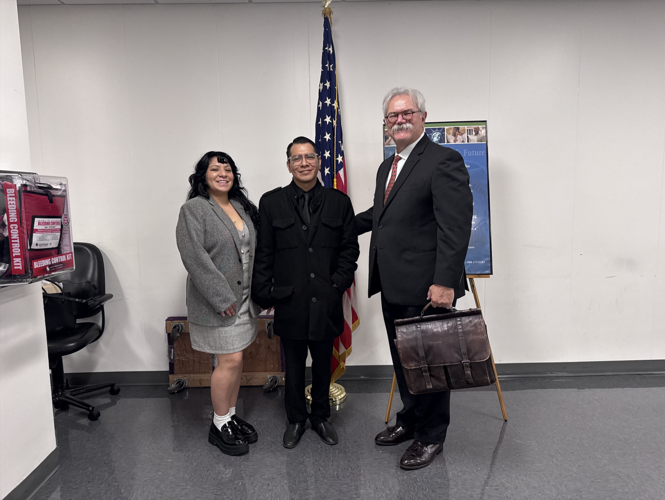



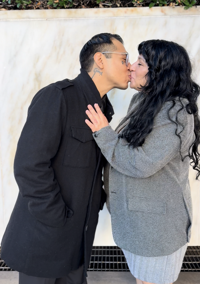


Angel and Jocelyn Cruz pose with their lawyer at the federal building shortly after receiving the news that he would be granted Lawful Permanent Resident status (image credit: Michelle Zacarias)
It’s 6:45 am on a crisp, October morning in downtown Los Angeles. Outside the federal courthouse, a line has already formed around the building. Among those waiting is Angel Cruz, 34, listening intently as his lawyer briefs him ahead of his immigration hearing.
He is not alone. His long-time partner and spouse, Jocelyn Cruz, stands beside him, joined by a close family friend, his sister, and brother-in-law — all there to offer support and help care for Cruz’s two-year-old daughter.
Cruz first received protection under the Deferred Action for Childhood Arrivals (DACA) program in 2012. On this day, he will learn whether he is becomes a Lawful Permanent Resident.
California has the largest population of DACA recipients, with recent estimates placing the number at roughly 144,000 to over 180,000, representing about a quarter to a third of all active DACA holders nationwide. Although the program provides work authorization and some protection from deportation, It does not provide a pathway to ship or permanent lawful status.
To enroll in DACA, the individual must have been brought to the U.S. before their sixteenth birthday and continuously resided in the United States since June 15, 2007. In addition to meeting other requirements, recipients must submit renewal requests every two years.
Cruz has been in the U.S. since he was two years old, the current age of his daughter. After years of waiting for clarity on his legal status, the day marks a turning point for Cruz’s entire life.
Just a couple of months prior, Cruz’s immigration appointment was delayed following protests that erupted throughout downtown L.A. In an unusual turn of events Cruz's immigration appointment was suddenly moved up, which led to some cause for concern – especially from Cruz’s wife, Jocelyn.
When Jocelyn spoke to CALÓ News in July, she emphasized that while they both had concerns about the upcoming appointment they were trying to remain positive for their daughter. “We've wanted to be parents for so long–we can't let anyone ruin that for us; we are trying to stay as positive and loving for her as possible,” she stated.

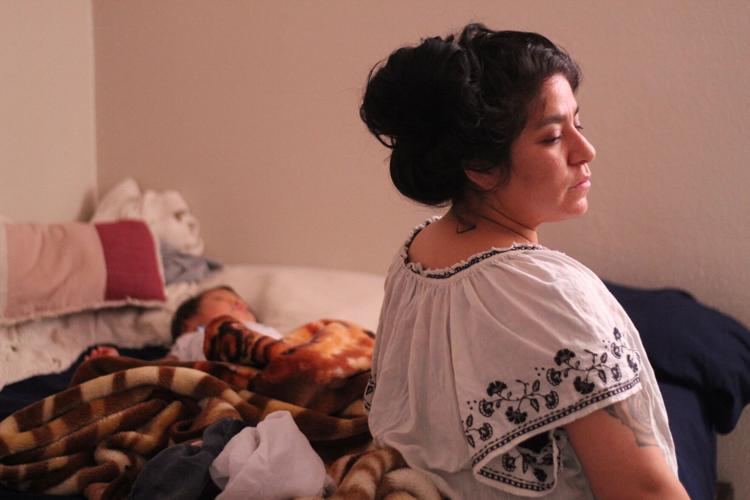
Jocelyn Cruz watches over her daughter as she sleeps (Image credit: Michelle Zacarias)
The couple has been together for over a decade, married for two, and share a daughter, but neither is close to their extended family. Jocelyn said that if Angel were deported, they would have few options for community support or caregiving.
“If we need to go to Mexico, who is over there that we can truly reach out to? Who will truly accept us there?” she asked.
Two beloved community artists and parents
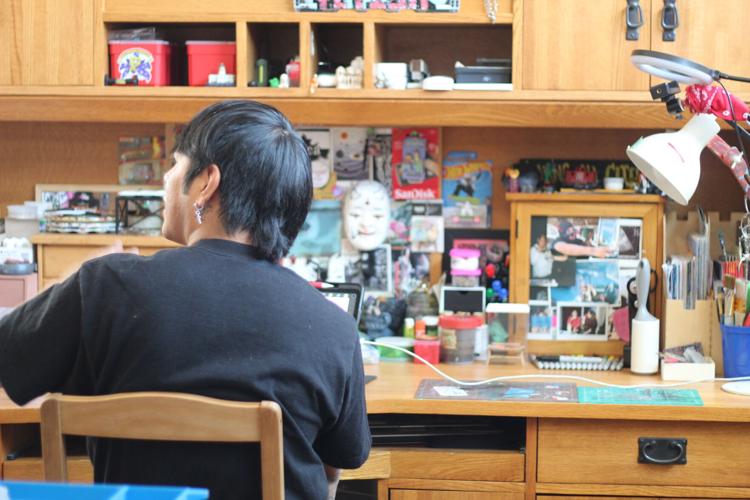
In their day-to-day lives in L.A. both Angel and Jocelyn are respected community artists and curators. They have a plethora of friends and a support system that treats them like family and helps in raising their daughter. Their home is an extension of the community they’ve created; welcoming and decorated with Angel’s intricately designed figurines and illustrations.

Angel Cruz sits in front of his work station in July of 2025 (Image credit: Michelle Zacarias)
Throughout his life, Cruz has walked a line between his identity as an Indigenous Oaxacan and an Angeleno. As a child, he said, he faced ostracism from other Mexicans who often labelled him “Indio,” “paisa,” or from “el pueblo,” language that reflects longstanding anti-Indigenous and classist sentiments within some Latino communities. He also didn’t speak Spanish like many of his peers, a gap that he said made it even harder to make sense of his undocumented status. “I couldn’t understand it,” he recalled. “I was just trying to fit in.”
Cruz learned about his legal status when he was preparing for a class field trip in middle school. “We were going to go to Washington for a camping trip with the school," he said, but was informed that he would be unable to participate with his classmates.
Angel's parents immigrated to the United States when he was two, making it difficult for him to see anything other than the local communities throughout L.A. as his actual home. “L.A. is my community,” he told CALÓ News, “I didn't understand it until I was told you can't go because there's no paper that says you can go.”
Even a cursory look at Cruz’s body of work reveals how deeply L.A. has shaped his artistic creativity. In 2025 he was selected for cohort 8 of the Ellsworth Artist Residency, supported by the Eastside Arts Initiative and the National Endowment for the Arts, and has been recognized by the City of Los Angeles for producing work that captures the spirit of Los Angeles and challenges the status quo.
Cruz’s home functions as an extension of his practice, arranged like a gallery, with artwork lining the walls and miniatures adorned with graffiti and urban iconography. His drawings are rooted in symbols specific to Chicano aesthetics, The miniatures, which take up a majority of his home’s decorations, are a reflection his belief that graffiti and urban art are are a part of the artistic ecosphere that make communities unique, often with negative associations

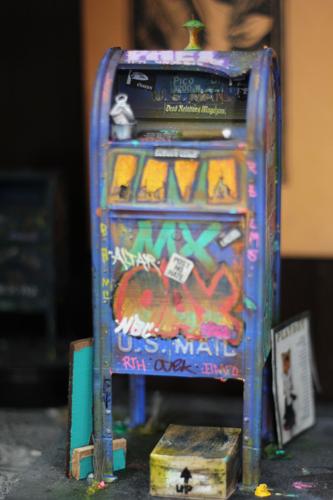
One of Angel's artistic miniatures that decorates his home (Image credit: Michelle Zacarias).
Cruz embraces the evolution of his style, and uses his art as a way to reclaim his voice and identity. So much of his creativity is characterized by the loss of agency he experienced as an undocumented person living in the United States, limited by his legal status.
“I couldn't make my own choices. The choices were made for me” he told CALÓ News as he reflected back on his own upbringing. Cruz shared that his independent and rebellious streak created tension growing up, which his parents interpreted as “going against” everything that they’ve sacrificed to build.
Cruz pushes back on this assertion, “I feel like the only way to be acknowledged is if you raise your voice or stand up for something” he stated in July of this year.
A long-awaited immigration appointment
After months of delays, Cruz’s immigration appointment was finally rescheduled for October 15. On the morning of, a line wrapped around the federal courthouse. Cruz arrived with his wife, best friend and family members, prepared for every possible outcome.
After clearing security, they entered the waiting area, where tension hung in the air as people slowly filtered in. Many aspiring-residents anxiously awaited for their names to be called.
Cruz’s lawyer, his immigration attorney of 13 years, reassured him as they reviewed the final steps. “The three of us will go,” she said, gesturing to Cruz, his wife and their daughter. “We’ll say hello to the officer, then we’ll hand [the baby] off. For now, just relax.”

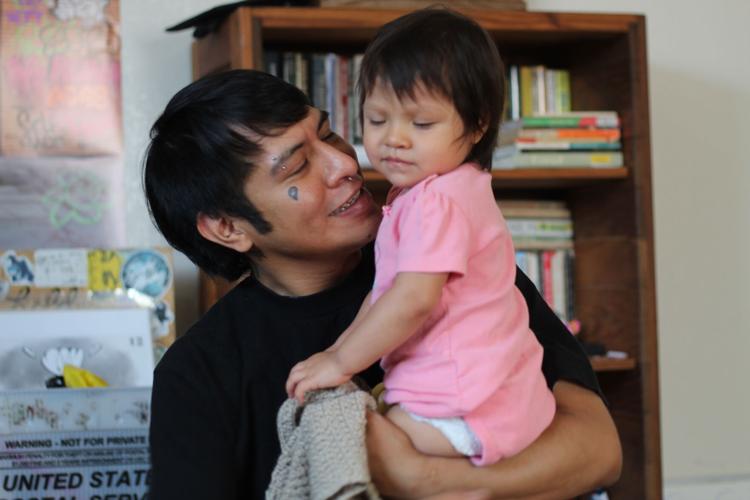
Angel Cruz holds his daughter closely as they share a moment in their home (Image credit: Michelle Zacarias).
When Cruz’s name was finally called, his wife and lawyer accompanied him into a back office, while the rest of the group remained behind, waiting. As the seconds ticked by on the wall clock, it became impossible not to reflect on the long journey his family had endured—and on what was at stake in that moment.
About twenty minutes passed, and the door swung back open. Angel and Jocelyn Cruz stepped out, his lawyer close behind. Few words were exchanged, but Jocelyn offered a small thumbs-up, signaling that the appointment had gone well. Moments later, Cruz’s lawyer announced, “You’re looking at the newest Green Card holder.”
The energy shifted and the weight that had hung over the lobby was suddenly lifted. After 13 years under DACA, uncertain whether he would ever be fully accepted in the United States, Cruz was now a Lawful Permanent Resident, or Green Card holder. And with enough time, he will eventually be on the pathway to become a naturalized U.S citizen.
Spirits were high outside of the courthouse following Cruz’s appointment. There were still some remaining uncertainties as a result of the current administration's political tactics but there was a newfound sense of hope in the air. “We’re one step closer to achieving that American dream,” said Angel.
Jocelyn expressed gratitude through tears: “I’m trying not to get emotional but I’m excited about our life now and not be so overwhelmed all the time now.”
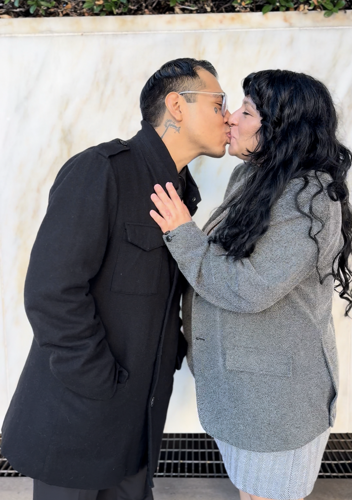
Outside the federal courthouse, the two shared a brief kiss as they took in the news.

Angel and Jocelyn Cruz share an intimate moment outside of the federal building in Los Angeles (Image credit: Michelle Zacarias).
Everyone hugged and celebrated the milestone, Angel thanked his wife, calling her “the backbone of everything.” Jocelyn, addressing other DACA recipients, urged them not to be afraid. Turning back to Angel, she thanked him for being “a great dad” and “a strong foundation for our family.”
Even as uncertainty continues to shape the lives of many immigrants under the current administration, outside the courthouse that day, Angel, Jocelyn and their daughter allowed themselves a moment of relief.













(0) comments
Welcome to the discussion.
Log In
Keep it Clean. Please avoid obscene, vulgar, lewd, racist or sexually-oriented language.
PLEASE TURN OFF YOUR CAPS LOCK.
Don't Threaten. Threats of harming another person will not be tolerated.
Be Truthful. Don't knowingly lie about anyone or anything.
Be Nice. No racism, sexism or any sort of -ism that is degrading to another person.
Be Proactive. Use the 'Report' link on each comment to let us know of abusive posts.
Share with Us. We'd love to hear eyewitness accounts, the history behind an article.