
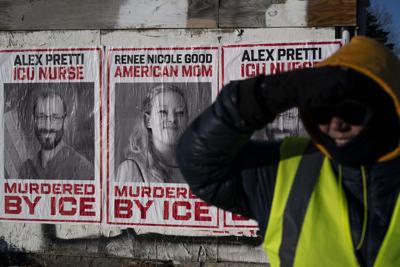
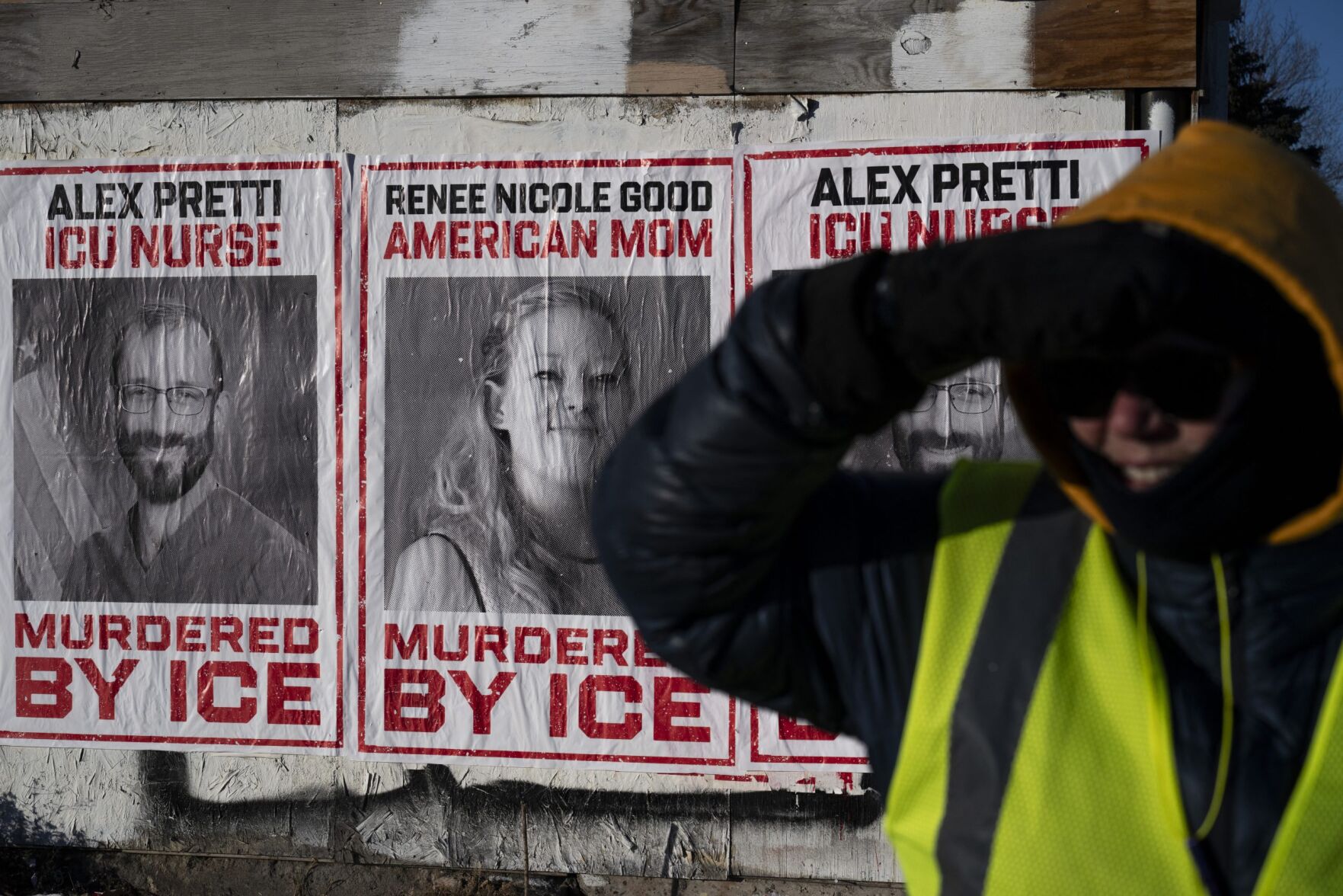
Backdropped by posters with images of Renee Good and Alex Pretti, a Minneapolis resident mans a corner to keep an eye out for ICE agents near a school where some students were recently arrested, on Jan. 29, 2026. (Credit: Roberto Schmidt / AFP via Getty Images)
Since the Immigration and Customs Enforcement (ICE) surge in Minneapolis began in December, the wider world has witnessed its horrors through news coverage and social media capturing agents’ brutal treatment of immigrants and protesters. The federal government’s bullets, tear gas, and beatings have been on full display, laying bare the inhumanity of this incursion.
But too often the media gives the impression that conflict and resistance are limited to the places where ICE detains immigrants and the streets where protests break out. When in fact, no part of our city has gone untouched, and all of our lives have been affected.
With news of 700 agents leaving the state, and promises that “Operation Metro Surge” will soon end, I fear that attention on this crisis may begin to wane, even if the brutality continues. I want the rest of the world to understand the full toll the surge has taken, and even more important, the full scope of resistance, in large part so that other cities and states can prepare as the Trump administration pursues its anti-immigrant agenda nationwide.
Being in Minneapolis is like reliving the COVID -19 pandemic, except this time the omnipresent threat is state violence. So many people feel unsafe leaving home that streets are emptier, businesses are struggling, and schools are sparsely attended as students opt for virtual learning. It isn’t just undocumented people who are scared to go out; ICE has targeted immigrants with legal status and U.S.-born citizens, with no mercy for the elderly or young children, giving many residents reason to fear.
The university where I work feels like a ghost town compared to the usual throngs of students moving around campus. Driving to work or running errands, I’ve seen abandoned cars on the shoulder of the road, left behind when immigration agents detained the driver. Sometimes the blinkers are still on, or the doors are open. Everywhere you go, absences signal ICE’s presence.
Direct encounters with ICE are also part of daily life, whether you’re their target or not. Testimonials collected by local media and volunteers have captured the kinds of experiences that don’t always make headlines but show how far-reaching the impact is. I keep thinking of a story that a dad submitted about his child who was home alone when ICE came to take their neighbor. Looking out the window at masked men with guns drawn, surrounded by neighbors shouting and blowing whistles, “the only emergency training she’s ever gotten kicked in. She turned off all the lights in our house and went and hid in the back room. You know, like an active shooter drill at school.”
Vast mutual aid networks have sprung up to support people who are hiding at home. I’m aware of more than 100 people regularly grocery shopping for families in one neighborhood alone. Seemingly every neighborhood has a network like this, which leads me to guess that thousands are helping with grocery deliveries across the Twin Cities. Residents are also demanding an eviction moratorium and raising money for rent assistance because people in hiding are missing paychecks. People are doing laundry for those who can’t safely get to the laundromat, running errands for their homebound neighbors, and giving rides to work and medical appointments so no one has to risk facing ICE alone.
I drove a man to work because ICE detained and released him without returning his driver’s license. He’s a refugee living here legally with his wife and kids, but his wife was nevertheless afraid when federal agents came to their door. She told her husband not to open it. He replied they had nothing to fear, all their papers were in order. But the agents didn’t ask for papers, they just dragged him out and sent him to Texas. He said the first time anyone even asked his name was at the Texas detention center, which he described as a prison. He was stuck there for nearly a week before his lawyer managed to sort things out. He was released with about a dozen other people who’d been detained under similar circumstances. They had to find their way to the airport and book their own tickets home. Far from an outlier, experiences like this have become commonplace.
I volunteer with an after-school program that’s short-staffed because their workers are in hiding, and many students in the program are staying home too. When the kids ask about their missing caretakers and friends, the adults say they’re out sick or on vacation, even though it’s been like this for weeks. At this school—and seemingly every school in the Twin Cities—parents patrol in reflective vests to ward off federal agents who are known to show up during drop-off and pick-up. No one wants a repeat of the melee at Roosevelt High School, where a swarm of Border Patrol agents tackled and teargassed students, staff, and witnesses.
In my neighborhood, there are also people in reflective vests standing watch on street corners and outside vulnerable businesses that have requested support. I stood watch for a business one frigid night, after learning how to identify unmarked ICE vehicles. I was ready to alert staff if any showed up so they could lock the doors, but it was quiet that evening. Another time I joined someone patrolling in their car, a tactic that journalists have fixated upon (they frequently request ride-alongs), and it’s easy to see why. Mobile patrol is high octane.
When you’ve identified an ICE vehicle—which happens quickly because they’re everywhere—you follow it and alert other patrollers nearby to join through a dispatch system coordinated at the neighborhood level. That way, when ICE stops to harass or detain someone, there are people ready to honk horns and blow whistles in warning, capture video footage, and collect information from anyone being detained. Tens of thousands of residents have joined this effort, so many that former Border Patrol commander Greg Bovino conceded that our organization and communication “have made it a difficult operating environment.” One morning I was eating breakfast near my front window when a darkly tinted SUV drove past with three cars honking behind it. Thanks to them, I quickly texted a vulnerable neighbor that it was a good time to stay inside.
ICE agents often retaliate against people who follow or observe them. Sometimes they look up the registration of the patroller’s vehicle and lead them to the registered address. It’s their way of saying, “We know where you live.” More aggressive agents have pepper-sprayed into people’s car vents, broken their windows, and arrested them. And of course, they ruthlessly killed Renee Good and Alex Pretti.
When ICE arrests anyone, they’re taken to the Whipple Federal Building, part of the historic Fort Snelling complex where the U.S. government suppressed a 19th century Dakota uprising with mass execution and a concentration camp. A recently filed lawsuit alleges that Whipple lacks adequate beds, toilets, and phones, and that immigrants detained there are denied the right to speak with a lawyer. People who ICE intends to deport are sometimes held there for days before they’re sent to larger facilities in other states. Citizens have been held for as long as 10 hours before being released without charges. There are so many protesters, observers, and racially profiled citizens getting arrested by ICE that volunteers now wait outside of the building at all hours of the day to help them as they are released. ICE does not immediately return their belongings, so they are usually without a phone, ID, or coat in freezing temperatures.
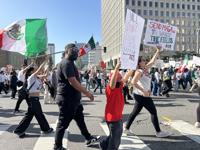
The level of resistance in Minneapolis simply would not be possible if there were only “activists” or “protesters” involved. People from all walks of life are using whatever skills and resources they have to stand up for our communities. I know of a high school teacher who coaches sports by day and monitors ICE agents by night. Notaries have offered free in-home services for people who need to complete paperwork like the Delegation of Parental Authority, authorizing someone else to care for their children if they’re taken. Musicians are relentlessly playing loud music late into the night outside of hotels where ICE agents sleep. Construction workers are volunteering to repair doors that ICE agents batter down. Tow truck companies are returning the vehicles of detained people to their families, free of charge. Even our mail carriers are anti-ICE, and local police are speaking out too. One of my elderly suburban relatives who surprised everyone in the family by attending a massive downtown rally said, “I want to do something because I never have.”
I don’t think the resistance is widespread because Minneapolis is progressive—it overwhelmingly leans that way, but there’s still a political spectrum here. I think the resistance is widespread because regardless of political perspective, this occupation has made clear how entwined we all are, how persecuting any group of people impacts everyone.
The ICE surge has transformed the city we love into a terrifying, grief-stricken place. But we’re determined that this will not last, and resistance is only growing. Minneapolis residents have turned attention to helping people in other cities and states prepare for similar conditions. And even when federal immigration agents leave for good, we’ll have a long road ahead of repairing the harm, rebuilding the local economy, and fighting for the return of our neighbors taken by ICE.
Because we don’t just want ICE out. We want our city back, and all of the people who call it home.






(0) comments
Welcome to the discussion.
Log In
Keep it Clean. Please avoid obscene, vulgar, lewd, racist or sexually-oriented language.
PLEASE TURN OFF YOUR CAPS LOCK.
Don't Threaten. Threats of harming another person will not be tolerated.
Be Truthful. Don't knowingly lie about anyone or anything.
Be Nice. No racism, sexism or any sort of -ism that is degrading to another person.
Be Proactive. Use the 'Report' link on each comment to let us know of abusive posts.
Share with Us. We'd love to hear eyewitness accounts, the history behind an article.