

This story was originally published by EdSource. Sign up for their daily newsletter.
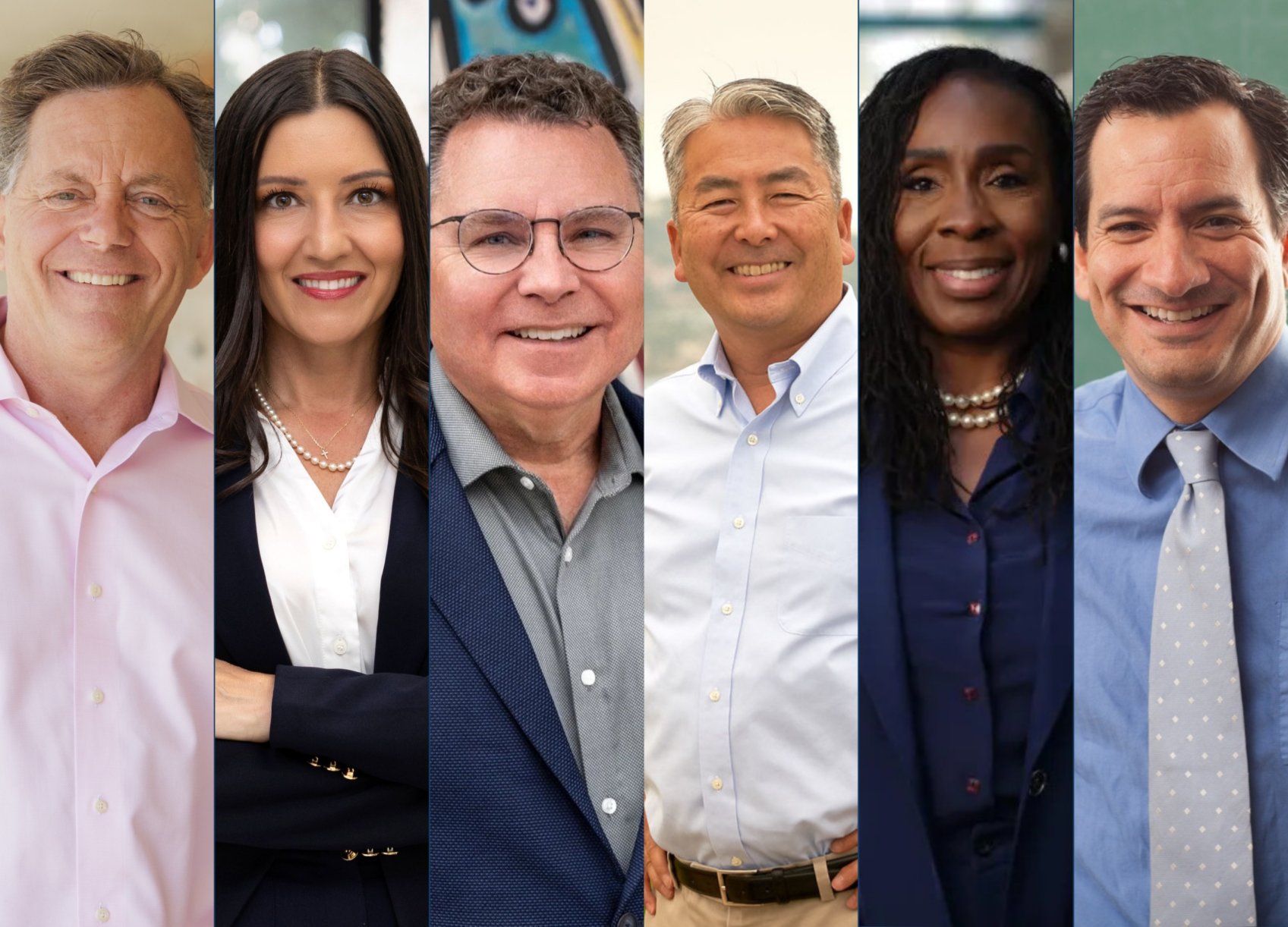
The top candidates vying to be California’s next superintendent of public instruction took the stage for two virtual forums this week, detailing how they would handle achievement gaps, artificial intelligence concerns, LGBTQ+ protections and more.
Six candidates participated in the forums hosted by EdSource, about six weeks before voters will go to the polls for the June 2 primary election.
Whoever wins the position will help shape the future of nearly 6 million students in California.
Tuesday’s forum featured San Diego Unified School District Board Member Richard Barrera, former State Sen. Josh Newman and Chino Valley Unified Board President Sonja Shaw.
Wednesday’s forum included State Assemblymember Al Muratsuchi, former Assembly Speaker Anthony Rendon and Nichelle Henderson, a trustee for the Los Angeles Community College District.
The forums took place in a wide-open race with no clear front-runner.
None of the candidates reached even 10% of support from likely voters in a survey released last week by the Public Policy Institute of California.
The achievement gap
One of the biggest challenges facing the next superintendent will be persistent achievement gaps across racial and ethnic groups, as well as between low-income and affluent students in California schools.
Newman suggested three approaches: reforming curriculum to “make sure that standards are set and maintained in every district,” ensuring that teachers are paid enough to live in the communities where they teach and addressing chronic absenteeism by “bringing kids back into school and making them engaged.”
Muratsuchi touted his role in passing the Local Control Funding Formula, California’s education funding formula designed to give more resources to districts with the highest percentages of low-income students.
He said the funding formula has helped, but acknowledged more needs to be done, especially before students reach kindergarten.
“We need to make sure that we provide more quality child care, quality preschool experiences for all kids, regardless of income, in order to close the achievement gap,” he said.
Barrera pointed to San Diego Unified as a model for improving outcomes at the high school level. He said that when he joined the district’s board, only 45% of all students overall, and 25% of Black and Latino students, were graduating having completed the A-G requirements, the college preparatory courses needed for admission to a California State University or University of California campus.
“We raised the standards for our graduation rates,” he said. “We said we want A-G to be the sequence that all students take and all students have access to. And we got those numbers up to 70% for the entire student body, and also 70% for Latino and Black students.”
Artificial intelligence
Several candidates agreed that artificial intelligence in the classroom presents risks and challenges and called for stricter guardrails.
Shaw said she is concerned that artificial intelligence is eroding students’ critical thinking skills and called for more research, including creating a “group to study” AI.
Henderson said students should be taught “how to utilize AI to enhance their learning” and prepare for future careers, predicting that many jobs they will hold have yet to be created “because of the innovations and the rapid change of AI.”
Rendon pointed to New York as a model, where he said teachers are “front and center” in the discussions around how to use artificial intelligence in the classroom. He said California should do the same. “Incorporate teachers into that conversation to make sure it’s not just administrators who are telling schools and telling teachers how they need to be incorporating AI,” he said.
Protecting LGBTQ+ students
The forums were not designed as debates, but some of the candidates did clash over California’s efforts to make LGBTQ+ students feel more welcomed in schools. Those efforts include the SAFETY Act, a 2024 law prohibiting districts from requiring staff to disclose a student’s sexual orientation or gender identity.
Barrera said California’s laws protect LGBTQ+ students, but added that there are “uneven protections” depending on the district. He said his district, San Diego Unified, partnered with Equality California, an LGBTQ+ civil rights organization, and has been recognized as a model district on issues including sexual health education curriculum and anti-bullying efforts.
Moments later, Shaw accused Barrera and San Diego Unified of financial mismanagement for “putting money towards ideologies in the classroom.” She also claimed groups such as Equality California are discriminatory, and that “our daughters don’t feel safe in their locker rooms and in their sports.” Shaw has worked to keep transgender athletes out of girls sports.
Barrera responded by citing estimates that there are 65,000 to 80,000 transgender students in California schools and noted that the mother of AB Hernandez, an openly transgender track athlete from Jurupa Valley, sent Shaw’s district a cease and desist notice, which accused Shaw of cyberbullying.
“That’s not the kind of leadership that we need in California,” Barrera said.
Shaw’s stances were also brought up during Wednesday’s forum, when Rendon said that if he isn’t elected, he wants to make sure that a candidate other than Shaw wins the election. He said Shaw is “very much against the principles that we as Californians have stood for repeatedly.”
Opposition to restructuring CDE
Gov. Gavin Newsom has proposed that the operation of the California Department of Education be shifted away from the superintendent of public instruction and instead to the governor and the State Board of Education.
Unsurprisingly, the candidates all said they oppose that idea.
Shaw noted that voters elect the superintendent to run the Department of Education, calling it a “constitutional seat.” Barrera agreed, noting that California voters in the past have rejected initiatives to eliminate the superintendent as an elected position. He called Newsom’s proposal an “end-around” to bypass voters.
Newman suggested the proposal, if implemented, would decrease accountability. That view was echoed the following night, when Muratsuchi said the state superintendent serves as part of a “checks and balance system” to the governor.
Rendon voiced perhaps the strongest opposition to the proposed changes, which he called “awful.”
“I think they would be bad for Californians. I think they would be bad for California schools. And ultimately, they would be bad for democracy at a time when we see the demise of democracy, threats to democracy all over the world,” he said.
Henderson, who arrived late to Wednesday’s forum, was not present when Newsom’s proposal was brought up, but she has previously said she is against the idea.


















(0) comments
Welcome to the discussion.
Log In
Keep it Clean. Please avoid obscene, vulgar, lewd, racist or sexually-oriented language.
PLEASE TURN OFF YOUR CAPS LOCK.
Don't Threaten. Threats of harming another person will not be tolerated.
Be Truthful. Don't knowingly lie about anyone or anything.
Be Nice. No racism, sexism or any sort of -ism that is degrading to another person.
Be Proactive. Use the 'Report' link on each comment to let us know of abusive posts.
Share with Us. We'd love to hear eyewitness accounts, the history behind an article.