




In October of 2013, Governor Jerry. Brown signed SB 468 (Emmerson) into law to create the SDP. Photo by Nathan Anderson
People can hire a family member, friend or another chosen worker to support and help with aspects of their care and physical and mental well-being. This is known as the California Self-Determination Program (SDP).
The SDP allows participants the opportunity to have more control in developing their health service plans and selecting service providers to better meet their needs.
Generally, those who qualify and are eligible for SDP can be anyone with a developmental disability. Conditions that often meet this criteria include cerebral palsy, epilepsy and autism. SDP allows people with these disabilities to have self-determination and agency to make everyday decisions on things like their monetary budget, personal care plans and living circumstances, among other things.
“It gives them the ability to be productive members of society and unfold their true potential. It’s a remarkable program," said Maria Perrin, president and chief strategy officer of Public Partnerships LLC (PPL), a financial management service organization helping to coordinate self-determination programs for eligible individuals.
SDP can be a Medicaid, Medicare, and MediCal benefit that, according to Perrin, is widely underused. “It's not well known, especially among Latinos,” she said.
In October of 2013, Governor Jerry. Brown signed SB 468 (Emmerson) into law to create the SDP. During the three-year implementation period of the SDP, the program was only available to 2,500 individuals.
Starting July 1, 2021, SDP became available to all eligible individuals receiving services from a regional center, such as the Central Valley Regional Center, Eastern Los Angeles Regional Center, Harbor Regional Center and South Central Los Angeles Regional Center, among many others.
“There are 21 regional centers in California,” Jessica Mercado, the California account manager at PPL, said. “The first step is a little more knowledge, especially in our Latino community. Many do not know about this; they don't even know they have access to a regional center.Anybody that has a loved one with a disability can indeed, if they reside in California, have access to these services through the regional center.”
For people to be able to enroll in a self-determined care program, the state requires one to use a financial management services vendor (FMS) such as PPL. FMS can support SDP participants by setting them up as an employer and making sure they understand their roles and responsibilities, explaining how to use their budget and managing the people who are servicing them.
PPL also helps with hiring the person’s care workers, including friends or family members who are already assisting them. In addition, PPL conducts worker background checks and provides monthly statements to help SPD participants monitor and manage their spending plans.
“We have seen firsthand the impact it has on many families who want to keep their loved ones at home,” Perrin said. “It’s also a way for relatives and family to become caregivers without worrying about the financial struggle because this helps them get paid for their time.”

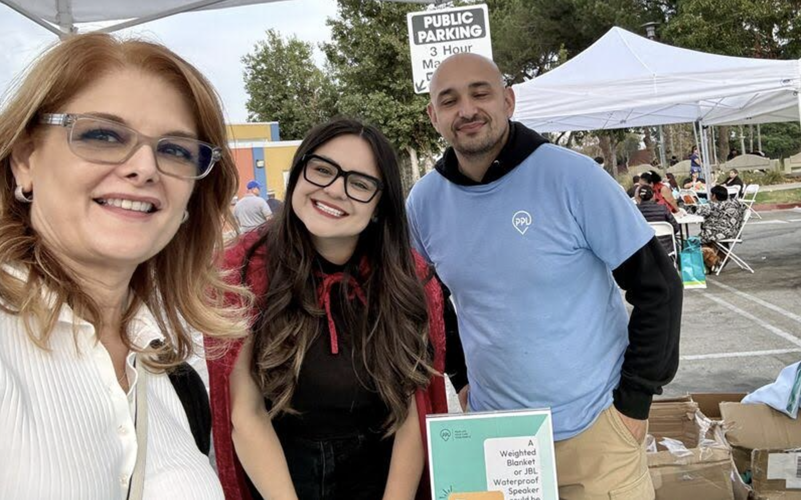
Perrin (left) and Mercado (right) at the Disability Fall Festival in East Los Angeles. Photo courtesy of Maria Perrin.
Mercado also said many SDP participants are much more comfortable with the care they could receive at home. SDP beneficiaries select a caregiver who often understands their cultural needs and speaks the same language, but ultimately it enables beneficiaries to hire whoever they want, including family or friends, to provide them with daily non-medical care, like bathing or dressing, with pay coming from Medicaid services.
“It’s a service that is not well known about but that once you start informing yourself and starting the process, it is not as hard to obtain as it might seem,” Mercado said.
Mercado and Perrin explained that the first step to being an SPD participant is to become familiar with and identify your regional center in your community. The participant (and their family, as applicable) creates a person-centered plan, which outlines what is important to and for them as well as the services, supports, and resources that will help them reach their goals. Some of the things listed in a person-centered plan can be physical therapy, employment support, specialized medical equipment and financial management, speech, hearing and language support, technology services, among many other things.
The person-centered plan is then presented to the regional center, which will come back with an individualized budget. This budget is then used by the participant to create a spending plan that outlines what the participant will do with the money, including addressing any unmet needs.
Financial management services vendors like PPL can be a start-and-finish point for many looking for these services. “People do not have to select PPL as their financial management services vendor; even if it is not us, they [should] find someone willing to support them and their families, making the best decision for their care and ultimately their future,“ Perrin said.
To learn more about PPL services, visit: pplfirst.com/programs/california/ca-sdp/






(0) comments
Welcome to the discussion.
Log In
Keep it Clean. Please avoid obscene, vulgar, lewd, racist or sexually-oriented language.
PLEASE TURN OFF YOUR CAPS LOCK.
Don't Threaten. Threats of harming another person will not be tolerated.
Be Truthful. Don't knowingly lie about anyone or anything.
Be Nice. No racism, sexism or any sort of -ism that is degrading to another person.
Be Proactive. Use the 'Report' link on each comment to let us know of abusive posts.
Share with Us. We'd love to hear eyewitness accounts, the history behind an article.