



Ages 18-29, voted in the 2020 presidential election, a remarkable 11-point increase from 2016.
Ava Mateo said people think young voters in America don’t want to vote.
“We have a system designed to make it not easy to vote in many places across the country,” Mateo, president of the nonpartisan, youth-led nonprofit 18by Vote, said at a youth vote panel.
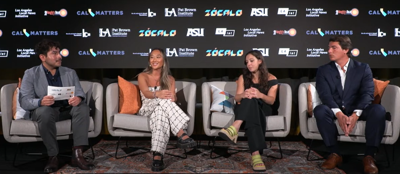
At Tuesday's Zócalo Public Square event, panelists discussed the misconception about young voters. Christian Paz, a senior political reporter at Vox covering the Democratic Party and the 2024 elections, asked the panelists about the biggest misconceptions people have about young voters or the frustration that comes to mind for young voters.
During Tuesday's Zócalo Public Square event, Gen Zers and Millennials civically engaged in politics were brought together.
The panel of experts discussed what Americans ages 18–29 want, what politicians get wrong about their voting bloc, and the barriers that keep young people from turning out to the polls. The public program, “Will the Real Young Voters Please Stand Up?,” was co-presented with LAist 89.3, Los Angeles Local News Initiative, Boyle Heights Beat, and CalMatters, with support from The Eli and Edythe Broad Foundation, in downtown Los Angeles at the ASU California Center Broadway in the historic Herald-Examiner building.
Joe Mitchell, who is the founder & president of Run GenZ, a nonprofit that supports young Republicans running for office responded with the following: “I think when you look at young people, obviously Gen Z loads votes per capita much less than a lot of other generations," Mitchell said. “I think you had to look at data and see what's actually happening and you had to look at the people that are registered to vote and actually what they’re thinking versus the general population.”
According to an analysis by the Center of Information & Research on Civic Learning and Engagement, it estimated that in the 2020 election 50% of young people, ages 18-29, voted. It also stated an 11-point increase from 2016 (39%) and likely one of the highest rates of youth electoral participation since the voting age was lowered to 18 years of age.
Mateo added that many young people don’t feel represented by their politicians in this year’s election. “That’s partially because our representatives are not representative of Gen Z and younger populations. And that’s also because politicians don’t reach out to young people because they’re not high-propensity voters,” she said.
Annie Wu Henry, who is a political digital media consultant for progressive organizations and campaigns, agreed with panelist Mateo. “There is disenchantment but it’s not because young people don’t care. And it’s understanding that those two things can happen at the same time,” she added. What young people want, Henry said, is for “politicians to hear them and invite them in, and not just to hear them out but actually to listen.”
Both presidential candidates have lately been appearing in podcasts such as “Call Her Daddy” and “This Past Weekend w/ Theo Von” clearly trying to target young voters. “People are trying to get their demographics to show up to the polls,” said Mitchell. According to the Pew Research Center, 67% of the ages between 18 and 29 have listened to a podcast in the last year.
The panel also discussed how there has been a shift in media since the last election in 2020. Henry said that the media ecosystem in 2024 vs. 2020 is drastically different in terms of how much information is out there and where individuals are getting the information. “TikTok is being utilized by campaigns this cycle. Is being invested in by whether it’s campaigning themselves or outside organizations or people organizing on there?
Moderator Paz also brought up how in this year's election there have been more celebrities involved. Henry added “I think a lot of people that follow these celebrities, whether it’s a musician or whether it's an actor, etc. They show more than just what their talent is and that’s how they build these audiences and that’s how they build these communities. And if you've been following Taylor Swift, if you’ve watched her in Miss Americana, you know she's made statements in the past and she’s made it pretty clear where she stands on issues,” she said.
“Is there a risk to having so many silos of media, particularly for young people encountering this information for the first time?” Paz also asked.
It comes down to making sure people have a civics education, said Mateo. “With all of the different ways young people are consuming media, we really need to be teaching critical thinking and how to understand what a policy is versus a personality,” she said. She cited the nonpartisan coalition CivxNow as an example of an organization helping promote civics learning around the nation.
Mitchell shouted out the Community Notes feature on X, which gives users a means to add context to posts to counter misinformation: “There’s a lot of information that I consume on that platform that maybe I would agree with, and I see it’s community noted, and I go and look at the data and why it’s been corrected. I think it’s been a great thing from a civic discussion perspective.”
As the panel answered audience questions—including an idea to make Election Day a national holiday—Paz asked the final question of the evening: Do we think we’ll get record turnout this year among young people?
“I like to stay optimistic,” said Mateo, who brought up the 11-point increase in turnout among 18- to 29-year-olds from 2016 to 2020. “There’s more money being invested in this election than I think has ever been invested before. And we’ll see if it pays off. What I would say to everyone and anyone is to encourage young people in your life to make a plan to vote. Encourage all people in your life to vote and make a plan to vote and you know you might have an impact on whether there’s a record turnout.”






(0) comments
Welcome to the discussion.
Log In
Keep it Clean. Please avoid obscene, vulgar, lewd, racist or sexually-oriented language.
PLEASE TURN OFF YOUR CAPS LOCK.
Don't Threaten. Threats of harming another person will not be tolerated.
Be Truthful. Don't knowingly lie about anyone or anything.
Be Nice. No racism, sexism or any sort of -ism that is degrading to another person.
Be Proactive. Use the 'Report' link on each comment to let us know of abusive posts.
Share with Us. We'd love to hear eyewitness accounts, the history behind an article.