


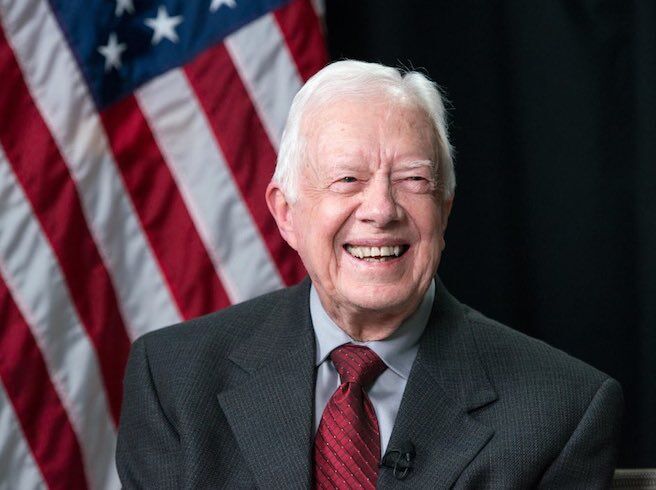
President Jimmy Carter (The Carter Center)
Jimmy Carter, 39th president of the United States and winner of the 2002 Nobel Peace Prize, died peacefully Sunday, December 29, at his home in Plains, Georgia, surrounded by his family. He was 100, the longest-lived president in U.S. history.
Carter's health gradually weakened in recent years. In February 2023, his family announced that he would forego further hospital stays and live out his final time receiving hospice care at home. His wife of 77 years, former First Lady Rosalynn Carter, died on Nov. 19 of that year at age 96.
“My father was a hero, not only to me but to everyone who believes in peace, human rights and unselfish love,” said Chip Carter, the former president’s son. “My brothers, sister and I shared him with the rest of the world through these common beliefs. The world is our family because of the way he brought people together, and we thank you for honoring his memory by continuing to live these shared beliefs.”
President Carter is survived by his children Jack, Chip, Jeff and Amy; 11 grandchildren; and 14 great-grandchildren. He was preceded in death by his beloved wife, Rosalynn, and one grandchild.
“Today, America and the world lost an extraordinary leader, statesman and humanitarian,'' President Joe Biden said in a statement issued by the White House. “Over six decades, we had the honor of calling Jimmy Carter a dear friend.”
Reactions from local officials
In Los Angeles, local officials remembered the president. Los Angeles County Supervisor Janice Hahn said on X, “Jimmy Carter's extraordinary public service didn't end when his presidency did. He has remained an icon of kindness and humility and a champion of peace.''
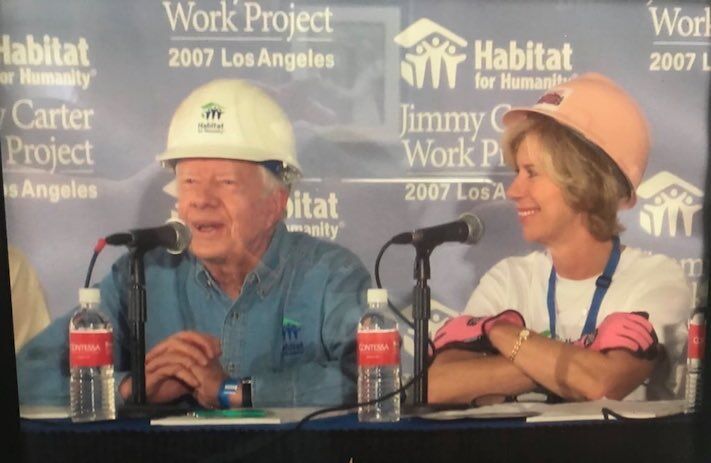
Hahn said she had the opportunity to build houses with him for low-income families in San Pedro in 2007 when she was on the City Council.
“His legacy will live on for generations to come, not only here but around the world. May he rest in peace,'' she added.
Los Angeles Mayor Karen Bass also weighed in on the loss Sunday afternoon.
“It's a sad day as the country mourns the loss of President Jimmy Carter -- a leader who exemplified the importance of service and care during his presidency and beyond. While in the White House, President Carter established the idea of human rights as a core tenet of American foreign policy and created a path towards a clean energy future, among other important achievements. After his term, he continued to lead,'' Bass said.
Bass added that years ago, she was fortunate to sit and speak with President Carter and will cherish the conversation and is grateful for his wisdom and guidance.
“I send my deepest condolences to the entire Carter family and his loved ones on this difficult day,” Bass said.
Assemblyman Mike Gipson, D-Los Angeles, also remembered Carter's work for Habitat for Humanity.
“Habitat Humanitarians: The Carters Carter Work Project will always remember President Jimmy Carter for his work with Habitat for Humanity as I served on the Board of Directors in Los Angeles. Rest in peace and rest and power, Mr. President,'' Gipson posted on X.
“President Carter was a man of rare character -- whose beliefs ran true, deep and never wavered,'' Gov. Gavin Newsom said. “His candor and compassion, moral leadership and sense of duty set a standard we all should aspire to. California joins the nation and the world in mourning his passing,'' Newsom added.
Carter's death was also mourned by the daughters of the late President Richard Nixon.
“Our family is saddened to learn of the passing of President Jimmy Carter,'' Tricia Nixon Cox and Julie Nixon Eisenhower said in a statement issued by the Richard Nixon Foundation in Yorba Linda, home of Nixon's presidential library.
“Throughout his long and productive life, President Carter's service to others -- both in public office and as a private citizen -- earned him the respect and affection of the American people and of people across the globe."
His hands-on humanitarian work, which he and Mrs. Carter tirelessly carried out together, helped to provide decent housing, eradicate disease and improve the lives of millions in communities both at home and abroad. His quest for peace in troubled regions of the world, which culminated in the signing of the Camp David Accords, will long be remembered as one of the hallmarks of his presidency and his life.
The public was also invited to pay tribute to Carter at the Nixon Library beginning at 10 a.m. Monday by signing a book of condolences that will be delivered to the Carter family.
Carter’s life and career
The Plains native graduated from the Naval Academy in Annapolis in 1946, and spent seven years as a naval officer before returning to Georgia and entering politics in 1962. He was elected governor in 1970.
When Carter emerged from the pack to claim the Democratic presidential nomination in 1976 he was largely unknown outside his home state. With the nation reeling from the Watergate scandal and the resignation of Nixon in 1974, Carter's outsider status, humble background as a peanut farmer and perceived honesty proved a winning combination in a close election against incumbent Gerald Ford.
Carter's presidency began with much hope and featured some high moments, most notably his brokering of the 1978 Camp David peace accord between Israel and Egypt. However, the economy was marked by rising inflation and energy shortages, and as Iranian militants seized 52 American hostages and held them for more than a year, Carter began to be perceived by voters as weak and ineffectual.
His stubborn refusal to nurture cooperative relationships with leaders of his own Democratic Party in Congress didn't help his fortunes either, leading to a primary challenge from Massachusetts Sen. Ted Kennedy in 1980.
Carter held off Kennedy, but was helpless to withstand the nationwide tide of conservatism that swept Ronald Reagan into office in November.
Carter's reputation among historians and the public at large was at a low ebb when he left the White House, but would undergo a historic transformation in the years that followed.
He established the Carter Center in 1982, a nonprofit institution dedicated to promoting human rights and finding peaceful solutions to conflict.
He traveled the world tirelessly, monitoring elections and otherwise advocating for peace and democracy.
Back home in the United States he devoted chunks of his time and energy to Habitat for Humanity, and could often be seen wielding a hammer himself helping to build houses for needy families.
He wrote books about faith, family and good works.
He was awarded the Nobel Peace Prize in 2002 for "undertaking peace negotiations, campaigning for human rights, and working for social welfare,'' according to the Nobel Committee.














(0) comments
Welcome to the discussion.
Log In
Keep it Clean. Please avoid obscene, vulgar, lewd, racist or sexually-oriented language.
PLEASE TURN OFF YOUR CAPS LOCK.
Don't Threaten. Threats of harming another person will not be tolerated.
Be Truthful. Don't knowingly lie about anyone or anything.
Be Nice. No racism, sexism or any sort of -ism that is degrading to another person.
Be Proactive. Use the 'Report' link on each comment to let us know of abusive posts.
Share with Us. We'd love to hear eyewitness accounts, the history behind an article.