




Research shows the number of youth mental health hospitalizations and suicides has increased in the last decade.
According to the National Alliance of Mental Illness, (NAMI) 1 in 6 U.S. youth aged six through17 experience a mental health disorder each year, while 50% of all lifetime mental illness begins by age 14, and 75% by age 24.
With the support of LA Care Health Plan, Health Net, their plan partners, and L.A. County Department of Mental Health, the Los Angeles County Office of Education (LACOE) is offering mental telehealth services to over one million K-12 public school students free of charge through Hazel Health to combat the mental health crisis among youth.
“There are a couple of reasons why schools want to do this. Schools have found that kids tend to perform better if mental health and substance abuse issues are addressed,” said psychiatrist Michael Brodsky. “So there are a lot of good reasons on the school district side. On the medical side, on the health plan side, we like to see kids get treatment for their conditions. We don't want them to suffer in silence.” To help make mental healthcare more accessible for students, all Local Education Agencies (LEA) in the county can participate in the Hazel Health virtual mental health program.
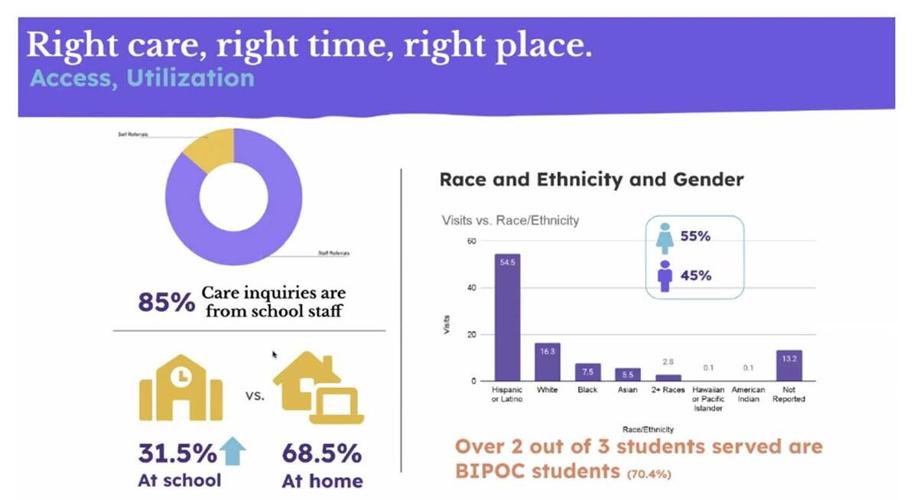
Hazel Health provides school-based telehealth to nearly three million students in over a hundred school districts across fourteen states, consistently meeting and exceeding the needs of students wherever they are, either at school or home. The program also works with parents and school staff to make the best care decisions for students. Hazel Health’s mission is to transform children’s access to health care, intervening earlier to help fuel better learning and health outcomes to create thriving communities.
Currently, the Los Angeles Unified School District and Compton Unified School District have already made the decision to leverage this service. L.A. Care Health Plan and Health Net are allocating up to $24 million to cover the services for all LEAs over two years. As part of Governor Gavin Newsom's Student Behavioral Health Incentive Program (SBHIP), funds are provided by the Department of Health Care Services.
“We are excited about this endeavor and honored to have such trusted partners join us in our efforts to ensure students receive every support possible on their education journey. Providing access to quality, responsive mental health services is not only important for their academic success, it is also our moral imperative,” said Compton Unified School District Superintendent Dr. Darin Brawley.
Compton Unified School District (CSUD) is located in the south-central region of Los Angeles County. CUSD encompasses the city of Compton and portions of the cities of Carson and Los Angeles. The district currently serves over 18,000 students at 36 sites. CUSD is a district that is rising, with a high school graduation rate nearing 90%, dramatic facility improvements, increasing college acceptance rates and a focus on STEAM throughout all schools.
According to the 2022 California Health Care Almanac, one in 14 children has an emotional disturbance that limits functioning in family, school or community activities. And according to the California Master Plan for Kids’ Public Health, over 284,000 youth cope with major depression with 66 percent of youth with depression not receiving treatment. Alarmingly, suicide rates for kids ages 10 though18 increased 20 percent between 2019 and 2020.
Dr. Brodsky said that the most serious signs to look out for are when kids try to hurt themselves. “The state of California tracks every year the rates of kids either trying to hurt themselves or going to emergency rooms. And you could see the graphs went up and up and up,” he said. “The rising numbers started even before COVID and even before the murders of George Floyd and Brianna Taylor, but they didn't get better. They kept going up. So there were a lot of reasons to be worried and fortunately, the state paid attention to this.”
In addition, depression in kids should be monitored if they are feeling down frequently for a week or more, according to Dr. Broadsky. “That’s no longer feeling down but rather an early sign of depression,” he said.
He also said that during the pandemic era and as of now there has been an increase of mental health awareness, racial inequities, health disparities and systemic racism. “There's really been a lot of attention in California in trying to check in with the kids,” Dr. Broadsky said.
“Even before COVID-19, the incidence of adolescent depression, suicidal ideation and emergency room visits was on the rise, and mental health resources have not kept pace with rising levels of student distress, depression and traumatic experiences,” said John Baackes, L.A. Care CEO. “L.A. Care saw an opportunity to support the mental health needs of members and students by leveraging telehealth to improve access to prompt evaluation and treatment. We believe this initiative will provide an accessible, expandable, and sustainable model to bring mental health treatment to students across L.A. County.”
A phased deployment approach is being used for all LA County LEA’s that opt-in to the program. District leaders are learning about the implementation process and next steps through information sessions hosted by LACOE and the Hazel Health virtual telehealth program. Also with Hazel, they are presenting a new model for what collaborating between public, private, and community stakeholders can look like.

Photo courtesy of James Chisum.
“Providing access to early intervention services, systematically, at this scale has the potential to change the trajectory for students struggling with mental health across L.A. County,” said Josh Golomb, Chief Executive Officer at Hazel Health. “This model provides more equitable access to care at an unprecedented rate for students from families who may otherwise not benefit from it and can truly change lives.”
Now that Hazel Health is being integrated into schools, students and parents have easier access to mental health resources. “We helped put this program together in schools so that teachers or parents could ask for help and we could try to get help for kids while they're in school because a lot of times kids are spending most of their time in school,” Dr. Broadsky said. “Parents and kids take different approaches to asking for help. Some will go to their regular doctor and ask for help. Others will go to the emergency room when it's too late and that's where some of the worrying data comes from.”
According to data from the American Psychiatric Association, each year, 243,000 Latinos in the U.S. attempt to take their own lives and 17% of high school-age Latinos experience suicidal thoughts. Additionally, between 2011 and 2021, suicide death rates have increased substantially among the Latino community, with a 39% increase per 100,000 people, according to an analysis from the CDC WONDER underlying cause of death data.
The importance of timely intervention and prevention cannot be overstated. The virtual mental health platform Hazel allows California-licensed therapists from across the country to support students in a convenient manner. “Fortunately, we developed this plan, and we specifically chose to work with a company that has this video version of counseling that selects therapists who work in communities of color and Latino communities,” Dr. Broadsky said.
The partners are committed to connecting students to therapists who reflect on and understand diverse populations. More than 60 percent of Hazel Health therapists identify as people of color, and more than 30 percent are bilingual. This commitment to culturally competent care is unique among service providers and reflects the LEAs’ commitment to equity and inclusion.
Whether it's in school or at home with parents, teachers, and students, Dr. Broadsky believes that mental health awareness is crucial to saving lives and ending suffering in silence. If you or someone you know is experiencing mental health problems, you can call the 988 hotline. Help is also available in Spanish.













(0) comments
Welcome to the discussion.
Log In
Keep it Clean. Please avoid obscene, vulgar, lewd, racist or sexually-oriented language.
PLEASE TURN OFF YOUR CAPS LOCK.
Don't Threaten. Threats of harming another person will not be tolerated.
Be Truthful. Don't knowingly lie about anyone or anything.
Be Nice. No racism, sexism or any sort of -ism that is degrading to another person.
Be Proactive. Use the 'Report' link on each comment to let us know of abusive posts.
Share with Us. We'd love to hear eyewitness accounts, the history behind an article.