
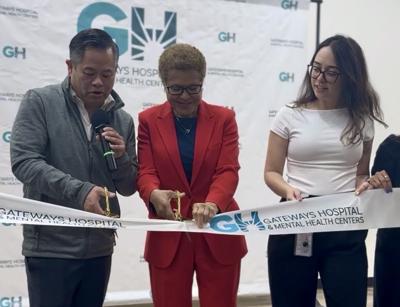


L.A. Mayor Karen Bass at the ribbon-cutting celebrating the new location for the GCAOP in Chinatown. Photo by Brenda Verano
In the heart of L.A.’s Chinatown neighborhood, a 6,000-square-foot space looks to provide mental health care services for Los Angeles Unified School District students, as well as for kids and young adults ages six to 25.
For years, mental health has been a top concern for L.A. youth, many of whom experience high-level stressors, including housing insecurity, gun violence and discrimination in and outside school.
Last year, the L.A. County Youth Commission’s annual report revealed mental health was the top concern for youth, with education and employment falling close behind.
The commission surveyed 856 youth across the five different districts of the county, 524 of whom listed mental health as a top concern. The majority of the youth who selected mental health as their main concern were Latino and system-impacted.
Witnessing rising health care costs and deep cuts to mental health funding in California led Gateways Hospital and Mental Health Centers to expand their critical outpatient services for youth, also known as their Child and Adolescent Outpatient Program (GCAOP).
With a new location for its GCAOP inside the Chinatown Service Center, the Gateways Hospital and Mental Health Centers hope to reach more children and youth who can benefit from therapy, medication management and psychiatric care.
On Tuesday, L.A. Mayor Karen Bass attended the ribbon-cutting ceremony to celebrate the new location for the GCAOP in Chinatown. She began her remarks by thanking Gateways Hospital and Mental Health Centers “for stepping up,” with the new facility expected to serve more than 230 youth annually.
“This place will provide the healing needed to prevent challenges from escalating into crises,” Bass said. “Make no mistake, we have a long way to go, but my administration and leaders like those at Gateways are turning the tide on major challenges like mental health that have been ignored for decades.”
Last year, the U.S. Department of Education, under the Trump administration ,announced it would stop funding roughly $1 billion in grants that were meant to boost the ranks and training of mental health professionals who work in schools. The department claimed that the grants were awarded under the Biden administration, a decision that was said to conflict with the current administration's priorities.
Aside from terminating the 2025 grants, the department also proposed an additional reduction for the 2026 fiscal year. These consecutive cuts would reduce resources for school counselors and psychiatrists, something that for school districts like LAUSD can be detrimental.
As L.A. Public Press reported earlier this year, LAUSD enrollment has dropped due to ICE raids spreading across L.A. County and many LAUSD staff, including counselors, have indicated that in times like these, the hiring of more trained attendance counselors and investing in mental health support are vital.
Despite that, for many LAUSD campuses, especially in low-income neighborhoods, staff shortages, including counselors and therapists, are a reality.
To combat some of the local shortages when it comes to mental health, the Gateways Hospital and Mental Health Centers are partnering with LAUSD to provide outpatient services to students, including individual and family therapy and psychiatric evaluations across more than 15 of the district's campuses.
“Our program is designed to meet young people where they are, whether that’s in school, at home, or here in the new Chinatown Service Center location,” said Charlotte Bautista, director of Gateways Child and Adolescent Outpatient Program. “We know early access to mental health care can change the trajectory of a child’s life, and we are providing a safe space where families can heal, grow and thrive together.”
Charlotte Bautista, director of Gateways Child and Adolescent Outpatient Program, said this expansion also allows for more students and families who deserve consistent, high-quality care to be reached, reducing waitlists and out-of-pocket costs.
“Our program is designed to meet young people where they are, whether that’s in school, at home, or here in the new Chinatown Service Center location,” she said. “We know early access to mental health care can change the trajectory of a child’s life, and we are providing a safe space where families can heal, grow and thrive together.”













(0) comments
Welcome to the discussion.
Log In
Keep it Clean. Please avoid obscene, vulgar, lewd, racist or sexually-oriented language.
PLEASE TURN OFF YOUR CAPS LOCK.
Don't Threaten. Threats of harming another person will not be tolerated.
Be Truthful. Don't knowingly lie about anyone or anything.
Be Nice. No racism, sexism or any sort of -ism that is degrading to another person.
Be Proactive. Use the 'Report' link on each comment to let us know of abusive posts.
Share with Us. We'd love to hear eyewitness accounts, the history behind an article.