
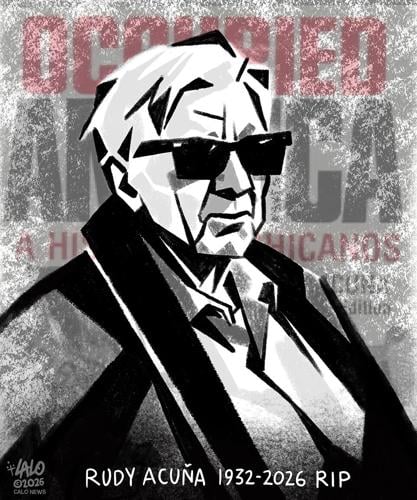




I always thought that Professor Rudy Acuña was the coolest professor ever. But despite his signature shades, he wasn't just that. He was the founder of Chicano Studies, and author of one of the seminal CS books, the once banned Occupied America. Anybody in any Chicano Studies class had to have read that foundational book. I met Professor Acuña a few times, he was friendly, yet cranky, and just the towering figure we all thought he was. Rest In Peace, Rudy.
Chicano scholar and activist Rodolfo "Rudy" Francisco Acuña, largely considered the father of Chicano Studies, has died at 93.
Acuña was a founding Chair of the Mexican American Studies Department, which is now the Chicano and Chicana Studies at California State University, Northridge (CSUN).
His death was announced on Facebook by CSUN’s Department of Chicano and Chicana Studies. The Facebook group announced last week that he had entered hospice care.
“We are indebted to his many contributions and will forever carry with us the many lessons learned,” their statement read.
His advocacy for social justice extended to protests, campus debates, books and speeches, directing most of his activism against racism in higher education and society.
His 1972 book "Occupied America: A History of Chicanos" is considered one of the most influential contributions to the history of Chicano Studies.

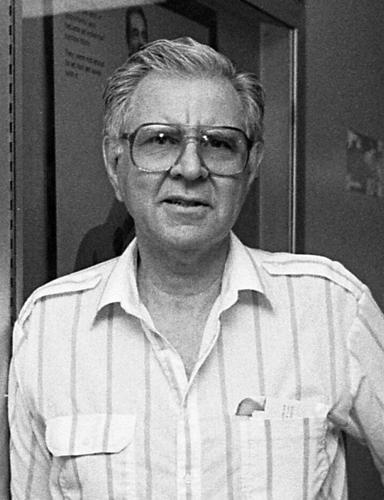
Rodolfo F. Acuña, Chicano scholar at the California State University, Northridge. (Iris Schneider, Los Angeles Times/UCLA Digital Library/Wikimedia Commons)
“Everybody has to feel proud of themselves and many times as immigrants, you’re made to feel inferior,” Acuña said about his book in an interview posted on YouTube by The International Union, United Automobile, Aerospace, and Agricultural Implement Workers of America (UAW). “I wanted to teach students about themselves and teach them pride.”
The Tucson Unified School District banned his book in Arizona in 2012.
Acuña founded the Department of Chicana and Chicano Studies in 1969 during the Civil Rights Movement. It is one of the largest Chicana/o Studies departments in the country, housing 25 full-time and 35 part-time professors and offering 160-170 class sections each semester.
Former state assemblymember Wendy Carrillo said Acuña was the key architect of Chicano Studies.
“He challenged power, told our stories and helped generations of students see themselves in history,” Carrillo posted on Facebook. “My deepest condolences to his family, friends and loved ones. Rest in power, Profe.”
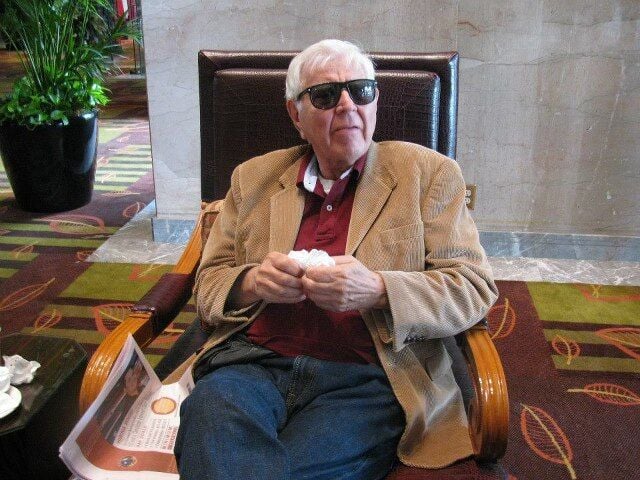
Rudy Acuña NACCS 2012 (rudyacuna.net)
Acuña was born in Boyle Heights, Los Angeles, California, in 1932. His parents were from Sonora and Jalisco, Mexico. In his early education, he was taught by Jesuits.
“I was educated by the Jesuits and have strong ideas of right and wrong,” Acuña said about his upbringing and how it influenced his work. “There is also right and wrong in history and it is wrong for a person to be born with millions of dollars while another is born with a crack habit. If you know something is wrong, you have a duty (not an obligation) to do something about it. A person should not separate his or her scholarship from his life – it is not intellectually honest.”
Acuña graduated from Los Angeles State College, now California State University, Los Angeles with a BA and a Master’s. He later earned his Ph.D. in Latin American Studies, concentration in history from the University of Southern California (USC) in 1968.
He started as an educator at San Fernando Junior High in 1958, then at Cleveland High School, where he taught social studies until 1965. He then received a tenured position at Los Angeles Pierce College before founding the Chicano Studies department at CSUN, where he remained for his scholarly career.
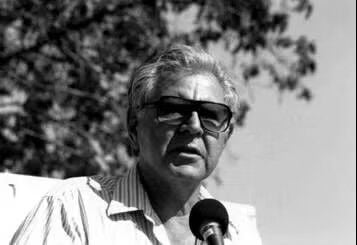
Rodolfo Acuña at UCSB Rally for discrimination lawsuit in 1993. (rudyacuna.net)
In 1996, he won a lawsuit against UC Santa Barbara for age discrimination after applying for a tenured position and was awarded $326,000 in 1996.
Three of his books received the Gustavus Myers Award for the Outstanding Book on Race Relations in North America. Acuña has received the National Hispanic Institute Lifetime Achievement Award, Austin, Texas, 2008, a Lifetime Achievement Award from the Mexican American Legal Defense and Education Fund in 2010, the Distinguished Scholar Award from the National Association for Chicano Studies, the Emil Freed Award for Community Service and the Founder’s Award for Community Service from the Liberty Hill Foundation.
Among his best-known books are “Voices of the U.S. Latino Experience,” “Corridors of Migration: Odyssey of Mexican Laborers, 1600-1933,” “Sometimes There is No Other Side: The Myth of Equality,” “Anything But Mexican: Chicanos in Contemporary Los Angeles,” “U.S. Latinos: An Inquiry,” “Community Under Siege” and “The Making of Chicana/o Studies: In the Trenches of Academe.”
In the interview from 2014, when asked what he would like to be remembered for, he said: “I really don’t know. I have tried my best. I hope that others will look after my family, there is no hereafter but I am still concerned and my love for them will not cease. I don’t believe in god, I am a big boy so I am not afraid of the dark. But I care. I want people to read my works because without a historical memory we are vulnerable and can be more easily exploited. Much of my work is centered on preserving historical memory. Without a common memory, we allow the oppressors to define our reality.”






(0) comments
Welcome to the discussion.
Log In
Keep it Clean. Please avoid obscene, vulgar, lewd, racist or sexually-oriented language.
PLEASE TURN OFF YOUR CAPS LOCK.
Don't Threaten. Threats of harming another person will not be tolerated.
Be Truthful. Don't knowingly lie about anyone or anything.
Be Nice. No racism, sexism or any sort of -ism that is degrading to another person.
Be Proactive. Use the 'Report' link on each comment to let us know of abusive posts.
Share with Us. We'd love to hear eyewitness accounts, the history behind an article.