
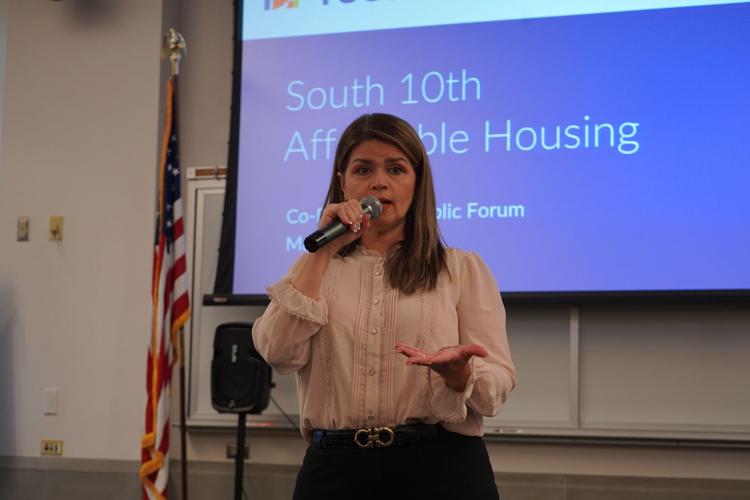

Tucson Mayor Regina Romero speaks at a public forum on Wednesday, March 4, 2026, about housing needs in the south side.
TUCSON – A protest over a south side housing development project was cancelled after a group of community members met with Mayor Regina Romero and Vice Mayor Lane Santa Cruz privately to discuss their concerns about the affordability of the project.
The protest was supposed to take place on March 4, right before a co-developer public forum, where two developers presented their tentative plans for the land, which included 300-340 housing units, complete with various plans like a community market, a dedicated after-school tutoring program, community centers, picnic areas, a walkable greenway and multifamily housing with rent-to-own opportunities.
The development has faced pushback at every step of the way, despite the city's efforts to engage the community in the planning process. Barrio residents in the area have had concerns ranging from environmental issues to property taxes and general distrust of city officials. As the need for housing increases, the city will have to reckon with decades of mistrust from barrio communities who feel like their neighborhoods have time and again been condemned, razed and led to displacement without them having a say in it.
“I really feel that they've already decided what they're going to do when they're going to do it and the community input is really not even an issue of what's going to happen,” said Gloria Hamelitz at a Nov. 5, 2025, meeting for the project. “I am concerned that we’re headed backwards 20 years.”
The public forum on March 4 was part of a formal procurement process, one typically conducted behind closed doors, according to Johanna Hernandez, Tucson’s deputy director of Housing and Community Development.
Over red chilli burritos, community members took in the two presentations, offering feedback via a form and asking questions that the developers answered on the spot.
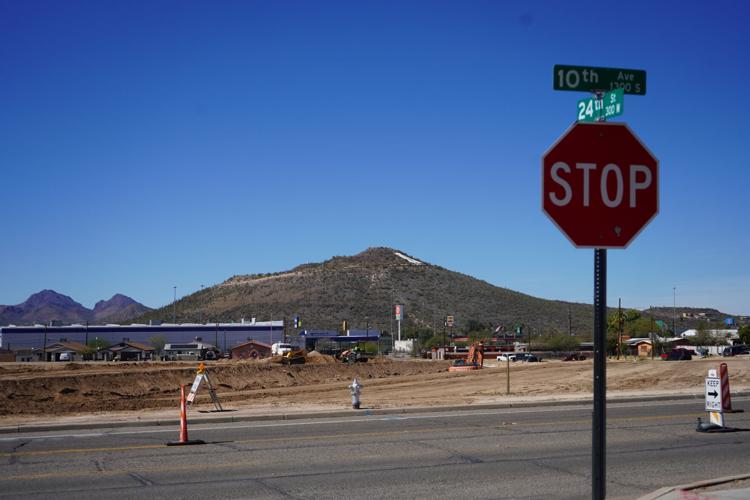
The housing development site is on South 10th Avenue, a 12-acre parcel owned by the City of Tucson. It used to be a refuse transfer station, where waste collection trucks dropped off garbage to be sorted, compacted and transported to a landfill. The city’s new vision for the site includes a 300-400-unit mixed-income, mixed-use community, with an emphasis on affordable and workforce housing.
Present at the forum was Edilia Toro, a Tohono O’odham woman whose family has lived in the neighborhood for close to a century. From where she lives, on 8th and 25th streets, the sight of “A” Mountain has been her north star all her life.

Demolition of the existing site is underway on February 26, 2026, in Tucson's south side, in preparation for the next phase of the South 10th Avenue housing project.
She’s known of the project for a while, but became interested when she saw the buildings that were previously on the land go down and tractors take over the area earlier this year. She and other neighbors are not in agreement with the development, she said.
“[The city] is saying it's a good thing, but time and time it's proven things don't always go the way it's going to go or the way they present it,” she said.
This isn’t a typical NIMBYism situation — a growing movement pushing “not in my back yard” neighborhood resistance against developments that often intend to offer affordable housing. Residents in the area say the distrust stems from the city's history of silencing barrio voices.
It’s a lack of trust that even city officials say is “well-founded.”
“I absolutely understand why people distrust the city of Tucson,” Mayor Regina Romero said to CALÓ News, pointing to the city’s history of urban renewal. “But I'm not the leader that was there 40 years ago. I've been very clear publicly… in the work that we're doing to prove to the community that I deeply believe in affordability, deeply believe in the right to return to the neighborhoods that many families were kicked out of.”
She said the city is requesting at least 30 years of affordability, but since the land is city-owned, the development will have “eternal affordability” because the city is “unwilling to sell the land to public investors”. The developers at the Wednesday meeting proposed a range of 30-80% of the area medium income. For a household of four, that’s a median income of $32,150 to $76,900, according to the Tucson Housing and Community Development.
Tucson’s history of development has a pattern of demolishing and displacing Mexican American communities.
The downtown urban renewal effort in the 60s and 70s, for example, razed the heart of the barrio community to make way for the Tucson Convention Center.
La Reforma, a public housing complex just south of downtown, built in 1942 for low-income Tucsonans, was repurposed for defense workers flooding the city after Pearl Harbor. Following the war, defense workers vacated and the complex returned to its original purpose of providing low-income housing. In 1977, it was deemed structurally unsound and demolished in 1984. The land now houses Drachman Elementary School and Santa Rosa Park.
There’s also Connie Chambers, a public housing complex that was built in the 60s and demolished in 1990. Despite the area being replaced with Posadas Sentinel — a half-low-income, half-market-rate development — low-income families were still displaced when it was demolished, according to reporting by El Independiente.

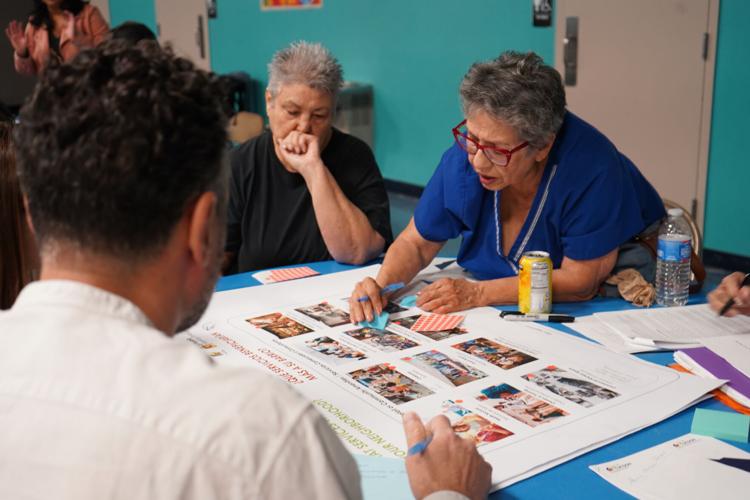
Tucson south side residents engage in a community input event on Wednesday, November 5, 2025. The city organized the event to understand the community's needs.
“Communication, especially with people who are going to be affected by this, is something that needs to be done. I know, some people don't always come off kindly, but being in the positions you're in, these are things you have to do,” Toro said. “People from the barrio just want their voice heard and listened to and actually taken into account.”
A year and a half ago, city officials, including Romero and Vice Mayor Lane Santa Cruz, left a city-organized community engagement meeting on a housing development proposal on South 10th Avenue after neighborhood community members interrupted the meeting to speak out against the development.
At first, the community was worried about possible environmental issues. Then they were concerned about property taxes, as many of the surrounding residents are retired and on fixed incomes. The city addressed those concerns at various meetings, bringing in a Pima County property tax assessor to answer residents’ questions directly.
But no matter how many community engagement events are hosted, some residents still aren’t convinced. They fear history repeating itself.
“All we can do is keep showing up and doing what we say we're going to do and build that trust over time,” said Hernandez. “I believe that through doing that, we can get those people to be, like, ‘oh, they are going to do what they said they were going to do.’ And it won't be on this project necessarily, or on one of my other projects, but it'll be all of them together.”
The next step for South 10th Avenue is to select a developer based on presentation and community feedback. The city expects to sign a contract by spring.
The next phase of community engagement will be over the design of the development.
Susan Barnett is an independent journalist in southern Arizona covering the immigrant and Latine community. She is a recent graduate from the University of Arizona, where she received her Master of Arts in Bilingual Journalism. She previously worked at La Estrella de Tucson and co-founded Tucson Spotlight.







(0) comments
Welcome to the discussion.
Log In
Keep it Clean. Please avoid obscene, vulgar, lewd, racist or sexually-oriented language.
PLEASE TURN OFF YOUR CAPS LOCK.
Don't Threaten. Threats of harming another person will not be tolerated.
Be Truthful. Don't knowingly lie about anyone or anything.
Be Nice. No racism, sexism or any sort of -ism that is degrading to another person.
Be Proactive. Use the 'Report' link on each comment to let us know of abusive posts.
Share with Us. We'd love to hear eyewitness accounts, the history behind an article.