





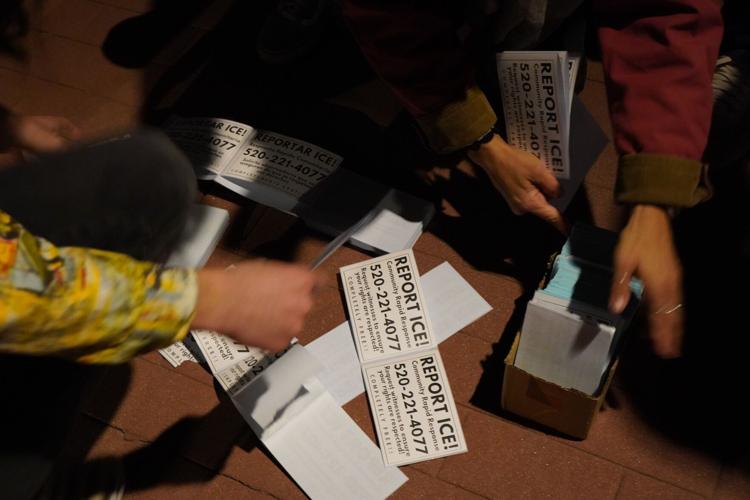

Organizers hand out stickers encouraging people to report ICE activity to the Community Rapid Response Team during a protest in downtown Tucson, on Friday, Dec. 5, 2025. (Susan Barnett/CALÓ News)
Nearly a year into President Donald Trump’s second term, hundreds of thousands of people have been detained and deported, leading the Trump administration to boast about processing over 600,000 deportations since Jan. 20, according to a Dec. 10 press release from the Department of Homeland Security (DHS).
While the DHS has yet to provide evidence — NPR noted that the department has ignored numerous attempts to obtain documentation that backs these claims — immigration enforcement tactics have escalated since Spring and have been felt nationwide. Arizona, while not a primary target of the efforts, has seen and felt the ripple effects of migrants being taken.
An analysis of Immigration and Customs Enforcement (ICE) arrest data by CALÓ News, obtained through a FOIA request by the Deportation Data Project, shows a significant escalation in enforcement activity in Arizona for the 2025 fiscal year.
More than 6,000 arrests were recorded by ICE in Arizona — the bulk of which occurred soon after Trump returned to office.
While the previous year averaged 149 arrests per month, the monthly average more than tripled during the U.S. government’s fiscal year, from Oct. 1, 2024, to Sept. 30, 2025, reaching 513 arrests.
In September, federal immigration agents hit a record high of 997 arrests in Arizona.
Notably, most arrests happen behind the scenes in local jails and prisons run by local and state law enforcement, as well as federal facilities in Arizona. These are known as custodial arrests. Approximately 40% of these arrests involve agents taking custody of individuals already being held by local law enforcement for separate charges.
Still, hundreds of others were swept up in the surge of enforcement operations by federal agents.
When reached for comment regarding local arrest trends, an ICE spokesperson pointed to national enforcement figures that have already surpassed half a million arrests under the current administration.
“Since January 20, DHS has arrested more than 595,000 illegal aliens,” DHS Assistant Secretary Tricia McLaughlin wrote in the Dec. 10 release. “[Undocumented people] are hearing our message to leave now. They know if they don’t, we will find them, we will arrest them, and they will never return.”
Amid the DHS’s increasing enforcement efforts, local organizers working within traditional nonprofits as well as grassroots groups rooted in mutual aid — some of which were created in response to Trump’s re-election — have observed firsthand the damaging impacts of immigration raids, indefinite detentions and ultimate deportations, leading to an increase in resource-sharing and community trainings since January.
“We're seeing a lot more folks being kidnapped, arrested and taken to detention, even while they're already in immigration processes. We're noticing increased violence against some of the folks who are from the LGBTQJ+ community who are in detention. We are seeing an incredible need for advocating for folks release because they are being subjected to what we call torture and violence in detention,” Narda Rivera, a core housing organizer with the advocacy group Mariposas Sin Fronteras, told CALÓ News. “A lot of processes that have existed in the past from, you know, organizing and legislation and all those things that have supported folks in detention, especially trans women in detention, we're seeing a lot of those things not being done now.”

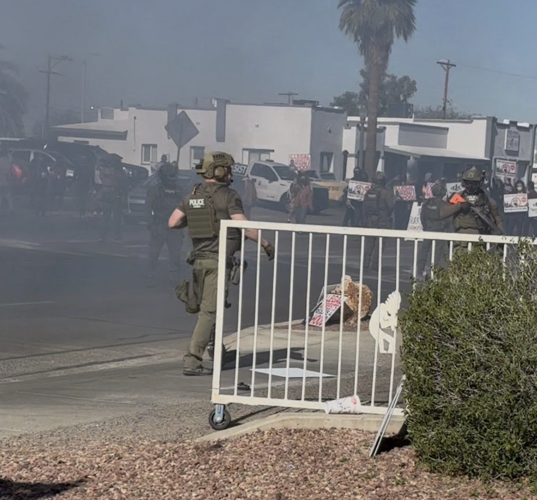
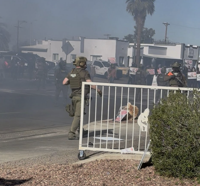
ICE and DHS agents pepper spray activists and community members after raiding a nearby taco shop in Tucson, Arizona, on Dec. 5, 2025. (Liliana López Ruelas/Somos Tucson)
‘What they're doing is illegal’
Activists like Maria Carrasco, a long-time volunteer with the Coalición de Derechos Humanos and lead organizer with the Tucson Rapid Response Hotline — 520-221-4077 — have witnessed the detentions being executed in Arizona, which often deprive those being arrested of their right to due process.
“What they're doing is illegal. There's no due process for people. [Immigration agents] are really violent towards the migrants… It's really dangerous for [agents] to be out there and our migrants are in their hands,” Carrasco said. “We are in a very dark area. There's no laws. There's no protection for any of us… we still have three more years.”
She was one of the first people at the scene in early December, when Immigration and Customs Enforcement (ICE) carried out a joint operation with the Internal Revenue Service (IRS) and detained 46 people in Tucson restaurants and homes. She also detailed a call she got last week from a man who was deported to Nogales even though he had a U-Visa — which offers protection to victims of certain crimes — asking for advice. Similar calls and cases are being documented by organizations and rapid response groups across the country.
Decades of lobbying, advocacy and protest have made strides in advancing migrant rights in the U.S. However, with international students and workers’ visas being revoked, birthright citizenship still being scrutinized in court and the increasingly extreme tactics being employed by ICE agents, the weight of the absence in safeguards Democratic legislators failed to put in place prior to the Trumps’ second term is being felt by advocacy groups.

A set of photos posted to the group Tucson Beauty Babe's on Nov. 15, 2025, in which Facebook user Ivis Montaño describes immigration enforcement actions taking place in her Tucson neighborhood. (Photos taken by Ivis Montaño to the Facebook group Tucson Beauty Babe's)
“I am, personally, [a part] of a few networks where there is enforcement news that is shared and I have seen an increase this year,” Karime Rodriguez, empowerment services manager with the Arizona Center for Empowerment (ACE), said. “Especially seeing [ICE] in perhaps places that we haven't seen them before. I've seen more going into businesses and homes, and so I have definitely seen an increase here. I don't know that it has escalated as I've seen in other states, but… I presume that it's going to only increase from here.”
Rodriguez’s observations are supported by enforcement data, which reveal a pivot toward street-level operations.
While ICE’s reported data shows that custodial arrests in Arizona more than doubled — rising from at least 1,249 last year to 2,578 in FY25 — non-custodial arrests saw the most explosive growth.
These kinds of arrests were nearly non-existent at the start of the fiscal year, with just 18 recorded in October 2024. They have become increasingly visible through videos shared online of neighborhoods flooded with federal immigration law enforcement.
However, following Trump’s inauguration, the number increased from 63 in January to 124 in February, reaching a peak of 421 non-custodial arrests in August 2025. This represents a nearly seven-fold increase in just seven months.
More than six out of every ten people arrested during these street-level operations had no prior criminal convictions. Even among custodial arrests, less than half of the people placed in ICE custody had no criminal priors.
A community response based on education, care and protection
Since November 2024, local organizations began preparing for Trump to make good on his promise: to carry out the largest deportation efforts in history. They’ve seen an influx of calls, both from community members seeking help and from would-be volunteers looking to lend a hand.
“I do think that because there has been more enforcement, people do want to get these services more often. Where somebody might have waited a little bit to renew work authorization, now I see people really wanting to get ahead of the game, even trying to renew early,” Rodriguez with ACE said. “Folks who are green card holders, we saw an increase in wanting to become citizens, to get that more permanent protection. So there has been an increase, I would say, or at least some sort of correlation… [that] came from community members seeing that increase in enforcement.”

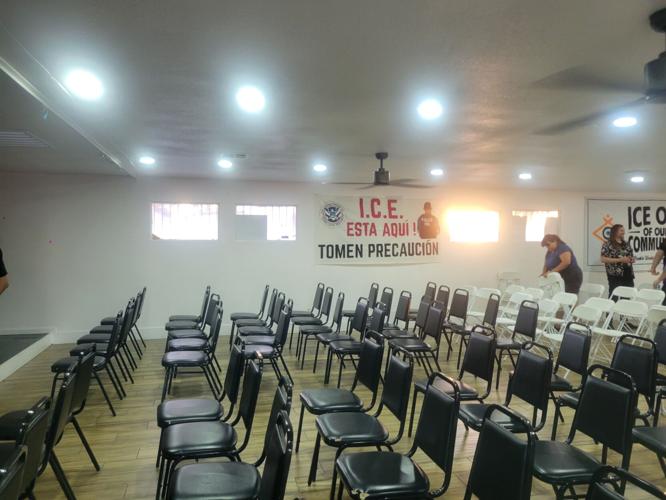
Puente Human Rights Movement prepares its space for a community training. (Analisa Valdez / CALÓ News)
Created in response to SB 1070 in 2009, ACE — a sister organization to Living United for Change in Arizona (LUCHA) — has been one of the many social justice non-profits based in Phoenix stepping up to help in what ways they can, from financial literacy classes, naturalization and DACA processes and kick-starting campaigns for “Know Your Rights” trainings.
“We have led a huge campaign here in Arizona where we have reached thousands of families just informing them about their rights, particularly when it comes to immigration enforcement. We're also working with our members to create a wide range of workshops that we can bring to our community,” Rodriguez said.
As community liaisons guided by their community and their members’ needs, ACE’s support groups, classes and campaign are similar but not identical to programs that other local non-profits and migrant justice groups have launched to combat the $170 billion detention-deportation industrial complex that is being built with this administration’s efforts.
Puente Human Rights Movement partnered with the Borderlands Resource Initiative to create a Rapid Response Hotline — 480-506-7437 — to keep track and verify ICE sightings and activity, and their volunteer accompaniment program has now trained and educated thousands on how to properly spot and document immigration agents.
The Tucson Rapid Response Hotline operates similarly. According to Carrasco, volunteers like herself have been tirelessly taking phone calls from eye-witnesses, friends and family members reaching out to report ICE sightings. The volunteers catalogue video and photos of detainees — shared with them via their rapid-response email inbox — that may not appear in the ICE database for days.
Their program, like many in Arizona, relies on community participants to be their eyes and ears on the streets as they document and try to find those being taken by ICE.
Aliento, an advocacy group for migrants and DACA recipients in Phoenix, offers a free legal clinic for immigration representation and helps people stay prepared in the event of detention.
“Our defense plan, we launched that a little bit before January of 2025, so it's been available since then, but our mental health resources and all the other resources on our website have been around for a couple years,” Ivette Sosa-Barraza, the family community coordinator with Aliento, said. “In January, there was a bigger influence of people needing that preparation plan and needing help finding immigration attorneys. And then there was another influx over the summer, when we started seeing more ICE activity out here in Arizona, and more in public areas. But the need for resources, and people requesting resources, has been pretty steady so far this year.”

Community members gather during a Puente Human Rights Movement training session. (Analisa Valdez / CALÓ News)
As part of their preparation plans for migrant and mixed-status families, Aliento helps individuals fill out preparation paperwork, like power of attorney, bank information, identification and G-28 representation forms. They guide people in developing a family plan and connect them with lawyers.
“Our motto is ‘transforming trauma into hope and action.’ We're hoping that by having these resources for people and helping them with a preparation plan, they're able to be prepared ahead of time,” Sosa-Barraza said. “The overall message is for them to know that they're not alone, and even when the worst thing happens to us, that we're always there for them to be a resource. Ultimately, we want people to be prepared and also to be able to depend on us as a resource for them.”
At the other end of that spectrum, in partnership with Trans Queer Pueblo and as part of the Detention Watch Network, Mariposas Sin Fronteras concentrates its efforts on protecting the trans-queer, migrant community from detention and deportation while also offering support to those who have recently been released from ICE custody.
Based in Tucson, they’ve recently started planning the re-opening of their rehabilitation house for migrants who need a place to stay and support after release.
“I think that the more we talk about this, the more we humanize people who are going through this. It’s critical,” Rivera with Mariposas said. “We, of course, always need volunteers and support. We do letter-writing events every month where we're writing to people in detention. We're sending [a] commissary to people in detention… There's, you know, a lot of concerns with sexual assault and violence and sickness, and all kinds of things that are happening in [detention]. So, definitely, getting involved in any way to push against these policies— letter writing, commissary, volunteers, donations — we do.”
Despite rhetoric, organizations see influx in support
Though not backed by federal agencies or a multi-billion-dollar budget approved by Congress, there’s no shortage of support for smaller grassroots organizations that are going up against the predatory policies being enacted by this administration.
“ICE has always been in our communities. They've never not been in our communities, they've never not targeted our community members,” Rivera said. “But we're very fortunate to also be getting a lot of support from organizations nationwide who are familiar with our work, and they're also fundraising and sending us more funding as well. We're seeing that we're still being supported despite everything… I think there's an increase of people wanting to support organizations doing the work.”
Those hoping to find ways to support can find Mariposas Sin Fronteras, Aliento, ACE and other Arizona-based immigration organizations and advocacy groups at CALÓ News’ Arizona migrant resource page.
“Sometimes people have the misconception that because they aren't born in the U.S., they don't have rights here, and that is incorrect. You have rights here in the U.S., regardless of what your immigration status is, and that is one significant way that you can help, by spreading these lawyer rights cards, by sharing the link to other resources,” Sosa-Barraza said. “But the biggest thing, overall, is informing community members of the resources that are out there and letting them know that they have rights regardless of what is being said by the administration.”
Carrasco urged neighbors to be on the lookout and support their fellow residents.
“You guys are our eyes, our ears, and you guys are the ones who're going to be able to do something,” Carrasco said, encouraging community members and witnesses of ICE operations to send their photos and videos to their rapidresponsetucson@gmail.com inbox. “We are cataloging all the cars, the plates, the kind of cars they drive, their faces — even though they're masked — eventually we're going to be able to use that technology against them, too, the technology they're using with us. We are out there, [but] you guys are the ones who are going to be able to help get them sooner or later, get some justice.”
Methodology
CALÓ News analyzed internal arrest records from U.S. Immigration and Customs Enforcement (ICE) obtained by the Deportation Data Project, a research initiative that acquires and releases government enforcement data through Freedom of Information Act (FOIA) requests. The data analyzed for this report cover fiscal year 2024 (Oct. 1, 2023 – Sept. 30, 2024) and fiscal year 2025 (Oct. 1, 2024 – Sept. 30, 2025).
The dataset offers a detailed look at federal enforcement, including the date and state of arrest, the individual’s sex and citizenship and the “apprehension method”— the specific circumstances under which ICE took the individual into custody. The data also tracks “apprehension criminality,” which classifies individuals as having a prior criminal conviction, pending criminal charges or no criminal record (labeled as “Other Immigration Violators”).
Defining arrest types: To distinguish between arrests in jails and those in neighborhoods, CALÓ News classified enforcement operations into two categories. Custodial arrests involve individuals detained through the Criminal Alien Program (CAP) or 287(g) agreements — programs where ICE takes custody of people already held in local, state or federal facilities. Non-custodial or “street-level” arrests include records labeled as “Non-Custodial Arrest” or “Located,” indicating arrests made in the community — such as during check-ins, at homes or in the field.
Geographic scope: This analysis focuses on arrests in Arizona, specifically those that occurred within both Arizona state boundaries and the Phoenix Area of Responsibility (AOR), ICE’s jurisdictional designation for the region.
Data cleaning: To ensure data integrity, CALÓ News removed duplicate records. When multiple arrest records existed for the same individual (based on unique identifiers), only the most recent arrest was counted. This deduplication removed 40 duplicate records from FY24 data and 575 duplicate records from FY25 data.
Criminal history classification: For the criminality analysis, individuals were classified as having “no criminal conviction” if they were categorized as either “Other Immigration Violators” (no criminal history) or having “Pending Criminal Charges” (charges that have not resulted in conviction). Individuals categorized as “Convicted Criminals” were classified as having criminal convictions.
The complete analysis code and data outputs are available on GitHub.
Analisa Valdez (she/her) is a freelance journalist based in Phoenix. Her reporting includes community & culture, social justice, arts, business, and politics.
Raphael Romero Ruiz is a journalist and a graduate fellow at the Howard Center for Investigative Journalism and now lives in Baltimore. Born and raised on the southside of Tucson, Arizona, he formerly covered the border beat for The Arizona Republic, reporting on immigration issues and communities across the Arizona-Mexico borderlands.









(0) comments
Welcome to the discussion.
Log In
Keep it Clean. Please avoid obscene, vulgar, lewd, racist or sexually-oriented language.
PLEASE TURN OFF YOUR CAPS LOCK.
Don't Threaten. Threats of harming another person will not be tolerated.
Be Truthful. Don't knowingly lie about anyone or anything.
Be Nice. No racism, sexism or any sort of -ism that is degrading to another person.
Be Proactive. Use the 'Report' link on each comment to let us know of abusive posts.
Share with Us. We'd love to hear eyewitness accounts, the history behind an article.