
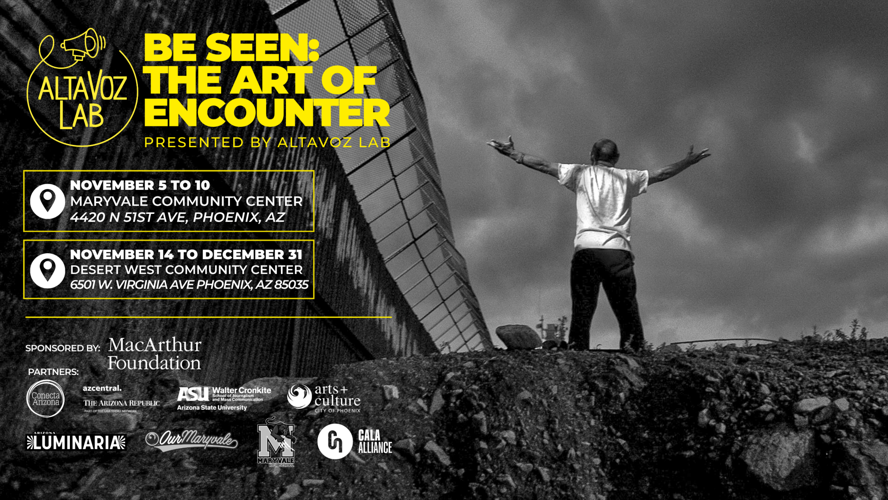

A man stands with his arms outstretched near the border in Nogales, Sonora, in a photograph by Nick Oza featured in “Be Seen: The Art of Encounter.” (Photo credit: The Arizona Republic, courtesy of Altavoz Lab)
Valeria Fernández first worked with photojournalist Nick Oza in 2006 when he accidentally showed up to photograph a story she was reporting.
She remembers seeing a thin man with dark hair and glasses, moving frantically through the neighborhood with his camera.
“He was just so full of passion and fascination and excitement, you know, almost like a kid behind the camera taking the photos,” Fernández said.
The mistaken assignment marked the beginning of a friendship and professional partnership that continued until Oza’s death in 2021.
Five years later, Fernández is helping bring his photographs back to the communities he documented through “Be Seen: The Art of Encounter,” an outdoor exhibition opening Nov. 5 at Maryvale Community Center in west Phoenix.
Oza, a two-time Pulitzer Prize-winning photojournalist who died at 57 from injuries sustained in a car accident, documented immigrant communities, protests, borderlands and everyday life in Arizona. The exhibition honors his legacy while inviting residents to revisit the history captured through his camera.
An exhibition that lives in community
Organized by Altavoz Lab, an organization that supports community journalists and storytellers, the exhibition will feature about 60 photographs selected from more than 300 images reviewed by organizers.
The photographs will be displayed on large, cube-shaped structures measuring approximately 6 feet high and 5 feet wide. Some will feature individual photographs printed on canvas, while others will combine images into larger compositions.
The exhibition will open Nov. 5 at Maryvale Community Center, 4420 N. 51st Ave., with a free reception from 5:30 to 8:30 p.m. The event will feature music from DJ Cervantes and De Cajón Band, food and children’s activities.
The exhibition will remain there through Nov. 10 before moving to Desert West Community Center, 6501 W. Virginia Ave., on Nov. 14. Its arrival will coincide with the Maryvale Made festival, featuring artist-led workshops and activities. The exhibition will remain at Desert West through Dec. 31.
Unlike a traditional gallery exhibition, “Be Seen” is designed to become part of residents’ daily routines. Families visiting the community center for basketball, swimming or other activities will encounter Oza’s photographs without having to seek out an art exhibition.
Fernández, founder and executive director of Altavoz Lab, said organizers deliberately chose public spaces where community members could experience the photography in familiar surroundings.
The project also includes bilingual materials and QR codes connecting visitors to additional information about the photographs, including captions, locations and historical context.
‘A labor of love’
The exhibition grew out of Altavoz Lab’s creation of the Nick Oza Visual Fellowship in 2025, an initiative established to honor his memory and support visual journalism.
Fernández, who worked alongside Oza on immigration coverage, said bringing his photographs into the community felt like a natural extension of the fellowship.
Organizing the exhibition has been “a labor of love,” she said, from selecting photographs spanning roughly 15 years of Oza’s career to working with local partners to construct and install the displays.
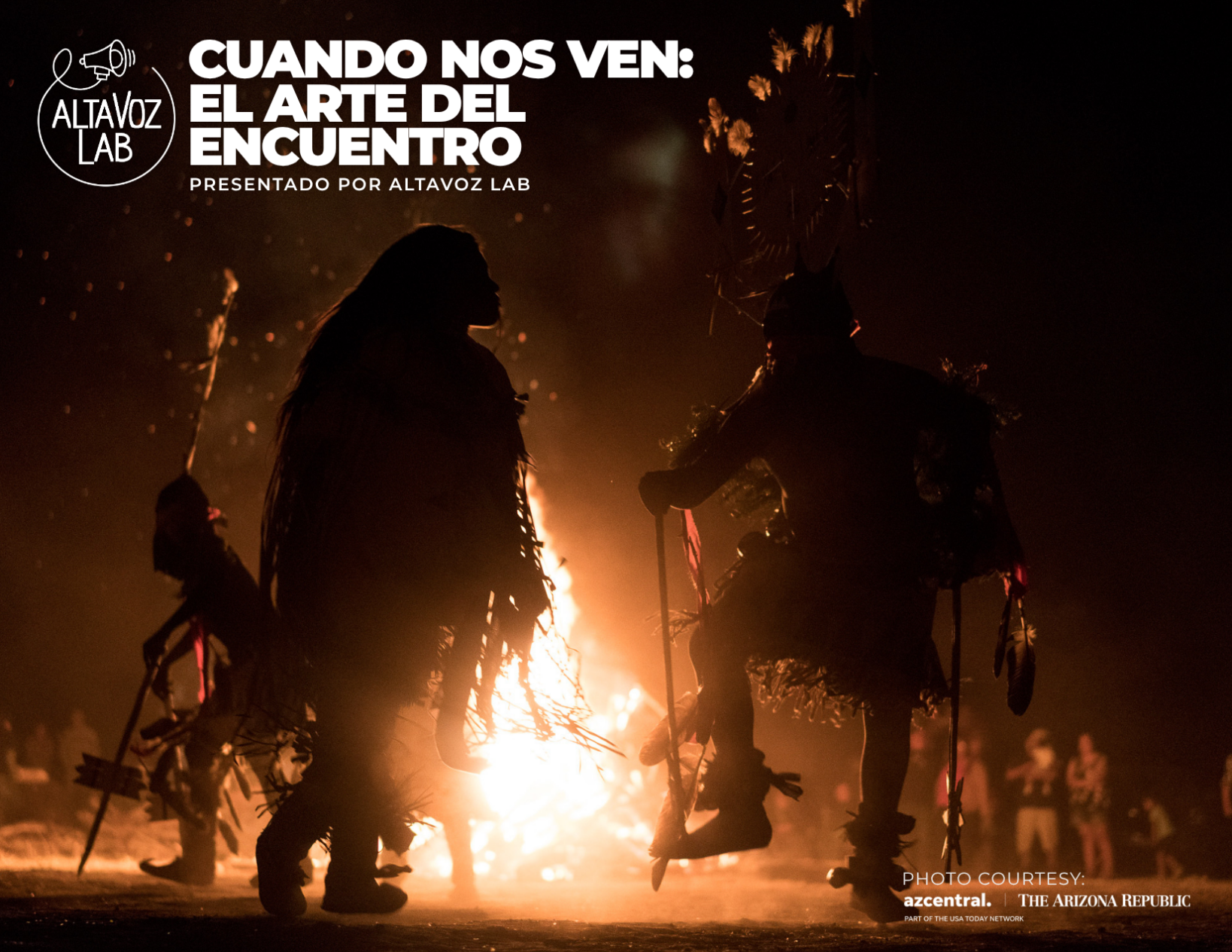
A photograph taken by Nick Oza appears in promotional materials for “Be Seen: The Art of Encounter,” an exhibition honoring his work. (Photo credit: The Arizona Republic, courtesy of Altavoz Lab)
The images document migration through Central America and Mexico, deaths along the U.S.-Mexico border, immigrant life in Arizona and protests surrounding SB 1070 and the Deferred Action for Childhood Arrivals program. Other photographs capture the desert Southwest, Indigenous lands and moments of everyday life.
Organizers looked to Oza’s past exhibitions, social media posts and personal selections to help determine which photographs he might have wanted to share.
“He left us some traces, you know, in his Instagram account, in his own selections, in his public showcasings,” Fernández said.
For Fernández, the exhibition is about more than preserving Oza’s photographs. It is about returning the images to the people and places that made his work possible.
At the center of the project is a question: What does it feel like to be seen?
“What happens when we use photography as a mirror and we reflect it back at the community?” Fernández said.
She hopes the exhibition offers a different perspective on communities whose experiences have often been overshadowed by negative public narratives.
The photographs reflect years of immigration enforcement, community organizing, grief, celebration and resilience. Together, they create a visual record of Arizona’s changing communities.
Fernández said Oza’s approach to journalism was rooted in the relationships he built with the people he photographed.
“He was the first person that I saw go places without bringing the camera,” she said.
Rather than treating an interview or photograph as a transaction, Oza spent time getting to know people and maintained relationships long after assignments ended, Fernández recalled.
His commitment to those relationships shaped her own understanding of journalism.
“I learned that from him,” she said.
Now, five years after his death, Fernández sees the exhibition as an opportunity not only to remember her friend but also to share his work with a new generation.
“This is as much an ofrenda to our colleague and friend Nick as it is to the community,” Fernández said.
Fernández hopes visitors leave with a renewed understanding of the role journalists play in documenting their communities' lives and histories.
“I hope that they feel seen,” she said.
Oza often told Fernández that a journalist’s mission should be to “be a beautiful soul, to love people and be a bit of a social worker.”
The images, she said, preserve memories of Arizona’s diverse communities — who they were, what they experienced and the paths they traveled.
For Fernández, the exhibition is a chance to share that gift with the people whose stories Oza spent his life documenting.
“He also used to say that you know photography is a gift to future generations. And honestly, like he'll tell me that all the time, and it didn't hit me as much as it's hitting me now,” Fernández said.
Jamie Montoya is a Phoenix-based journalist and writer covering community, culture and accountability. She earned a master’s degree in investigative journalism from Arizona State University’s Walter Cronkite School of Journalism and Mass Communication and has a background in investigative reporting and private investigation. Her work focuses on the people, communities and systems shaping Arizona.






(0) comments
Welcome to the discussion.
Log In
Keep it Clean. Please avoid obscene, vulgar, lewd, racist or sexually-oriented language.
PLEASE TURN OFF YOUR CAPS LOCK.
Don't Threaten. Threats of harming another person will not be tolerated.
Be Truthful. Don't knowingly lie about anyone or anything.
Be Nice. No racism, sexism or any sort of -ism that is degrading to another person.
Be Proactive. Use the 'Report' link on each comment to let us know of abusive posts.
Share with Us. We'd love to hear eyewitness accounts, the history behind an article.