
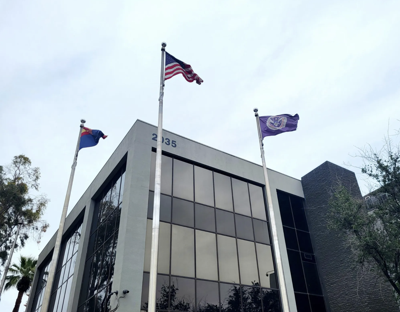

Flags outside the Phoenix ICE Office on April 12, 2026. (Pippa Fung/Cronkite News)
PHOENIX – Citlali Fontes is about to graduate high school. Most days, the 18-year-old wakes up, goes to school and comes home again to her mother and two younger siblings. But lately, home hasn’t felt the same.
Over the last year, she’s seen more federal immigration enforcement agents in her neighborhood near Phoenix – and in her online communities. Some of her classmates told her they’re afraid anything they post could be used to arrest them or target their family members. Now, Fontes worries about who will read her online posts, too.
 Citlali Fontes dancing at her quinceanera with her grandfather on October 22, 2022. (Photo courtesy of Citlali Fontes)
And when she leaves the house, she worries that one day officers might stop her, just like they did her dad.
Fontes is part of a mixed-status family. She, her siblings and her mother are U.S. citizens; her father was undocumented. Last August, he was arrested and deported to Mexico.
“There’s a lot of things I would want to tell him, like drama with boys, all sorts of achievements I would get at school,” Fontes said. “Especially with me graduating, him not being there, it just breaks my heart, because me and him always talked about graduation.”
Fontes said she has been able to turn those fears into action.
She’s now a student fellow for Aliento, an immigrant support and advocacy network in Arizona, and president of her high school’s Aliento Club. She joins protests and posts on social media, speaking out against deportations and the Trump administration’s immigration policies.
But her experience in advocacy is changing.
She still shares events and advice online but is finding it harder to reach her undocumented classmates, who are fearful their social media accounts are being monitored.
Surveillance and isolation
Since 2016, the State Department and Department of Homeland Security have used social media accounts to vet visa applicants and to track immigrants with arrest warrants.
As early as 2019, the government said in memos and online statements that it would only view public posts and that social media screenings could identify human traffickers or individuals supporting terrorism.
That year, a memo from Customs and Border Patrol stated that it would use “publicly available information, including information obtained from social media sites, to provide greater situational awareness and in turn greater security throughout CBP.”
Still, agents were not allowed to store information containing personal identifiers or speech protected under the First Amendment.
Over the past six years, the government has also used AI to screen social media accounts. Last year, DHS issued a directive that said “AI use cases that are high-impact must have appropriate human oversight.”
But advocates and lawyers believe social media monitoring has cast too wide a net through the years. As the government uses more AI and partners with tech companies to find data online, immigrant advocates say these screenings have transformed into surveillance. Now, beyond visa applicants and undocumented immigrants, some fear that advocates who are U.S. citizens or in the country legally may also be tracked.
Her best friend is one of those undocumented students.
“It hurts me a lot because me and her, we just instantly clicked,” Fontes said. “We just became best friends, and it’s heartbreaking for her to say that when she graduates, she’s going to have to go back to Mexico because of all the fear.”
 Citlali Fontes at her 12th birthday party. (Photo courtesy of Citlali Fontes)
Contacting undocumented classmates online has grown more difficult, too, Fontes said. They aren’t as responsive and seem to be staying offline as much as possible.
She tries to meet in person if friends have any questions. She sometimes talks to undocumented students at school or hands out red “Know Your Rights” cards they can carry with them.
For one friend, whose father was in detention, the resources were helpful. Still, that friend didn’t repost any of the information because they worried ICE could use social media activity to target their family.
What agencies are looking for
Federal immigration authorities use social media surveillance to find potential targets for arrest or deportation. The current administration has changed policy through a combination of executive orders and proclamations that expand this monitoring.
On his first day back in the White House last year, President Donald Trump issued an executive order stating that foreign nationals may be removed from the country if they “intend to commit terrorist attacks, threaten our national security, espouse hateful ideology, or otherwise exploit the immigration laws for malevolent purposes.”
U.S. Citizenship and Immigration Services, ICE and the State Department have also been ordered to monitor social media for antisemitism and terrorist ideology. In June 2025, Secretary of State Marco Rubio directed agents to review visa applicants’ social media trails for signs of a “hostile attitude toward U.S. citizens or U.S. culture.”
DHS, USCIS, ICE and the State Department did not respond to multiple requests for comment.
At The Heritage Foundation, a conservative think tank, senior research fellow Simon Hankinson said the use of technology and surveillance in immigration is effective and lawful.
Hankinson has seen these techniques detect visa fraud. As a former Foreign Service officer, he said AI helped spot a fraudulent pattern with one person who had sponsored 500 other visa applications.
“What you want is information that can help you figure out who's telling the truth, and then if (people) overstay their visa or otherwise break the rules, it should be able to identify them as quickly as possible and not give them the ability to stay and work legally in the U.S.,” he said.
Over the past decade, the U.S. has contracted with private American companies such as ShadowDragon, Palantir and Clearview AI, creating programs like ImmigrationOS or SocialNet. These can sort through large datasets or social media pages and make profiles about immigrants’ beliefs, associations and locations based on the information they find.
‘An invitation for … governmental overreach’
Rachel Levinson-Waldman, director of the Liberty and National Security Program at the Brennan Center, said these guidelines are far too broad – “an invitation for an enormous exercise of discretion and governmental overreach.”
Levinson-Waldman and other advocates said federal authorities have used social media screenings outside of the immigration application process to target individual immigrants and groups that support them.
Emily Tucker, executive director at Georgetown University law school’s Center on Privacy and Technology, said the government tends to justify this surveillance as a matter of national security. Courts generally defer to the executive branch in that area.
“National security and immigration are the two (areas) that have the fewest checks,” she said.
In December 2025, the State Department wrote on its website that “every visa adjudication is a national security decision.”
In October 2025, an ICE Request for Information sought contractors to support national security efforts by using “a wide range of commercial and law enforcement databases as well as internet-based open-source, deep web, social media and darknet sources, to collect, analyze and evaluate criminal intelligence information.”
The DHS request instructs potential contractors to use social media platforms including “Facebook, Google+, LinkedIn, Pinterest, Tumblr, Instagram, VK, Flickr, Myspace, X (formerly Twitter X), TikTok, Reddit, WhatsApp, YouTube, etc.” to collect any relevant public messages, postings, and “other media/data (e.g., photos, documents such as resumes, geocached information, etc.”
The ICE request further states that the contractor may be asked to gather “information about the target’s associates, such as family members, friends, or co-workers,” using the same sources.
This is called “surveillance creep.”
Still, some consider social media screenings less invasive than other types of surveillance.
Anything posted publicly is “fair game,” said Doug Gilmer, a former Homeland Security Investigations agent who now works in the private sector, adding that screening social media is simply targeted intelligence.
Only criminals and other potential threats will be flagged, he said.
“If it can help people work more efficiently and effectively and make better decisions, while also balancing privacy and making sure that there are guardrails around the AI to ensure privacy and accuracy, the benefit’s worth it,” Gilmer said.
‘DHS is watching’
That’s not convincing for some immigrant advocates, who see the surveillance as a means not only to target criminals and people already subject to deportation but to suppress free speech by noncitizens and citizens alike.
“Collectively, all these different agencies are working together to carry out the purpose of trying to silence certain viewpoints, with the intimidation campaign of threatening deportation and detention,” said Sadaf Hasan, an attorney at Muslim Advocates.
Late last year, Muslim Advocates joined other nonprofit organizations and labor unions to file a lawsuit against the federal government, arguing that online surveillance is unconstitutional.
This is one of several lawsuits targeting the current Trump administration’s crackdown on immigrants’ speech.
But U.S. law isn’t clear on whether the First Amendment applies to immigrants. Some advocates argue that anyone physically present in the U.S. is protected by the Bill of Rights, while others say immigrants gain constitutional rights once they have “substantial voluntary connections” to the U.S., such as being a student. This precedent was established in the case U.S. v. Verdugo-Urquidez.
Regardless, Stephen Loney, a senior attorney with ACLU of Pennsylvania, said the concern lies in identifying controversial opinions as a threat to national security.
“It's intimidation,” he said. “It's trying to chill speech and activity that the government doesn't like and trying to target people, or at the very least keep a pool of information on people, so that they can be targeted in retaliation for having views and doing things the government doesn't like.”
Loney has worked on two lawsuits in the past year in which DHS sent subpoenas to tech companies asking for data on users.
One of these cases was in Montgomery, Penn., involving the Facebook account of a group called MontCo Community Watch. The group organized last year to monitor and document ICE activity and help local immigrants.
The government dropped its subpoena for Facebook data before a judge could rule on the group’s motion to block it.
The second case involved a naturalized citizen who emailed a DHS attorney asking them to exercise “common sense and decency” in a deportation case involving an Afghan refugee, which was reported on in The Washington Post. According to the lawsuit, within hours, DHS issued a subpoena to Google demanding information about the sender’s Gmail account and other user data. Two and a half weeks later, federal agents came to the man’s home and interrogated him.
After the ACLU filed its lawsuit, DHS dropped the Google subpoena.
In February, The New York Times reported that DHS has issued hundreds of administrative subpoenas, which do not require a judge’s approval, demanding user data from Google, Meta and other companies, according to anonymous spokespeople.
Loney believes that because he has represented people in such cases, he’s a target, too.
“Even before this, people had a sense that DHS is watching, ICE is watching, so you're aware of that, especially if you're an organizer, when you're posting on social media,” he said.
Advocacy despite surveillance
The threat of being monitored and the uncertainty of free speech protections has been enough for some immigrants to change their online behavior.
José Patiño moved from Mexico to Arizona in March 1985, when he was 6 years old. He received DACA status at 24, under an Obama-era program to protect young immigrants from deportation, and has worked at Aliento as vice president of education and external affairs since 2017.
Patiño has not heard of any arrests in Arizona stemming from immigration authorities tracking people’s online presences, but said he has noticed many immigrants have stopped using social media.
In particular, he said, immigrant students have stayed off social media. He worries they will miss online information about schools and scholarships.
“I'm concerned because now the one place that they had where they can be in the community is being separated,” he said.
ICE’s presence is uniquely hard on mixed-status families like Fontes’, Patiño said. When a parent is undocumented, it’s difficult to run errands or even for children to show up for school.
Leaders at Aliento are debating whether to shift away from social media and focus on direct text and email communication instead, he said. He worries that this will lose community connections.
And other advocacy groups said it’s impossible to do their work entirely offline.
As she approaches graduation, Fontes said she wants to be an immigration lawyer after college – and the first lawyer in her family — because she knows what it’s like to have no support in a deportation case and doesn’t want others to feel the same.
For now, she continues to advocate for herself, her friends and her family – both in person and online.
“My mom’s worried, when I post in my social media, about how ICE can find out that I’m posting a lot of things that are against them,” Fontes said.
She’s concerned, too, but not enough to stop posting.
“Although I am afraid they can track me, either way I’m doing, for me, what’s right in my community,” she said.
This article first appeared on Cronkite News and is republished here under a Creative Commons Attribution-NoDerivatives 4.0 International License.










(0) comments
Welcome to the discussion.
Log In
Keep it Clean. Please avoid obscene, vulgar, lewd, racist or sexually-oriented language.
PLEASE TURN OFF YOUR CAPS LOCK.
Don't Threaten. Threats of harming another person will not be tolerated.
Be Truthful. Don't knowingly lie about anyone or anything.
Be Nice. No racism, sexism or any sort of -ism that is degrading to another person.
Be Proactive. Use the 'Report' link on each comment to let us know of abusive posts.
Share with Us. We'd love to hear eyewitness accounts, the history behind an article.