
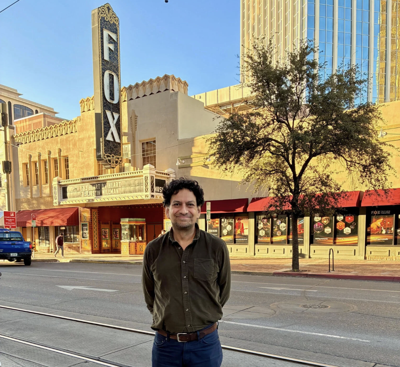

The director of Cinema Tucson, Carlos A. Gutiérrez, in front of the Fox Theatre in downtown Tucson, where a Mexican film is screened every month. (Liliana López Ruelas/Somos Tucson)
This article was originally published in Spanish by Somos Tucson.
Carlos Gutiérrez believes that Tucson is a city that truly spoils lovers of Mexican cinema. And he isn't wrong.
For the past five years, Cinema Tucson has brought us one Mexican film per month — usually a new production — and often these are films that premiere here before they do in major hubs like New York or Los Angeles.
Moreover, the films are screened in a majestic venue: the Fox Theatre, located downtown.
“The success of Cinema Tucson lies, in itself, in having the space,” said Carlos, co-director of Cinema Tucson and co-founder of Cinema Tropical, who splits his time between New York City and Tucson.
“The very act of screening Mexican films at the Fox Theatre is, in itself, a political and poetic act,” he added.
This ongoing Mexican film series was established in 2021. Prior to that, an annual festival called Tucson Cine México was held every March. Instead of condensing all the films into a single week, Carlos and Vicky Westover — co-founder of Cinema Tucson and former director of the University of Arizona’s Hanson FilmTV Institute — decided that bringing films to the city throughout most of the year would be a better approach.
The most recent screening featured “La Reserva” (2025), a suspense film based on true events that has already garnered two major awards: Best Mexican Film and Best Lead Actress at the Morelia Film Festival.
“La Reserva” — presented in Spanish with English subtitles and screening fittingly on Earth Day — is an environmental thriller about a female park ranger in Chiapas who discovers illegal logging within a nature reserve and attempts to mobilize her community to expel a group of trespassing loggers. This triggers a larger threat that causes people to abandon the fight out of fear and apathy, leaving Julia, the protagonist, to face the danger increasingly alone.
The program runs from September through May (with the exception of December), although this season, there will be no screening in May. Cinema Tucson will resume in September 2026.
The best cinema in the world
Carlos is originally from Mexico City, though he has now lived in the United States longer than he lived there. “I proudly consider myself Mexican-American,” he said during an interview with Somos Tucson at a downtown café, just steps away from the Fox Theatre, several weeks ago.
He always knew he loved cinema, but his intention was never to make films; rather, he wanted to watch them. That is how he ended up in New York to pursue a master’s degree in Film Criticism and Theory. During that time, he founded Cinema Tropical alongside his Colombian colleague, Monika Wagenberg. Cinema Tropical, a New York-based nonprofit that promotes Latin American cinema, partners with the School of Latin American Studies at the University of Arizona to promote Cinema Tucson.
A few months ago, Cinema Tropical received the Film Heritage Award from the National Society of Film Critics for its work in promoting and distributing Latin American cinema in the United States. Additionally, in late 2025, Carlos was honored with the Leading Light Award from DOC NYC, the largest documentary film festival in the U.S.
From his vantage point as a film distributor and programmer, Carlos asserts that in Latin America, “we are making the best cinema in the world.”
Particularly in Mexico, he explained in the interview, “the last two decades have been impressive” in terms of both production volume and quality. He believes this is due in part to the fact that “technology has become democratized” — it has become more accessible — “and this has vastly enriched the quality and diversity of cinema in Mexico.”
He cited “Vainilla” (2025) as an example — the film featured by Cinema Tucson in January of this year — a semi-biographical picture by a young female director from Torreón, Coahuila.
For Gutiérrez, there is no single “Mexican cinema” or “Latin American cinema,” but rather many.
“I prefer to speak in the plural of ‘Mexican cinemas’. Cinema is as diverse as the country itself, and there are many different approaches to production,” he said.
Showcasing a diversity of themes, narratives, and productions is important to Cinema Tucson.
“In cinema, there is that division between ‘art films’ and ‘commercial films’ — I hate that division,” said Carlos, “because in countries like Mexico, even in films with a commercial bent, there are very interesting elements that, simply because they are commercial, aren’t validated as such.”
“Corina” (2024) and “Huesera” (2022) — both of which have screened at Cinema Tucson — represent that type of “wonderful film capable of reaching both a broader audience and a more niche one,” much like “La Usurpadora, El Musical”. “So, at Cinema Tucson, we pay no mind to those artificial divisions.”
‘Tucson is special’
After working on various projects across the United States, Carlos concludes that “there is something wonderful about the Tucson audience.” Perhaps it is because, in cities like New York, people take for granted that they will have access to a wide variety of cinema. “Not here; here, access is quite limited, and I believe that is precisely why the audience embraces it so warmly.”
Although the films are selected by Carlos and Vicky, he notes that watching them again alongside the Tucson community is a refreshing experience. “I find great joy not only in programming the films but also in watching them — seeing how the audience responds and how we come together as a community. There is something deeply comforting in all of this.”
In 2025, Cinema Tucson saw its highest attendance figures to date. Even so, Carlos hopes that more members of Tucson’s Spanish-speaking community will attend the screenings, events that frequently include Q&A sessions with the films’ directors or producers.
Cinema is always a reflection of what is happening within society.
“Screening Mexican films — showcasing cultural products from communities that often feel unwelcome in this country — and standing together as a community also becomes a political act. I believe there is something truly beautiful in that as well,” he said.
In that sense, and in terms of the collaborations that make it possible to screen a Mexican film in downtown Tucson every month, for Carlos, “Cinema Tucson is an act of love.”










(0) comments
Welcome to the discussion.
Log In
Keep it Clean. Please avoid obscene, vulgar, lewd, racist or sexually-oriented language.
PLEASE TURN OFF YOUR CAPS LOCK.
Don't Threaten. Threats of harming another person will not be tolerated.
Be Truthful. Don't knowingly lie about anyone or anything.
Be Nice. No racism, sexism or any sort of -ism that is degrading to another person.
Be Proactive. Use the 'Report' link on each comment to let us know of abusive posts.
Share with Us. We'd love to hear eyewitness accounts, the history behind an article.