
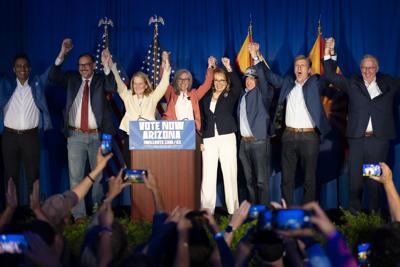


Democratic candidate for U.S. Congress, in Arizona's first district, Dr. Amish Shah, Arizona Secretary of State Adrian Fontes, Arizona Attorney General Kris Mayes, Arizona Governor Katie Hobbs, former U.S. Representative Gabby Giffords, U.S. Senator Mark Kelly, U.S. Representative Greg Stanton and Democratic candidate for lieutenant governor and former Mesa Mayor John Giles share the stage during a Democratic Get Out the Vote rally at LiUNA Laborers Training School on October 30, 2026 in Phoenix, Arizona. (Photo by Rebecca Noble/Getty Images)
This story was originally published by AZPM.
As votes continue to be counted, it seems the “blue wave” that swept Democrats into power in national races last night flooded Arizona’s state legislature as well.
For the first time in 60 years, Arizona’s state legislature appears set to be controlled by Democrats. As of Wednesday afternoon, Democrats were on their way to a 14-seat majority in the State House and a 10-seat majority in the Senate.
The last time Democrats controlled both chambers of the legislature was in 1966, when Arizona’s voting rules changed from a county-based system to a population-based system.
With Governor Katie Hobbs having won her re-election bid as well, Election Day appears to have given Democrats the coveted “Trifecta” — control of both legislative houses and the governor’s seat.
On top of that, Democrats are on track to win every statewide race — including the Superintendent for Public Instruction race, which only a few days ago was said to be leaning to the right.
With their newfound control, Arizona Democrats could seek to implement a number of policies that were stymied under Republicans, such as reforming the state’s school voucher program.
The trifecta could also be part of a much larger national push by Democrats to change the way the country elects its presidents.
With Arizona and four other new Democratic trifectas won last night, Democrats have a theoretical path to making the 2028 Presidential Election be based on popular vote rather than the Electoral College. That would work through something known as the National Popular Vote Interstate Compact (NPVIC), which requires the consent of 270 electoral votes.
Currently, 19 states have passed the compact, amounting to a total of 222 electoral votes. With Arizona, Pennsylvania, Michigan, Wisconsin and Nevada now controlled by Democrats, there is the possibility of gaining 283 electoral votes in support of the compact — assuming all five states agree to it.
Replacing the Electoral College with a popular vote system remains popular among a majority of Americans, yet efforts to do so have been shut down by Republicans at the state and national levels. Four of the five presidents who have lost the popular vote yet won their elections have been Republicans.
The path to passing the NPVIC is far from certain, however, and would almost certainly face opposition from Republicans in Congress, who could delay its passage if it got that far, despite Democrats’ new majorities there.







(0) comments
Welcome to the discussion.
Log In
Keep it Clean. Please avoid obscene, vulgar, lewd, racist or sexually-oriented language.
PLEASE TURN OFF YOUR CAPS LOCK.
Don't Threaten. Threats of harming another person will not be tolerated.
Be Truthful. Don't knowingly lie about anyone or anything.
Be Nice. No racism, sexism or any sort of -ism that is degrading to another person.
Be Proactive. Use the 'Report' link on each comment to let us know of abusive posts.
Share with Us. We'd love to hear eyewitness accounts, the history behind an article.