
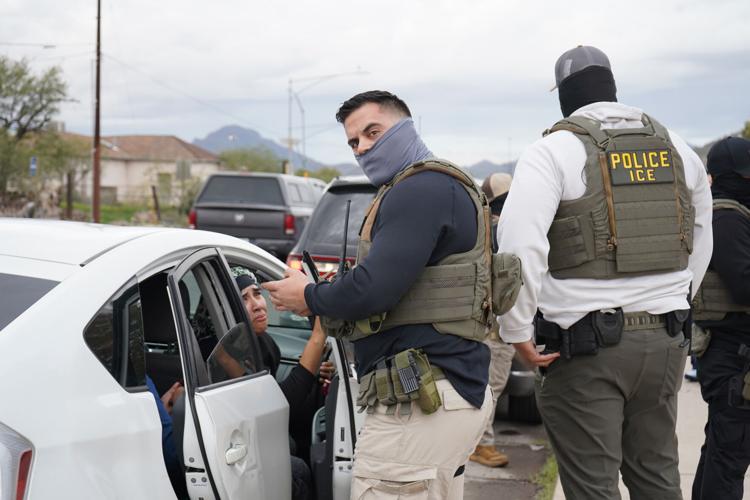
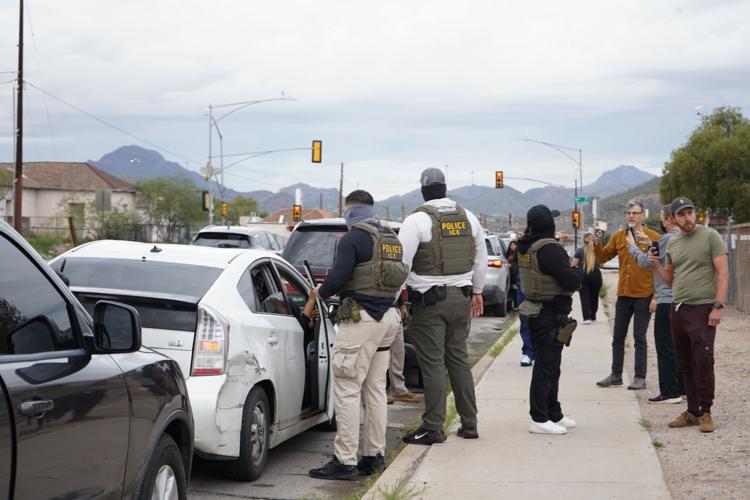

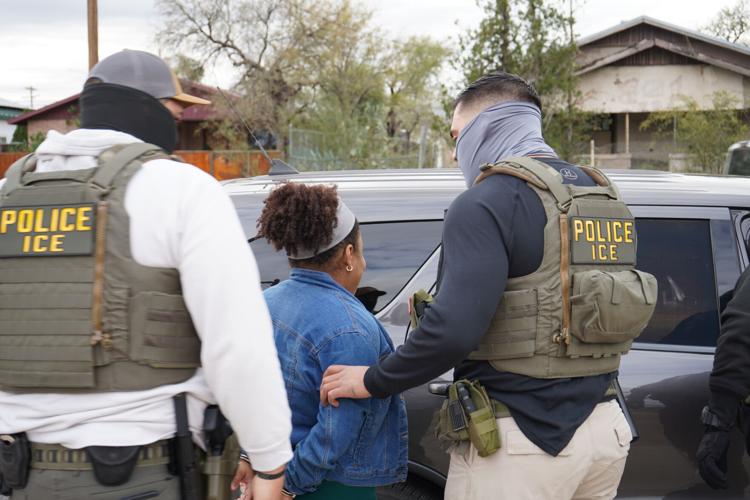
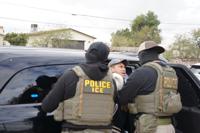

An Immigration and Customs Enforcement (ICE) agent stares at a CALÓ News reporter witnessing people being detained during a traffic stop on Friday, Jan. 23, 2026, in Tucson, Arizona.
TUCSON – Tatiana Farías was riding as a passenger with her husband, Elías José Colón-Delgado, her brother, Joseph Farías Ríos, and her sister-in-law, Carmen López Suárez, on Friday morning, headed to a doctor’s appointment, when an SUV pulled up behind their car.
“Don’t panic, but I think we’re being followed,” Farías recalled her husband saying to her. Days after her loved ones were detained by Immigration and Customs Enforcement (ICE) agents, she took a minute to talk to CALÓ News about what transpired that morning, an event I also witnessed and filmed.
The SUV turned its police lights on before three ICE agents exited the vehicle, surrounded Farias’ car and directed the passengers to roll down their windows.
The car was stopped on 22nd Street and 10th Avenue, right outside of Drachman Montessori K-8 Magnet School, where children were walking on the outskirts of the grass field, some curiously looking through the chainlink fence surrounding the campus at the scene unfolding before them.According to an email statement to parents from Principal Jesús Celaya, “at the time, one middle school class and three 2nd-3rd grade classes were on the playground participating in physical education class.”
Aside from the kids forced to take in the unfolding enforcement, I was the first to arrive on the scene at 10:56 a.m., having been driving down 22nd Street that morning.
When the passengers asked the agents what the reason for the stop was, they said it was an “operative to verify their immigration status,” Farias told me.
“We're going to wait and see what they tell us,” I heard one of the masked agents say to them in Spanish. “That is all we can do at the moment.”
CALÓ News reached out to ICE for a statement, but did not receive one at the time of publication.

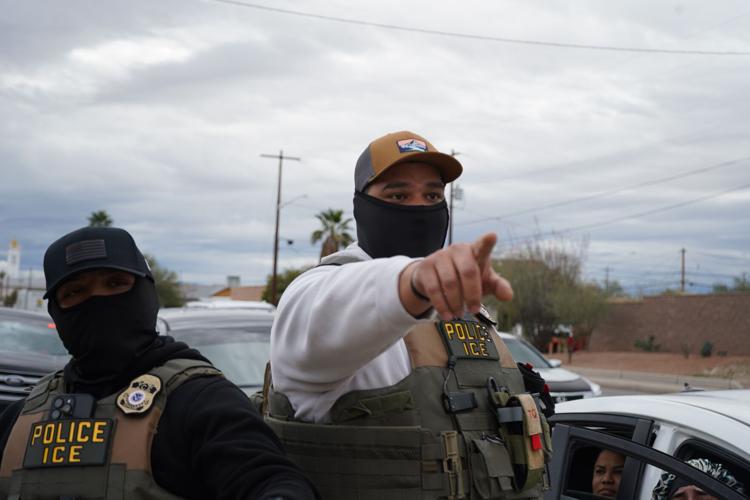
Two Immigration and Customs Enforcement (ICE) agents order observers to stand back as they detain several people during a traffic stop on Friday, Jan. 23, 2026, in Tucson, Arizona.
While ICE officials may conduct traffic stops, they must have reasonable suspicion. Previous case law states that ethnicity or nationality can be a factor in establishing reasonable suspicion, but not the only factor. In 2024, the Supreme Court ruled in Noem V. Vazquez Perdomo broadened it to include race, language, location and appearance as reasonable suspicion, in combination.
“It's not enough to just rely on one [factor], you have to look at a combination of these things,” Luis Campos, a local immigration attorney who specializes in asylum law, explained to me. “If someone gets pulled over and there's not a traffic infraction, in other words, the only motivation to pull someone over is their appearance, that is racial profiling. That is outside of the Supreme Court permit.”
The only reason the ICE agents gave for the stop on Friday was that it was a part of an “operative.”
They told the group they were waiting for someone in an office to review their cases and would proceed from there.
Farias is appealing the denial of her asylum case, she told me. During this time, her removal order is paused until the court issues a decision. Colón-Delgado has an affirmative asylum case with no removal proceedings or scheduled court dates, while Farías Ríos and López Suárez have pending asylum cases with court dates they had planned to attend in February, she said.
“Do they have a status? No, they don’t have a status. Are they being processed without a final determination of the cases? Yes, and that should be protection sufficient” to legally remain in the country, Campos said.
The four passengers, all from Venezuela, have valid Arizona state identification and valid work permits. Unlike other states, Arizona does not grant state identification cards to immigrants with unauthorized status.
All of them, except for Farías, had their IDs on them and showed them to the agents. Farías showed them a photo of hers on her phone.
Before the agents heard back from the office about their cases, I heard them say to the people in the car,“Y luego vamos a suponer que no se presentó.”
Farías told me that ICE agents claimed their database showed her husband hadn’t shown up to court, despite him not being scheduled for an appearance.
Two minutes later, I heard the agents tell Farías they would not be detaining her and López Suárez. Farías cried out as an agent opened the back driver's side door and began to tie Farías Ríos hands behind his back while he sat in the car and questioned why he was being detained, unwilling to step out.
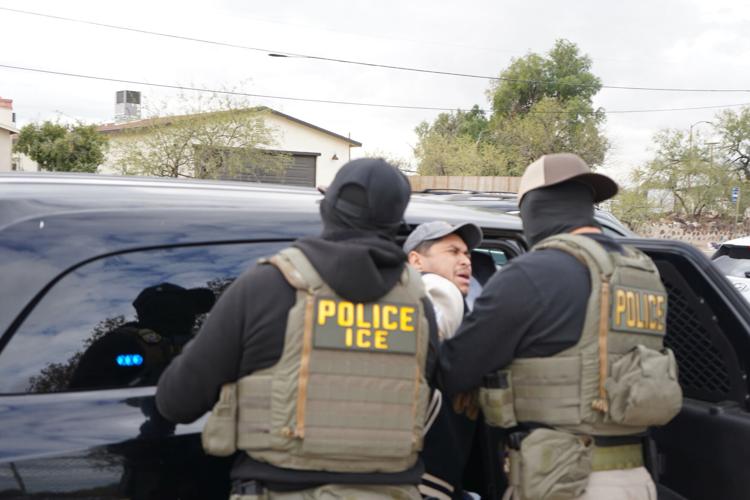
Two men and one woman were detained by Immigration and Customs Enforcement agents during a traffic stop in Tucson, Arizona, on Friday, Jan. 23, 2026.
“Sir, get down. I am speaking to you nicely,” the ICE agent ordered.
“I am in an asylum process, I have an ID, I have everything,” he said to me as he was patted down and taken to an unmarked vehicle.
Immediately after, another agent took Farías’ husband.
“I’m not a criminal, sir,” he says as two agents put his hands behind his back and take him to another unmarked vehicle. “I’m a worker, I help my family. I am not a criminal. I came to this country to work.”

Immigration and Customs Enforcement (ICE) agents detain Tatiana Farias' brother during a traffic stop on Friday, Jan. 23, 2026, in Tucson, Arizona.
As the current administration works to carry out the largest mass deportation in U.S. history, many who are in a limbo status — like Farías’ family — have had the rug swept from under them, caught in immigration enforcement operations that leave them with little recourse to fight detention.

Immigration and Customs Enforcement (ICE) agents detain Tatiana Farias' sister-in-law during a traffic stop on Friday, Jan. 23, 2026, in Tucson, Arizona.
The Venezuelan diaspora, especially, has been heavily impacted by various changes that President Donald Trump has enacted, from ending CBP One and revoking Temporary Protected Status status for Venezuelans to invoking an 18th century war-time law and deporting mostly Venezuelans migrants to a prison in El Salvador.
Cars honked as they drove by the scene, people yelling out of their cars — some with their phones out, recording as they drove by. As Farías' husband was being apprehended, multiple community observers were already present filming, while various teachers gathered on the other side of the fence, asking the agents to move the operation elsewhere.
I heard one witness say that “300 kids are about to be out here for recess.”
“Please, sir, I beg you, don’t take them,” Farías pleaded.
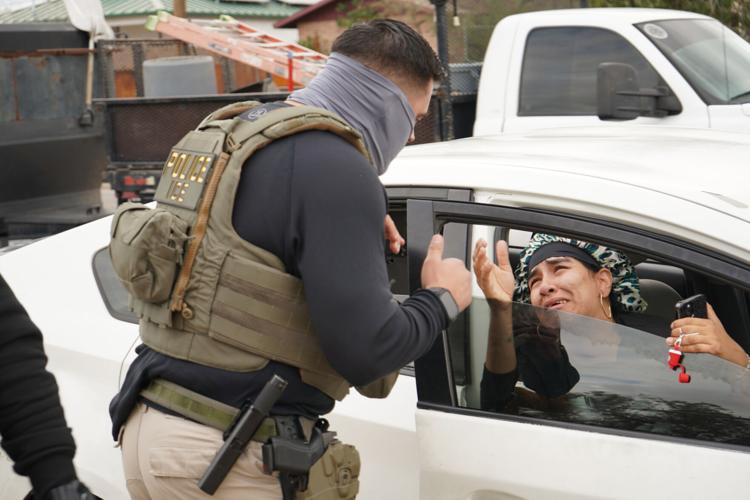
López Suárez, still in the rear passenger side of the car with the window lowered, questioned the reason for the traffic stop and demanded answers for the detention, given the couple's legal proceedings.
“You want to go with him? Let’s go,” I hear the agent say to her. She then opened the door and stepped out of the car. They cuffed her and walked her over to another unmarked vehicle that had pulled up as the operation unfolded.
Three of her family members taken, the agents approached Farías and asked if she was okay to drive before heading back to their vehicle and driving away.
Farías was left by herself. A morning drive that had started off with four ended with one.

Tatiana pleads with an Immigration and Customs Enforcement (ICE) agent to let her family members go after they were detained during a traffic stop on Friday, Jan. 23, 2026, in Tucson, Arizona.
“Today apparently marked a significant change in circumstances with increased ICE activity throughout many of our neighborhoods across the County,” said Pima County Attorney Laura Conover in an official statement. “Some of the activity observed today looked nothing like what we are familiar with from our local law enforcement.”
ICE arrests have increased across the country by over 75%, according to an American Immigration Council report, a nonpartisan organization that tracks immigration enforcement. That same report also states that “targeted enforcement operations… and changes in arrest practices (have resulted in) a 2,450% increase in the number of people with no criminal record held in ICE detention on any given day.”
An analysis of ICE arrest data by CALÓ News, obtained through a FOIA request by the Deportation Data Project, shows a significant escalation in enforcement activity in Arizona. More than 6,000 arrests were recorded by ICE in Arizona — the bulk of which occurred soon after Trump returned to office.
While the previous year averaged 149 arrests per month, the monthly average more than tripled during the U.S. government’s fiscal year, from Oct. 1, 2024, to Sept. 30, 2025, reaching 513 arrests.
“These actions do not make our communities safer. They terrorize neighborhoods, tear families apart and undermine public trust — especially when carried out by masked agents operating with no transparency of accountability,” said State Rep. Alma Hernandez in a statement released that day. “What happened today is exactly why so many people in Tucson are living in fear: fear of detention, deportation and criminalization simply for existing.”

Immigration and Customs Enforcement (ICE) agents detain several people during a traffic stop on Friday, Jan. 23, 2026, in Tucson, Arizona.
What followed for Farías back in her apartment was a series of tearful phone calls to all her family members in Venezuela. Filled with boxes and black garbage bags, Farías told me they had just been approved for a new apartment in Glendale and were set to move there at the end of the month to get away from Tucson, a city “hot with immigration enforcement,” Farías said.
Later that day, she got a call from Colón-Delgado from the Eloy Detention Center, where he is being held. I listened as he told her that while he was detained, the “system had updated,” ICE officials told him, and it showed that, indeed, he did not have any court dates scheduled, but that they would not release him.
“They arrested him because my husband hasn't appeared in any court because his asylum case is affirmative; he doesn't have a court date,” Farías said. “Nowhere in the system does it show that he has a court date. You can check the system, and it shows that he doesn't have a court date, so it's not his fault.”
He also told Farías that he and her brother were in the same cell, and that López Suárez was in a cell across from them. He relayed that her brother had been crying uncontrollably since their detainment. At that, Farías cried out. He has a history of severe depression and anxiety, she told me, and at one point tried to commit suicide. Her biggest fear, she said, is that Farías Ríos won’t be able to survive detention.
The rules for detention have changed under the Trump Administration. An executive order called for maximum use of detention and has created a “no release” system, even for those with no criminal history. By November 2025, discretionary releases from detention fell by 87%, according to the American Immigration Council.
What this means for Farías’s family is that they could spend years in a detention center appealing their case or choose to sign an order of deportation and be removed from the country.

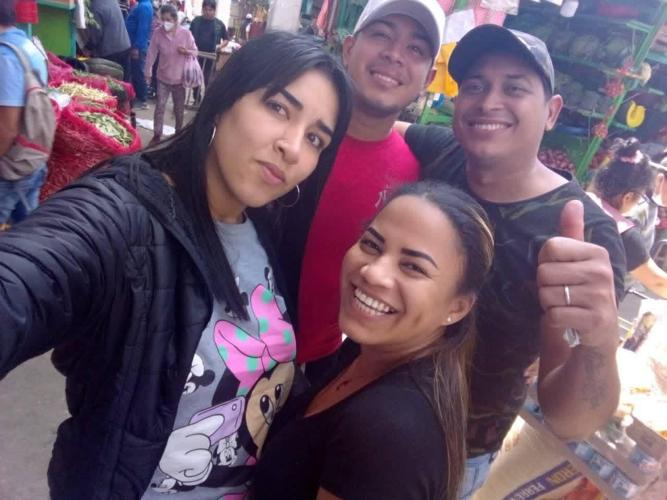
Tatiana Farias (far left) takes a selfie with her husband, Elías José Colón-Delgado, her brother, Joseph Farías Ríos, and her sister-in-law, Carmen López Suárez. (Courtesy of Tatiana Farias)
Farías and her family left Venezuela in 2023, fleeing violence and persecution in her home country after publicly opposing Nicolás Maduro’s regime in peaceful protests. They left behind their children and elderly parents hoping to one day bring them to the U.S.
“It’s a country with no freedom of expression, and the truth is we can't go back because we still don't feel safe,” Farías said.
While in the U.S., Farías has been able to pay for her father’s eye cancer treatment because in Venezuela, “you have to buy everything, up to the medicine and the syringe the doctors will use in his operations.”
The final event that led them to flee their home country was when Colón-Delgado and Farías Ríos were shot at while they waited for the bus after work. On a different occasion, her brother was kidnapped for opposing the government.
“I came here and felt very safe in this country because it's a country of laws, a country of freedom. That's why I came here,” she told me. “But things have changed since then.”
When they arrived in the U.S., they applied for asylum status and presented witness statements and other evidence. Their case was denied, but were in the process of awaiting a decision on their appeal case.
Then they were pulled over.
“I came here for the American Dream,” she cried out. “And now I’m experiencing the American Nightmare.”
Susan Barnett is an independent journalist in southern Arizona covering the immigrant and Latine community. She is a recent graduate from the University of Arizona, where she received her Master of Arts in Bilingual Journalism. She previously worked at La Estrella de Tucson and co-founded Tucson Spotlight.




(0) comments
Welcome to the discussion.
Log In
Keep it Clean. Please avoid obscene, vulgar, lewd, racist or sexually-oriented language.
PLEASE TURN OFF YOUR CAPS LOCK.
Don't Threaten. Threats of harming another person will not be tolerated.
Be Truthful. Don't knowingly lie about anyone or anything.
Be Nice. No racism, sexism or any sort of -ism that is degrading to another person.
Be Proactive. Use the 'Report' link on each comment to let us know of abusive posts.
Share with Us. We'd love to hear eyewitness accounts, the history behind an article.