
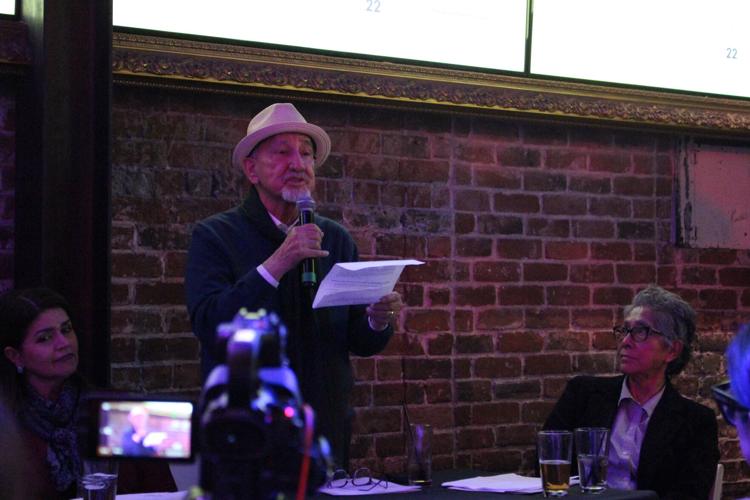
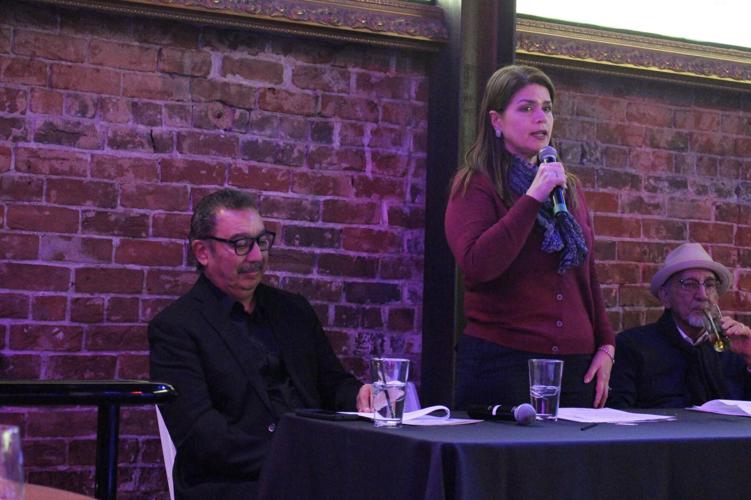

Tucson Mayor Regina Romero tells a crowd at Playground Bar on Thursday, Jan. 22, 2026, that the city is working with a consultant to identify a location for a Mexican American Chicano Cultural Center.
TUCSON – Tucson is the closest it’s ever been to having a Mexican American Chicano Cultural Center, as a consultant works with city officials to make the decades-long dream a reality.
On Thursday, Tucson Mayor Regina Romero, longtime Chicano community leader and organizer Raul Aguirre and historian and author Lydia Otero sat down with Javier Duran, director of the Confluencenter for Creative Inquiry, to talk about the need for a Mexican American Chicano Cultural Center in Tucson.
The Confluencenter hosted the event, titled “Re-envisioning Tucson’s Mexican Heritage” as part of its Show and Tell series — back after a yearlong break — at Playground Bar in downtown Tucson.
“Imagine a Mexican American Chicano Cultural Center that will help connect, strengthen and elevate the incredible work already being done by artists, organizations and cultural workers across the city,” Duran said.
The idea for a Mexican American-Chicano center in Tucson is not new. In the 1970s, community members organized and proposed a similar art center, Otero said. And while the city gave community leaders six acres of land back then — environmentally challenged land that was a former landfill — and organizers held fundraisers to cover construction costs, it never happened. Since then, Chicano community leaders have looked for ways to make it a reality.
Aguirre said he’s been advocating for a Mexican American-Chicano-Indigenous cultural center for 40 years.
“Tucson did not become a Mexican American city, a Chicano city, by accident. This culture has not arrived recently. It’s always been here,” Aguirre said. “Our labor has built this city, our music, our food, our language, our traditions define the very character of Tucson.”

Raul Aguirre, a Chicano community organizer, discusses the many ways a Mexican American Chicano Cultural Center would benefit Tucson on Thursday, Jan. 22, 2026, at Playground Bar in downtown Tucson.
Five sites being considered, including downtown library
When Romero became mayor in 2007 — the second Mexican American to serve 100 years after the first — she realized that she had an opportunity to create a permanent space for Chicano culture, she said.
Romero used American Rescue Plan (ARP) funds to launch Somos Uno, an office dedicated to creating a cultural heritage strategy for Tucson. She then used more ARP dollars to look into the possibility of founding a center.
The staff at Somos Uno is working with a consultant to identify a location for such a cultural center, she said, with five sites currently being considered, including the Joel D. Valdez Library in downtown Tucson. Other sites being considered include El Pueblo and El Rio.
Kelly Wiehe, a cultural affairs officer with the city, said she’s expecting a draft of the consultant's recommendations soon, which would include recommended use based on feedback from thousands of residents obtained through a survey.
Romero shared her own vision for the space: an industrial kitchen for tamal and tortilla-making classes, art workshops, folklorico and mariachi practice spaces and scheduled concerts.
“It has to be a living space where the culture that we have is shared,” she said.
The city is also looking at funding options to open and sustain the center. Romero suggested the possibility of asking voters to approve bonds to fund it, create a 401c3 nonprofit to find philanthropic funds and look to private partners for funding.
“It is a dream that we can put together and really find the money,” Romero said. “So what we're paying for, in terms of the cultural center, is putting together the strategy and the infrastructure to be able to make it happen with the support of the City of Tucson. Because… if the [Tucson Museum of Art] has had the support of the city of Tucson for 50 years, this can too.”
A decades-long push for a Chicano cultural center
Otero shared some history on past attempts to open a Chicano cultural center. In the 1970s, Maria Navarette Cordova, who lived in what’s now known as La Casa Cordova, was removed from her home by the City of Tucson “under the banner of urban renewal,” Otero said.
“Her house was given to the Tucson Museum of Art to start a Mexican Museum,” she said.
The family fought in court, but lost, as detailed in Otero’s latest book, “Storied Property: María Cordova's Casa.”
The city “bent over backwards” to accommodate the Tucson Museum of Art, Otero said. The museum still pays $1 a year in rent to the city and until about 2008, the city was funding the museum with $60,000 a year.

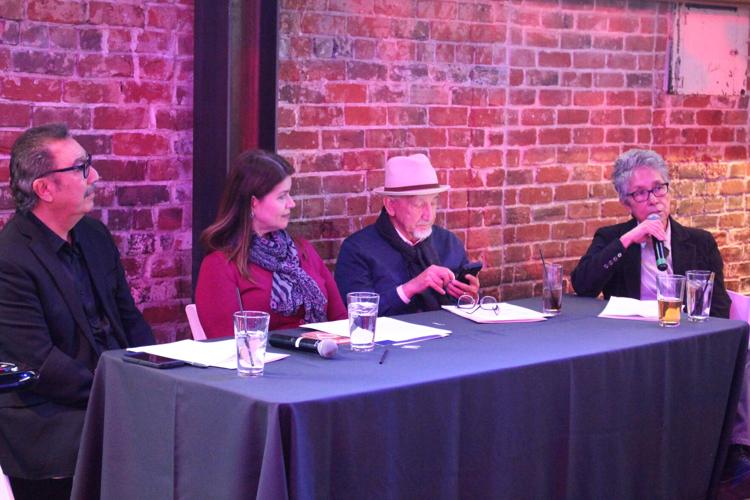
(From left) Confluencenter Director Javier Duran, Tucson Mayor Regina Romero, longtime Chicano community leader and organizer Raul Aguirre and historian and author Lydia Otero talk about the need for a Mexican American Chicano Cultural Center in Tucson on Thursday, Jan. 22, 2026, at Playground Bar.
“Those of us that are interested are not asking the city of Tucson for policy change,” Otero said. “The city has been engaging in these kinds of practices for more than 50 years. So I see us asking for institutional support — not a marginal, compromised site, but institutional support — and I think it's time,” referring to the six acres of land the city offered in the 70s.
Moving ‘from aspiration to action’
Gia Del Pino was shocked when she learned about the proposal for a Mexican American Chicano Cultural Center.
“I learned about it and I was so excited because I was shocked to realize that a place like this doesn't exist in Tucson,” Del Pino said. “And it feels like, ‘Oh, this is a natural home for such a cultural center.’”
It’s a good sign to learn that the city is actively shopping for a location and asking the community what they want to see in a cultural center. A lot of Tucson’s culture is inspired by Mexican and Chicano culture and history, Del Pino said, adding that she was inspired to see a packed house at Playground and such a diverse group of people interested in learning about the cultural center.
“I think it's a ray of light in a moment that feels pretty bleak for many people who share these identities,” she said. “And I think it's a way to speak to the abundance and the success, and how these cultures survive and thrive despite political turmoil and that such an institution will be that home and hub for many generations to come.”
Duran said Latino communities show up, spend money and sustain cultural life in Tucson. The vision for a cultural center is about bringing those contributions together to recognize “cultural participation as economic participation and heritage as something living and evolving,” he said.
Aguirre echoed Duran’s comments, adding that a center that houses and highlights the cultural contributions of Chicanos would strengthen the economy, activate the city center, bring Tucsonans education and civic pride and give future generations a place where they can see themselves.
“It's important to move from aspiration to action,” Aguirre said. “We are ready. The community, I think, is ready. The models exist, the spaces exist. What remains is the will to say that this history is not peripheral, but central to who Tucson is and who it wants to become. And I want to say that the question isn’t whether Tucson can afford this, it is whether we can afford not to.”
Stephanie Casanova is an independent, bilingual journalist from Tucson, Arizona, covering community stories for over 10 years. She is passionate about narrative, in-depth storytelling that is inclusive and reflects the diversity of the communities she covers.







(0) comments
Welcome to the discussion.
Log In
Keep it Clean. Please avoid obscene, vulgar, lewd, racist or sexually-oriented language.
PLEASE TURN OFF YOUR CAPS LOCK.
Don't Threaten. Threats of harming another person will not be tolerated.
Be Truthful. Don't knowingly lie about anyone or anything.
Be Nice. No racism, sexism or any sort of -ism that is degrading to another person.
Be Proactive. Use the 'Report' link on each comment to let us know of abusive posts.
Share with Us. We'd love to hear eyewitness accounts, the history behind an article.