
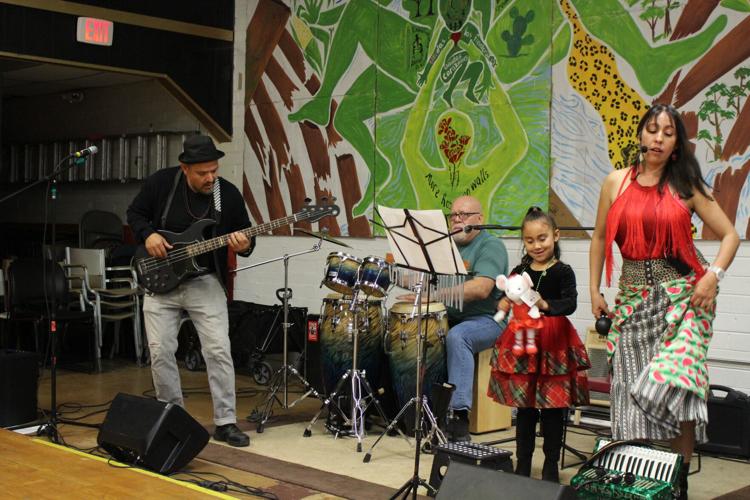
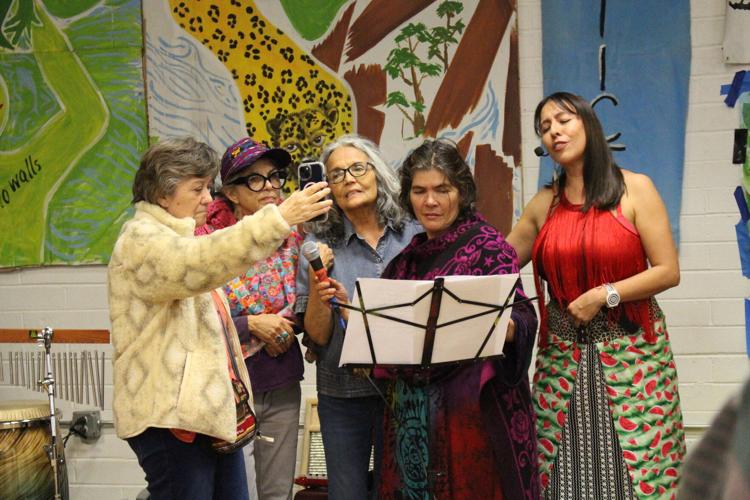

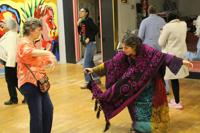

Conjunto LaPira performs during the Coalicion de Derechos Humanos’ International Migrant Rights Day celebration in Tucson, Arizona, on Saturday, Dec. 13, 2025. (Stephanie Casanova/CALÓ News)
TUCSON – After a year of organizing protests, vigils, marches and speaking out against anti-immigrant rhetoric and policies, Tucson immigrant rights organizers took a moment over the weekend to celebrate each other and the people they advocate for on the heels of International Migrants Day.
On Saturday, the Coalicion de Derechos Humanos hosted a celebration at the Global Justice Center that included a reading of parts of the Universal Declaration of Human Rights, sharing an update on changes the Trump administration has made to legal processes, a dance performance, poetry reading and more.
Derechos Humanos has been celebrating International Migrants Day and International Human Rights Day for at least 20 years, said Isabel Garcia, longtime organizer with the coalition. She said the commemoration is meant to remind people that there are international documents that outline specific standards about how humans should treat each other.
As people walked into the venue, they served themselves food from a table spread that included tamales, beans, rice, calabacitas con queso and arroz con leche.
International Migrants Day is celebrated on Dec. 18, on the anniversary of the United Nations’ International Convention on the Protection of the Rights of All Migrant Workers and Members of Their Families. The Convention was approved by the UN General Assembly on Dec. 18, 1990. The United States, and other countries that widely receive migrants, — Canada, Australia and Western European countries — have not ratified it.

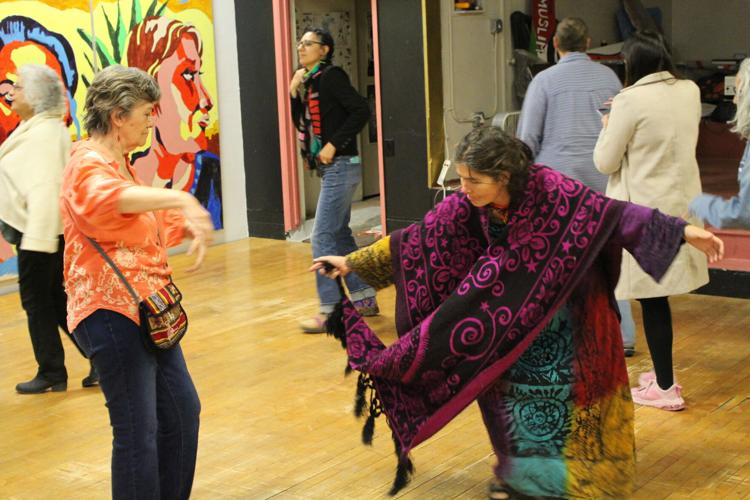
Women dance to music by Conjunto LaPira during the Coalicion de Derechos Humanos’ International Migrant Rights Day celebration in Tucson, Arizona, on Saturday, Dec. 13, 2025. (Stephanie Casanova/CALÓ News)
International Human Rights Day, observed on Dec. 10, commemorates the adoption of the Universal Declaration of Human Rights by the General Assembly in 1948.
“Every year, we want to remind people that regardless of the constrictions of rights we're seeing [in the U.S.], that we really are part of a worldwide community that shares standards for humans,” Garcia said.
The organization named itself Derechos Humanos because they felt the U.S. framework was “insufficient to deal with the issues that plague migrants,” she said, adding that the organization aims to focus on human rights for everyone.
Civil, social and cultural rights
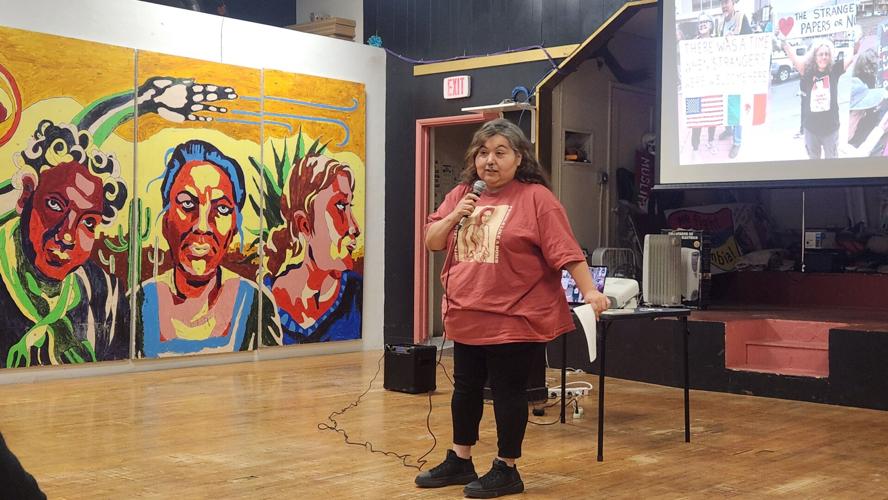
Jovana Renteria, an organizer of 18 years in Arizona, read aloud some of the articles in the Universal Declaration of Human Rights.

Jovana Renteria, a longtime immigrant rights organizer in Arizona, talks about the Universal Declaration of Human Rights during the Coalicion de Derechos Humanos’ International Migrant Rights Day celebration in Tucson, Arizona, on Saturday, Dec. 13, 2025. (Stephanie Casanova/CALÓ News)
The declaration includes three main pillars, Renteria said:
Civil and political rights, which include freedom of speech, due process, voting rights, protections from arbitrary arrest;
Economic and social rights, including the right to housing, health care, education, decent paid work; and
Cultural rights, which include people’s ability to preserve language, culture, identity and traditions.
“Let me know if you see the U.S. breaking any of these declarations of human rights,” Renteria said before she started reading. “We have Article One, all humans are born free and equal in dignity and rights.”
As she continued to read, a man in the audience snickered and scoffed.
“Article Five. No torture or cruel, inhumane or degrading treatment,” Renteria read.

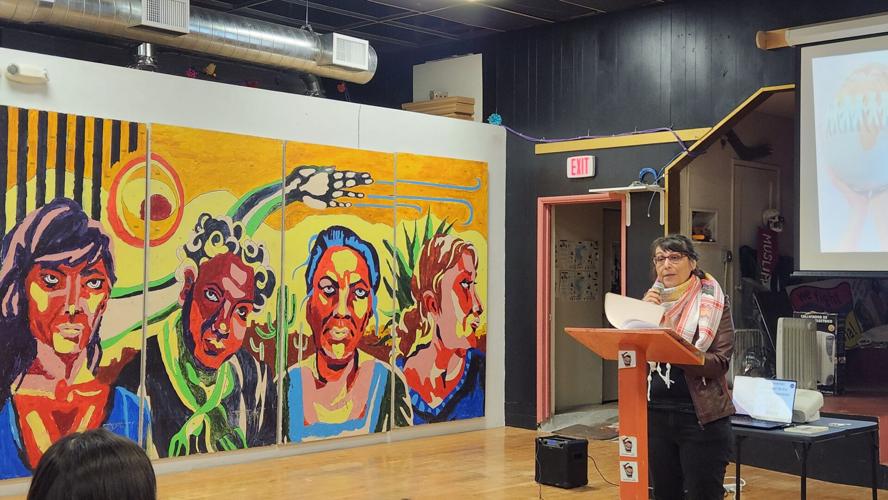
Muna Dawn Hijazi, a Palestinian poet, speaks before the crowd during the Coalicion de Derechos Humanos’ International Migrant Rights Day celebration in Tucson, Arizona, on Saturday, Dec. 13, 2025. (Stephanie Casanova/CALÓ News)
“Guantanamo,” the same man said, offering an example.
“We can actually pinpoint where this is actually being violated, right?” Renteria asked those present. “The overcrowding in detention centers, withholding of medical care, abusive conditions of [U.S. Customs and Border Protection] and other facilities, family separation policies, unsafe deportation practices.”
The Declaration of Human Rights has been a “gold standard” of how people should treat one another and what rights every human should have, Renteria said after she finished reading parts of the treaty.
“And 77 years after it was adopted, we are still asking one simple question: ‘Will we honor the rights we already know belong to everyone?’” she said.
'A full assault on the rule of law'
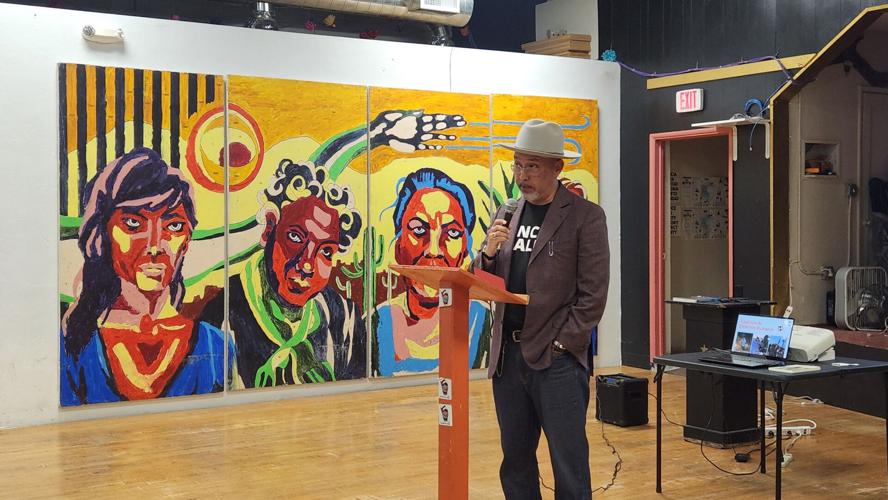
Luis Campos, an immigration attorney with 30 years of experience, spoke to the people present about the many changes President Donald Trump’s administration has made to the legal immigration process.

Immigration attorney Luis Campos speaks about his work in advocating for migrant rights during the Coalicion de Derechos Humanos’ International Migrant Rights Day celebration in Tucson, Arizona, on Saturday, Dec. 13, 2025. (Stephanie Casanova/CALÓ News)
“We are now witnessing a full onslaught, a full assault on the rule of law and on people of color and people who speak Spanish. Let's be frank and let's be honest,” Campos said, reminding people that the president doesn’t have the power to change the law.
He listed off disruptions to the immigration legal system under the Trump administration: immigration judges, who function under the executive branch, are being fired; asylum cases are being dismissed without due process; people are being kept in immigration prisons after they’ve won their case and applications that used to be free are now costing hundreds.
“I see the institution, I see the laws as having become illegitimate, and in the face of an illegitimate institution and illegitimate laws, I think that calls for extraordinary measures,” Campos said. “In my little part of the world, I've suddenly become an activist. I didn't think I would do that ever. I was always used to being in a courtroom and kind of just a standard run-of-the-mill lawyer. Now I feel I'm part of the resistance with all of you.”
The room erupted in applause.
Campos urged people to continue speaking out, documenting abuses and countering the narrative the Trump administration uses to vilify immigrants. He said everyone plays a part in resisting, whether it is through art, activism or protest.
'We are people of joy'
Renteria told CALÓ News it’s going to take everyone in the community coming together, organizing and fighting for one another to demand that people’s rights be honored and respected. It’s a moral obligation, she said, for people to take to the streets and call out the injustices everyone is experiencing.

A group of organizers with Derechos Humanos joins Miroslava Hernandez, lead singer of Conjunto LaPira, in singing the band’s version of “La Llorona” during the Coalicion de Derechos Humanos’ International Migrant Rights Day celebration in Tucson, Arizona, on Saturday, Dec. 13, 2025. (Stephanie Casanova/CALÓ News)
“We cannot continue to… be quiet, to be in silence, to be accepting the norms that they're trying to push upon us, on them, you know, violating human rights and just rights in general,” Renteria said.
It’s also important for organizers to unite as they fight a system that is attempting to divide them, she said.
“We've had a rough year in all our communities… we have to make sure we are sticking to our authentic self,” Renteria said. “We are people of love, we are people of joy and we're here to continue to pass down the traditions that have been passed down to us for many, many years.”
Garcia said the event also served as a reminder of the importance of celebrating each other, universal rights and community.
“We want to celebrate, we want to say that migrants are life,” Garcia said. “Without migrants in our country, oh, my God, I don't know what would be of us.”
Toward the end of the event, Conjunto LaPira played cumbias and other Latin music as people danced. A woman in a black and magenta poncho with the image of La Virgen on it swayed her poncho like a folklorico skirt as she danced around the others.
As the band members started putting away their instruments, Miroslava Hernandez, the lead singer of Conjunto LaPira, invited Garcia and some of the other women to join her in singing “La Llorona.”
“Lloro por los inmigrantes, víctimas de la crueldad,” they sang. “De este régimen fascista y su falta de humanidad,” which translates to: “We weep for the immigrants, victims of cruelty of this fascist regime and its lack of humanity.”
Stephanie Casanova is an independent, bilingual journalist from Tucson, Arizona, covering community stories for over 10 years. She is passionate about narrative, in-depth storytelling that is inclusive and reflects the diversity of the communities she covers.






(0) comments
Welcome to the discussion.
Log In
Keep it Clean. Please avoid obscene, vulgar, lewd, racist or sexually-oriented language.
PLEASE TURN OFF YOUR CAPS LOCK.
Don't Threaten. Threats of harming another person will not be tolerated.
Be Truthful. Don't knowingly lie about anyone or anything.
Be Nice. No racism, sexism or any sort of -ism that is degrading to another person.
Be Proactive. Use the 'Report' link on each comment to let us know of abusive posts.
Share with Us. We'd love to hear eyewitness accounts, the history behind an article.