
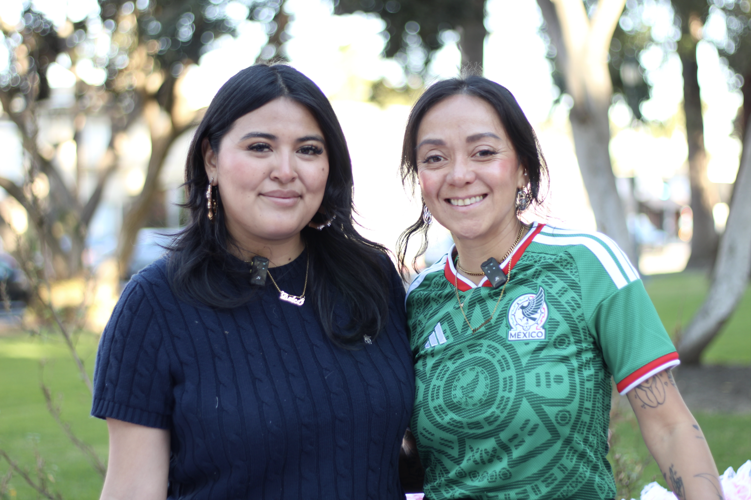



Dulce Flores and Angie Portillo, co-founders of Ponte Your Moños (image credit: Michelle Zacarias)
When the Trump administration sent federal troops to Southern California in June, Dulce Flores and Angie Portillo decided it was time to harness their combined expertise for a broader purpose. The colleagues recognized the need to protect their neighbors and community members, so they came together to launch “Ponte Your Moños.”
Flores, who was born and raised in East Los Angeles, and Portillo, originally from Mexico and currently living in Santa Ana, first bonded over a shared Mexican heritage. They soon discovered another common thread: a commitment to using their marketing and creative skills for a good cause.
“When the raids started to get really bad, we began to think, what can we do?” Flores told CALÓ News. Flores and Portillo already had bows and lace from their previous venture, Somos LAs Both. Instead of reinventing the wheel, they decided to use what they had.
That is how “Ponte Your Moños” (put on your bow) came into existence. The name was inspired by a Spanish language phrase, "ponte chingona," which is a call to action, rooted in Mexican slang. “Ponte chingona” means to channel your inner fierce, independent “badass” woman.
The pair shifted their focus from making lace-centric bows to incorporating them into their braiding, known as trenzas. Flores jokes that her and Portillo are like “Cynthia and Ariana” of the marketing industry. “You have a strategist, and you have a creative director, right? It works,” said Flores.
Aside from being friends, Flores and Portillo both have personal reasons for caring deeply about immigration. Portillo is a Mexican national, born and raised in Puebla. “I love to be Mexican, I love to show my culture – I love to hear my accent, and I embrace it,” she tells CALÓ News.
Portillo came to California four years ago for a job and has since navigated the uncertainties of living in the United States as a working immigrant under the Trump administration. Although she loves her life in California, Portillo's contract is not being renewed, leaving her with a looming deadline if her work visa expires.

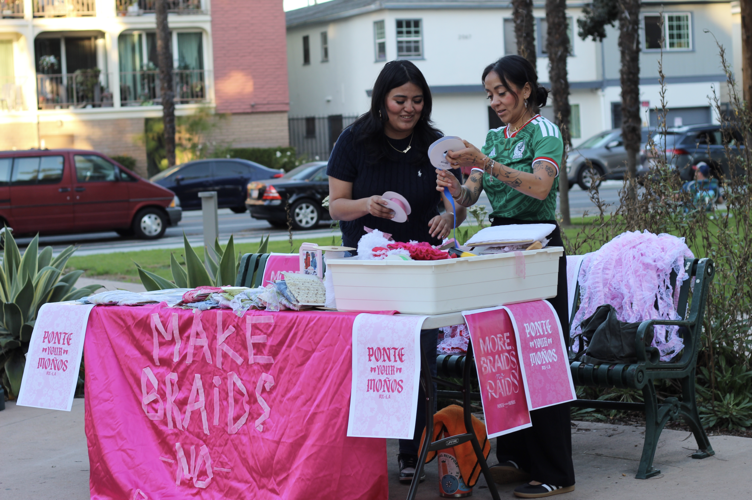
Flores and Portillo set up their braiding station in Long Beach. The 'Ponte Your Moños' vendor table has a large banner on the front that says "Make Braids Not Raids." (Image credit: Michelle Zacarias)
Flores, on the other hand, was born and raised in the United States. She grew up with undocumented parents in Southeast L.A. and recalls the constant fear that she would lose them to mass deportations. Even now, as an adult, she says the effects of the targeted raids impact her mental health. “It affects me at every level, my work, my relationships, my daily life,” she tells CALÓ News, “even as I’m working right now, I can’t help but think that there are people who are being detained.”
Even amidst uncertainty, the friends channeled their culture and creativity to build community. Since the launch of “Ponte Your Moños,” Flores and Portillo have braided the hair of more than 1,000 people, raising funds and providing relief for immigrant communities. They regularly host pop-up events in Santa Ana and have also offered their services in Los Angeles. They do not turn away individuals who cannot pay or donate, as they strive to create an accessible space for anyone seeking comfort and healing through their practice.
Portillo says that braiding carries a deep sense of nostalgia for her, recalling how her mother used to braid her hair. “Eso es como aprendí, viendo (I learned by watching),” she said. “I watched when she would braid my sister’s hair, so it’s something you just learn.”
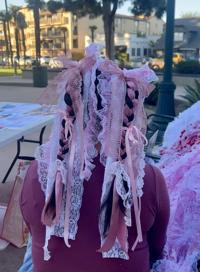
“It’s in our roots,” Portillo adds, noting specifically the women of Oaxaca who popularized the style of braiding with brightly colored ribbons and lace. “It’s a tribute, or homage, to them.”

Oaxacan-style braiding, known as trenzas with Ribbon and interwoven lace, is done by Portillo. (Image credit: Michelle Zacarias)
For many Mexicans and Central Americans, lace and ribbons are integral to a culture deeply rooted in Indigenous history. Young women and girls often wear them for Quinceañeras, Sunday mass, or even as part of wedding dresses. Lace fabrics and textiles were especially popular in places like Veracruz and Yucatán, where women’s outfits incorporate hand-stitched floral embroidery, sometimes worn with lace slips. American-born Latinos often carry down these traditions from their own relatives as a fashion accessory.
“Fashion has always been political,” said Flores, “even looking at history books and the start of the Chicano movement.” Chicanos of the 1960s and 1970s famously used fashion as a form of social protest and a means of showcasing political and cultural resistance.
"Ponte Your Moños" is more than just braiding; it’s a project that highlights the importance of cultural heritage and community support. While some may consider braiding to be trivial or unimportant in the current political landscape, this project illustrates that just two individuals can initiate positive change.






(0) comments
Welcome to the discussion.
Log In
Keep it Clean. Please avoid obscene, vulgar, lewd, racist or sexually-oriented language.
PLEASE TURN OFF YOUR CAPS LOCK.
Don't Threaten. Threats of harming another person will not be tolerated.
Be Truthful. Don't knowingly lie about anyone or anything.
Be Nice. No racism, sexism or any sort of -ism that is degrading to another person.
Be Proactive. Use the 'Report' link on each comment to let us know of abusive posts.
Share with Us. We'd love to hear eyewitness accounts, the history behind an article.