
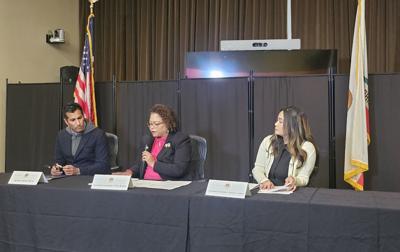


California Assembly members at a press gaggle on Thursday providing information on health care changes. (By Jacqueline García)
The California State Assembly members are calling on the U.S. Congress to take action and prevent massive cuts to Medi-Cal, SNAP (CalFresh) and other federally funded social programs, scheduled tostart in 2026.
On Thursday, four assembly members met with healthcare leaders, providers and advocates in L.A. Care of downtown LA to tackle the issue amid the growing threats to California’s health care system by the Trump administration.
The community discussion focused on H.R.1, also known as the “One Big Beautiful Bill Act” or the Republican’s spending plan, which includes ongoing federal cuts, causing major impacts on healthcare access and state budgets.
Robert Rivas, speaker of the Assembly, said Californians should be very alarmed about these healthcare changes. After making drastic cuts to Medicaid, the Trump administration and the Republicans refuse to extend subsidies that keep health care premiums affordable for nearly two million Californians.
The loss of subsidies could also cause an estimated 400,000 Californians to forgo coverage as a result of not being able to afford it, impacting low-income families, middle-class workers, older adults and small business owners.
Rivas said half of the Golden State's children rely on many programs that the Trump administration has actively sought to dismantle. So any federal cuts will immediately hit 14 million people in California.
“What does that mean for California? It's going to mean premiums are going to spike some 15 to 20% next year,” said Rivas to the media. “We're talking in a couple of weeks. It's the biggest jump in decades, only exacerbating our affordability crisis in this state, which we have actively tried to tackle this past year.”
Assemblywoman Mia Bonta said nothing is scarier than what is to come if Congress doesn’t vote on the Affordable Care Act (ACA) subsidies as soon as possible. Bonta, who chairs the health committee, said without the ACA subsidies, a family of four that is earning about $75,000 a year will see their premiums go from about $3,612 to $6,708.
ACA subsidies are federal financial help, mainly premium tax credits, that lower health insurance costs, especially for low-income families.
“What will happen is that people will drop out of receiving care,” Bonta said. “They will stop signing up for healthcare insurance, and we already know that that is compounded by the number of people, nearly 13 million people, who will drop out of being able to receive medical right now.”
Rivas and other assembly members have been traveling the state of California to reunite with leaders and have confirmed that nearly 15 million Californians live in communities without enough primary care providers.
“That's one in three of us that live in the state,” he said. “What about our rural hospitals? More than half of our rural hospitals are currently at a loss. And so you can imagine a single hospital closure will wipe out critical emergency care, and access critical care for residents.”
Rivas represents the 29th Assembly District, which includes the Central Coast, the northern part of the Central Coast, the Salinas Valley and his hometown, San Benito, which is a rural, suburban district.
A different end-of-the-year celebration
Assemblywoman Jessica Caloza said in a time when families and everyday working-class people should be thinking about what to get their kids for Christmas, many are worried about the future of their health care and social programs.
“We should be really at a toy giveaway right now, or something around the holidays, but we really wanted to again raise the conversation around the health care costs, because this is an affordability crisis, as we heard,” Caloza said.
The assemblywoman represents the 52nd District, which includes part of East and North East L.A., East Hollywood, Silver Lake and South Glendale.
Just in L.A. County alone, more than 40% of residents are covered by MediCal and nearly 60% of them are younger children, the most impacted population.
“This is the same group of people who have faced and endured the wildfires earlier this year. This is the same population that is being terrorized by immigration raids. This is the same population that's being impacted by all these crises all at once,” Caloza said.
Therefore, the call to Congress is paramount so they can take action and prevent low-income families from starting the new year making tough choices about whether or not they can pay their rent, buy groceries, provide for their family or go to a doctor's appointment.
“Those are the real-life choices that the communities that we represent are going to have to face,” she said.
The stop in Los Angeles was the sixth roundtable taking place throughout the state of California.







(0) comments
Welcome to the discussion.
Log In
Keep it Clean. Please avoid obscene, vulgar, lewd, racist or sexually-oriented language.
PLEASE TURN OFF YOUR CAPS LOCK.
Don't Threaten. Threats of harming another person will not be tolerated.
Be Truthful. Don't knowingly lie about anyone or anything.
Be Nice. No racism, sexism or any sort of -ism that is degrading to another person.
Be Proactive. Use the 'Report' link on each comment to let us know of abusive posts.
Share with Us. We'd love to hear eyewitness accounts, the history behind an article.