
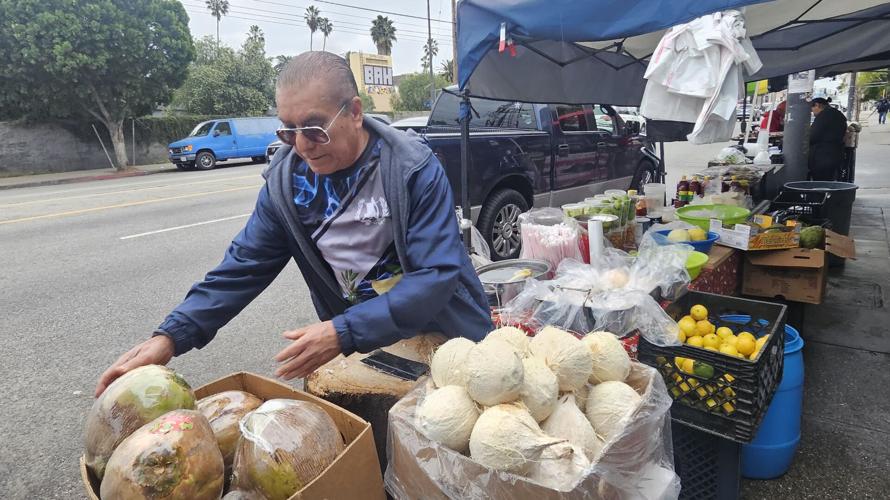



Julio Vargas sells coconuts in El Corredor Salvadoreño. (By Jacqueline García)
Julio Vargas is back at work selling coconuts in the same spot of El Corredor Salvadoreño in Los Angeles where two months ago he was taken into custody by immigration officers without a reason or warrant.
“I saw two (officers) coming,” he recalled. “[One of them] told me, ‘don’t move,’ I told him, don’t worry because, first, I haven’t done anything, second, I don’t owe anything.”
Immediately, the Guatemalan man was detained and put inside of a vehicle and taken to the downtown L.A. detention center.
Vargas, 66, said he felt humiliated because he had never been handcuffed in his life. He has spent more than 30 years living in Los Angeles.
There is no criminal record of him in Los Angeles Superior Court.
“But once you are there, they handcuff your hands and put chains from waist to legs, like a criminal,” he said with a broken voice. “I would like for authorities to detain people [who] are causing harm on the streets and not people like me [who] are working,”
El Corredor Salvadoreño is located on Vermont Avenue between 11th and 12th streets. On Nov. 2, 2025, the corridor was raided, where, according to the Department of Homeland Security (DHS), six undocumented immigrants from Guatemala and El Salvador were removed. Witnesses of the incident said it was about 11 people.
The cold and tense wait
Vargas said he spent a day in Los Angeles, then he was transferred to the Adelanto ICE Processing Center.
“We were still chained and they made us walk all the way to the cell without saying a word,” he said.
Vargas said there are about 60 or 70 people in every cell. They have men and women separated. He said the cell is extremely cold and people get so desperate that they cry, scream and some even want to commit suicide.
“The month and a half that I was there, I went out to the yard only like three times,” he said. “I would spend the majority of my time talking to God and praying, not just for me but for all the others, too.”
Vargas said the food is so bland that he went about three days without eating
“Nobody wants to eat that. No salt, no sugar. They would feed us mashed potatoes, white beans, black beans, salads, but you can only imagine how bad it was,” he said. “It’s like food for animals.”
Vargas said many times he had to encourage his cellmates to have patience and trust the process. However, for many of them, it was almost impossible since they didn’t have anyone to advocate for them outside.
It is estimated that more than a third of the 220,000 people arrested by ICE from January to October 2025 have no criminal record, according to the University of California, Berkeley’s Deportation Data Project.
In June 2025, California Representative Judy Chu said in a statement that she and other California representatives visited the Adelanto Center and confirmed the inhumane conditions at the facility.
“The detainees told me that they have gone days without changing their clothes, and they have been unable to use the telephone to call their families or a legal representative,” said Rep. Chu. “The people I met are not criminals; they are hardworking individuals who strengthen our communities and they simply want the opportunity to work for a better life.”
Praying for the best
From the moment he was detained, Vargas said he always knew in his heart that he wouldn’t be deported.

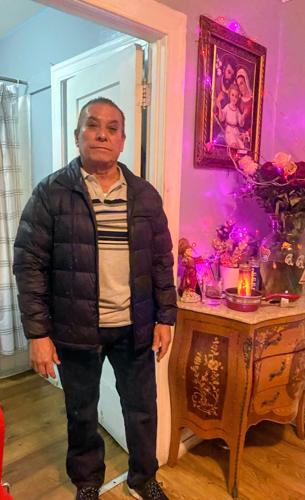
Julio Vargas was released in mid-December. (Courtesy of Vargas)
He said he is very grateful because friends and family mobilized to hire an immigration attorney to represent him. They paid about $27,000, including $15,000 in bond fees.
He was freed in mid-December with an ankle monitor and has to report himself at the federal building in downtown L.A. on certain days. He’s very hopeful that he will stay in Los Angeles, which is his home.
“The money comes and goes, we can manage, but for now, the most important thing is to work and be able to eat warm beans and we are able to clean ourselves and be free,” he said while selling his coconuts.
The family continues fundraising for Vargas’ legal fees.







(0) comments
Welcome to the discussion.
Log In
Keep it Clean. Please avoid obscene, vulgar, lewd, racist or sexually-oriented language.
PLEASE TURN OFF YOUR CAPS LOCK.
Don't Threaten. Threats of harming another person will not be tolerated.
Be Truthful. Don't knowingly lie about anyone or anything.
Be Nice. No racism, sexism or any sort of -ism that is degrading to another person.
Be Proactive. Use the 'Report' link on each comment to let us know of abusive posts.
Share with Us. We'd love to hear eyewitness accounts, the history behind an article.