
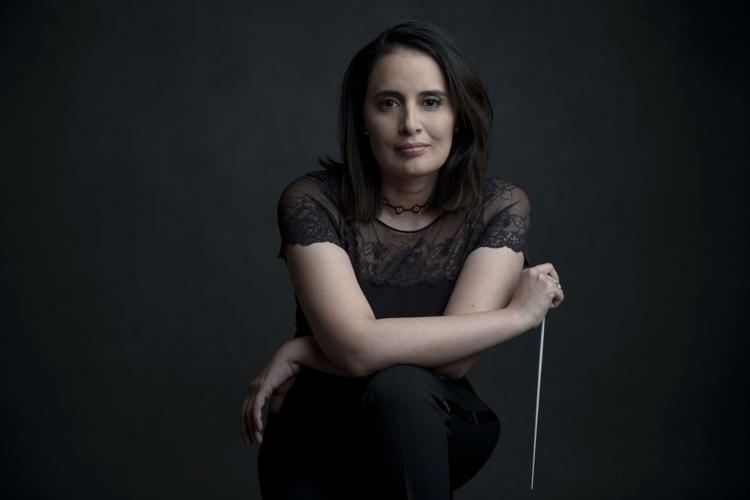

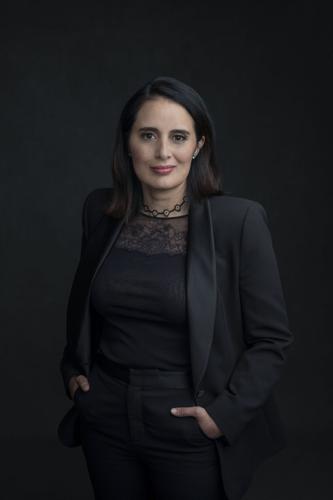
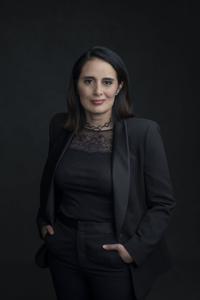


Lina Gonzalez-Granados is a Colombian-American conductor praised for her raw talent and advocate for Latino conductors. (Nora Hess: hair and makeup/Todd Rosenberg Photography)
Lina González-Granados is carving out a path for Latina conductors.
She is a Colombian-American conductor praised for her raw talent and for being an advocate for Latino conductors, who is also the first Latina appointed as resident conductor in the LA Opera.
González-Granados grew up with an admiration for all things beautiful, including the beauty in ugliness, which she found through the medium of music. “When you're little, you think about something beautiful and, for me, that was music,” González-Granados told CALÓ News.
“That's why I pursued beauty and how it felt to play something that made me happy. I related happiness with beauty,” she said. “In school, I would play castañets in the chorus or I would be singing pop music, rock, salsa, everything and it just made me feel very happy. That's how it started and then it became serious.”
When she was a child in Cali, the conductor’s parents encouraged her to learn how to play the piano, which propelled her into a professional career in music. Though she was a trained pianist since she was 13 years old, when she was 19 she realized that, while the piano is a beautiful instrument, she felt drawn to conducting instead. In 2008, González-Granados made her conducting debut at the Youth Orchestra of Bellas Artes.
“From the first time I stood up on a podium, I was very little,” González-Granados said. “I was 20 years old. And I say little in [terms of] conducting years. That sounds very extreme, but I was very little and I felt exhilarated. It was just such a rush of happiness and adrenaline that I never imagined myself doing anything else.”
Coming to the United States for the first time in 2010, the conductor attended the Juilliard School, where she studied conducting and theory for a year before pursuing higher education at the New England Conservatory of Music in 2011. In the following four years, she earned a master’s degree in conducting with Charles Peltz, a master’s degree in wild ensemble conducting and a graduate diploma in choral conducting with Erica Washburn. In 2015, González-Granados also received a doctorate of musical arts in orchestral conducting from Boston University.

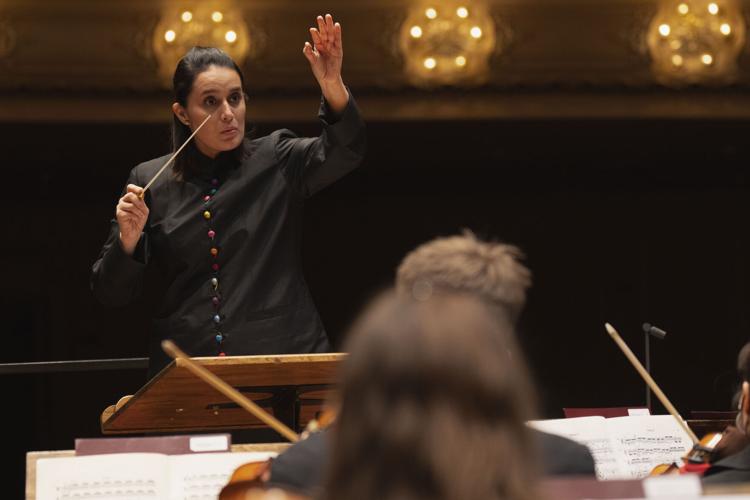
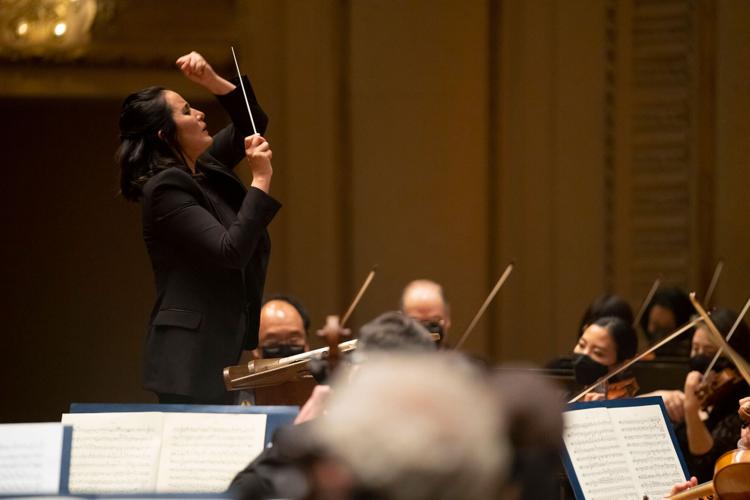
Lina González-Granados conducts the Civic Orchestra of Chicago. (Todd Rosenberg Photography).
Since relocating, González-Granados has lived in the U.S. for 14 years, 12 of those years being in Boston and nearly three in Philadelphia, Pennsylvania where she currently resides. She was the first Latina conductor ever selected for the 2017 Linda and Mitch Hart Institute at the Dallas Opera and, from 2019 to 2023, she joined the Chicago Symphony Orchestra and won the fourth CSO Sir George Solti Conducting Apprentice.
In 2022, the beginning of the 2022- 2023 season, González-Granados became the first Latina to be resident conductor at the LA Opera, a position she will hold until June 2025. She debuted with Opera Philadelphia, the Orchestre Metropolitain and the Orquesta Sinfonica de Galicia, to name a few, as well as leading a highly-acclaimed production of Britten’s “Rape of Lucretia” with LA Opera.
Her 2023-24 season kicked off with her return to the LA Opera to conduct “El Último Sueño de Frida y Diego,” the LA Opera rendition of a new musical portrait from Grammy Award-winning composer Gabriela Lena Frank and Pulitzer Prize-winning playwright Nilo Cruz. She is also set to debut with the Orquesta Sinfónica de Puerto Rico, I Musici de Montreal and the San Antonio Philharmonic, among others, with additional performances across the U.S. and internationally to be announced.
But regardless of her immense success as a rare Latina conductor, González-Granados is more concerned with the art of craft itself, as well as being an advocate for Latino musicians. It is that exact passion that pushed her to create Unitas Ensemble, Boston’s Latin-American Orchestra, in 2014, to bring performances of Latin-American music of the highest caliber to the people of Boston. Unitas Ensemble is a devoted member of the Boston community, performing concerts at surrounding schools and community events.

Lina González-Granados conducts the Civic Orchestra of Chicago at Sheherazade rehearsal. (Todd Rosenberg Photography)
She was the artistic director of the orchestra until April 2023, but González-Granados continues to dedicate herself to highlighting new and unknown music by Latino composers and choosing the projects she is personally passionate about.
“From a conductor's perspective, it does come from personal choice–what I want to be conducting and playing,” González-Granados said. “Every day, my taste changes, but that doesn't mean that my purpose does. I do it because it's a way for me to show layers of my identity. There is an affinity to be able to feel represented and when I do that, I feel I can show myself in my most authentic form. For me, it's all about choice. Someone makes a conscious decision to program or not program something. You learn to give people the space or not at all, because they don't think there is a need, or they don't think there is anything around that.”
Fewer than one in four conductors are women, including assistant conductors and music directors, according to the Racial/Ethnic and Gender Diversity in the Orchestra Field 2023 report from the League of American Orchestras.
The report also indicated that within the last decade since 2014, diversity increased partially due to an increase of Hispanic/Latinx conductors and music directors from 4.9% to 9%. For women conductors, the percentage almost doubled from 12.9% to 23.8%.
CALÓ News sat down with González-Granados to discuss being a Latina conductor, representing the Latino community and her purpose.
There is a lack of Latino representation in conducting. Did this deter you at all from choosing this path? How do you navigate this industry as a Latina?
I love that you asked me this because California is such a particular place. In California, there are the most notable Latino conductors that exceed, such as Gustavo Dudamel. In hindsight, people don't realize that it's uncommon. It is uncommon but, at least for women, it has gotten much better. I don't think [the lack of representation] deterred me because my purpose has always been clear. I kept studying even if I didn't see a clear path, like when you see incredibly unattainable goals, but the two routes that you can take are either give up and pivot, which is valid, or try to go for it. I decided to go for it.

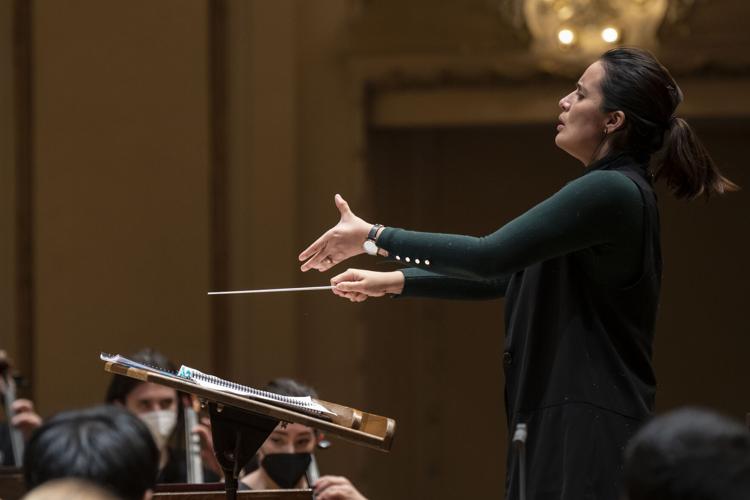
Lina González-Granados conducts the Chicago Symphony Orchestra. Beethoven Violin Concerto, Brahms Symphony No. 1. (Todd Rosenberg Photography)
[Navigating the industry as a Latina] depends on the place. When you get into a more culturally elevated community, that doesn't matter that much. Whether it's an orchestra of a very high caliber or a city where governments are somehow developing a certain way, being a woman doesn't matter that much. It's all about the music and you just have to measure yourself in different ways. But there are places that, no matter how hard you try, you are at a loss already. There was a moment in my life when I was like, ‘Ugh, it's exhausting to go to those places. If I could only go to places that accept me, I would be super happy.’ But in the end, I always think that the purpose is higher and the music is more important. Sometimes, I just let that go and make my music even if it's a hard space to occupy.
What is the role of the musical conductor and why is it an important factor for shows to go on?
The conductor is a leader of the big frame and the vision of the entire piece of art. [They’re] in charge of everybody who plays a role whether it’s, for example, in the opera where there is a singer or the people in the orchestra. Our job or our purpose is to help them be their best. On a more technical level, we let them know when to arrive at their part, to play at the right time with the right notes and in a certain way. But, on top of that, it has a subset of layers of leadership where you aspire to help them play their best and feel inspired. Because, sometimes, we have maybe 150 people on stage so you want them to know that their role matters and that they are there for a reason, they're not there just to fill a space. That's the real challenge for me because it's not like a psychiatrist or a therapist or anything, but, with only your hands, you have to make them feel something. Of course, there's the rehearsal and you can talk and then determine a way for them to play but in the end, the decision is in real-time. You don't make the sound, you just wave your hands or take a breath. And with a breath and a hand, you have to make people follow. You have to be very convincing.

Lina Gonzalez-Granados sees the beauty in music. (Todd Rosenberg Photography)
What are the challenges and rewards of being a conductor?
I always say challenges are the reward. I think the challenge, of course, is making music of the highest caliber, it's [also] the reward. The other reward is making the audience feel something, whether it is an extremely positive reaction, or whether they are connected via their own memories or with the music. That is a whole reward, bringing people to an aural experience. The challenge that feels like a reward at all times is when new people come to the opera and they feel that they belong and want to come back. That is the biggest reward. They want to come back not only because they feel that they belong, but they feel like ‘Oh, art is for a person like me, and I have a reaction to it.’
You have been praised for your “attention to orchestral colors” (Operawire) and ability to create “lightning changes in tempo, meter and effect” (Boston Musical Intelligencer). Can you take me through your methods or process of musical conducting?
I study a lot. I spend hours upon hours memorizing the music. After I go through the music, my main method is just to create an image, an image of the sound. It sounds like a boring job, but it isn't. I think a lot. I sit down with an image thinking, ‘How does this sound? What is the sound?’ That's how I spend my entire day. It's all about creating something material because the sound is not something that you can touch, you know? How do you envision that? That's how I spend my time. Then, hopefully, when I have a lot of time, I read a lot. And if I don't have that much time to read, I know a lot of people who read a lot and tell me stories. My dad reads a lot and tells me stories. I also see how their brain works in their imagination. I love to listen to people, I love to listen to people telling me the stories of their lives. Even sharing a meal with someone that I like, it's part of my process because it makes me think about history, sound and imagination differently. It sounds very esoteric, but it's not. Musicians are storytellers. Like you, when you write a story, you are doing the same thing from beginning to end. We start a piece, we are there to tell a story. To tell a story, you have to know how to pace it and how to guide it, but we tell it with sound while you tell it with words, something more visual. That's why we need to be thinking, thinking and thinking about how things work.
You are the first Latina to hold the title of resident conductor at LA Opera. What does this mean to you and what does it mean for the Latino community?
I think it's important because we need more women and someone has to do it for the first time. Once people see that it can be done successfully and beautifully, there is no point in putting any ceilings on women's careers and women's aspirations. It's also a big responsibility that I hope to not only see myself advance but also help people who look like me advance equally.
Your work has earned you international recognition, most recently being named part of Bloomberg Línea’s “100 influential Latinos of 2022.” What does recognition mean to you and what advice might you have for other young Latinas who have the passion to become a musical conductor as you did?
I have never worked with an award as motivation, just because it's not my personality. I hate competition and I just like to do my own thing and I think that's my advice. If you work in music for the awards, fantastic, that is your prerogative, but I think there are deeper things, such as the music and your search for beauty and fulfillment. When those are aligned, then awards happen. I always talk about purpose, but when I have lost sight of what the purpose is, whether things have slowed down, ego gets in the way or somebody else’s ego gets in the way, when you're completely aligned, there is no way to stop you. You will find a way to arrive at a point. That's my advice. Never lose sight of your vision for your own life. Never lose sight.





(0) comments
Welcome to the discussion.
Log In
Keep it Clean. Please avoid obscene, vulgar, lewd, racist or sexually-oriented language.
PLEASE TURN OFF YOUR CAPS LOCK.
Don't Threaten. Threats of harming another person will not be tolerated.
Be Truthful. Don't knowingly lie about anyone or anything.
Be Nice. No racism, sexism or any sort of -ism that is degrading to another person.
Be Proactive. Use the 'Report' link on each comment to let us know of abusive posts.
Share with Us. We'd love to hear eyewitness accounts, the history behind an article.