
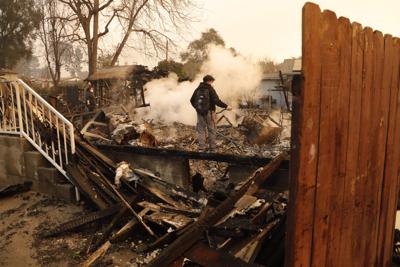


Neighbors and volunteers helped extinguish small fires in Altadena neighborhoods ravaged by the Eaton Canyon fire on January 10, 2025. (Gisselle Palomera/CALÓ News)
As many as 50 qualifying households in unincorporated areas of Los Angeles County will soon receive direct financial assistance to help build accessory dwelling units (ADUs) on their properties, which are usually independent, smaller residential units located on the back but in the same lot as a primary dwelling.
The financial assistance is part of a $3.8 million state grant from the state Regional Early Action Planning 2.0 Grant Program, known as REAP, an initiative designed to accelerate housing development projects that are affordable, sustainable, promote housing growth and reduce greenhouse gases.
ADUs serve as a secondary housing unit and although they can be smaller than the average U.S. house, they are meant to be equipped with a full kitchen and bath. Despite California law allowing ADUs on most residential properties, bundling them can cost millions of dollars.
The REAP 2.0 funds will be allocated to between 35 and 50 households with particular emphasis on properties within the Eaton Fire perimeter, where nearly 9,500 structures, including homes, churches, businesses and schools, were damaged due to the January 2025 fires.
With the grant, Eaton Fire survivors would be able to build the smaller units on their properties, which can help provide additional rental income and therefore offer long-term stability.
On Tuesday, March 7, the L.A. County Board of Supervisors, who serve as the governing body for over one million residents in unincorporated L.A. County areas, voted unanimously to accept the grant funds from the state.
“Eaton Fire survivors deserve support that helps them rebuild their lives," Supervisor Kathryn Barger said in a statement after the board vote. “This program will provide direct financial assistance so homeowners can add safe, affordable housing on their property. ADUs can help house displaced family members, provide rental income to offset rebuilding costs and offer long-term stability.”
To make sure they fall under the state’s strategic investments toward a more sustainable, resilient and inclusive future, the households that receive funds through the REAP program must develop housing that is affordable for middle-income households for at least 10 years.
In other words, the ADU or back unit inside the homes must be used for housing families earning no more than 120% of the area's median income.
According to the county, the households receiving funds through the program will work with the San Gabriel Valley Habitat for Humanity for the development of the housing units and construction must begin or be completed by 2030.
REAP 2.0 was established as part of the 2021 California Comeback Plan under Assembly Bill 140. This new program builds on the success of the first round of REAP and expands the program's focus by addressing housing and climate at the same time.
The state's $560 million REAP 2.0 program was established in 2021, expanding the success of a similar REAP program from 2019, both of which focus on accelerating affordable housing supply.
The 3.8 million in financial assistance for the building of the ADUs in the Eaton Fire perimeter comes from the $231.5 million in REAP funds that were allocated to the Southern California region.
Details on eligibility and requirements for funding applications will be released in the coming months by the L.A. County Board of Supervisors.






(0) comments
Welcome to the discussion.
Log In
Keep it Clean. Please avoid obscene, vulgar, lewd, racist or sexually-oriented language.
PLEASE TURN OFF YOUR CAPS LOCK.
Don't Threaten. Threats of harming another person will not be tolerated.
Be Truthful. Don't knowingly lie about anyone or anything.
Be Nice. No racism, sexism or any sort of -ism that is degrading to another person.
Be Proactive. Use the 'Report' link on each comment to let us know of abusive posts.
Share with Us. We'd love to hear eyewitness accounts, the history behind an article.