
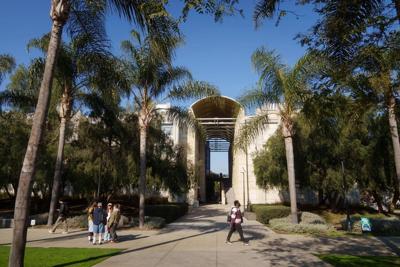



The Loyola Marymount University campus in the Westchester neighborhood of Los Angeles on Jan. 17, 2025. (Photo by Jules Hotz for CalMatters)
Smaller class sizes, grassy knolls, campus idyll — for low-income college students chasing that storied experience at California’s private nonprofit colleges, the expense is high: sometimes $30,000 or more in the first year alone after all grants and scholarships are considered.
While most California college students attend a public college or university, roughly 160,000 undergraduates pursue degrees at private nonprofit universities such as Chapman University, Loyola Marymount University, Stanford and the University of Southern California.
And low-income freshmen on average paid around $21,000 to attend private campuses for just one year in 2021-22, according to a CalMatters analysis of federal college costs data using the most recent year of information available. It used to be even higher, adjusted for inflation in 2023-24 dollars: The price students pay has declined by a few thousand dollars since data-keeping began in 2008-09, the CalMatters analysis shows. For its analysis, CalMatters defined low-income as a household income below $48,000.
There are exceptions: Stanford, for example, ends up being virtually free for low-income freshmen — those with family incomes below $100,000. University of Southern California is also relatively affordable, requiring low-income students to pay an average of about $15,000 after all financial aid is factored in.
But other campuses post much steeper net prices, a term that refers to the total cost of attendance — such as tuition, housing, transportation and food — minus all the state, federal, institutional and outside grants and scholarships students receive. For example, Pepperdine University’s net price for low-income students was more than $36,000 for the 2022-23 school year.
“Every year, we speak with students and families who truly desire to choose Pepperdine, but find that it isn’t financially feasible for their family,” wrote Kristin Paredes Collins, who leads enrollment and financial aid at Pepperdine. ”Although we truly believe that Pepperdine is a worthy investment, we acknowledge that it might not be financially feasible for every admitted student.”
She added: “We remind them that they will likely be successful at whatever school they choose.” Pepperdine spent $106 million on financial aid in 2023-24.
Net price calculators that colleges host on their websites can offer more fine-tuned estimates of what students will pay that may show lower costs, including extra school aid for high test scores and high school grades, but the prices still remain relatively high.
CalMatters reporters interviewed 16 students with Pell grants, the federal financial aid grant for low- and middle-income students, across eight California private nonprofit colleges to learn their struggles and reasons for attending these more expensive institutions.
These students worked 15 to 20 hours a week or more, missed out on campus cultural events and regularly sought additional financial aid by petitioning their colleges and applying for outside support. For most students interviewed, the effort was worth it. The students were motivated by the prestige of their institutions, smaller class sizes and the specific academic programming that other colleges don’t offer. Most students CalMatters spoke with avoided taking out any loans. And quite a few lived at home to avoid costly room and board fees.
Low-income students seem to know what’s more affordable, judging by where they enroll. Only about 27% of the state’s private nonprofit college students received the federal Pell grant in 2022-23, CalMatters calculations of federal data show. At the University of California, a third received the grant that year; nearly half got it at California State University. Both public systems, on average, cost less.








(0) comments
Welcome to the discussion.
Log In
Keep it Clean. Please avoid obscene, vulgar, lewd, racist or sexually-oriented language.
PLEASE TURN OFF YOUR CAPS LOCK.
Don't Threaten. Threats of harming another person will not be tolerated.
Be Truthful. Don't knowingly lie about anyone or anything.
Be Nice. No racism, sexism or any sort of -ism that is degrading to another person.
Be Proactive. Use the 'Report' link on each comment to let us know of abusive posts.
Share with Us. We'd love to hear eyewitness accounts, the history behind an article.