
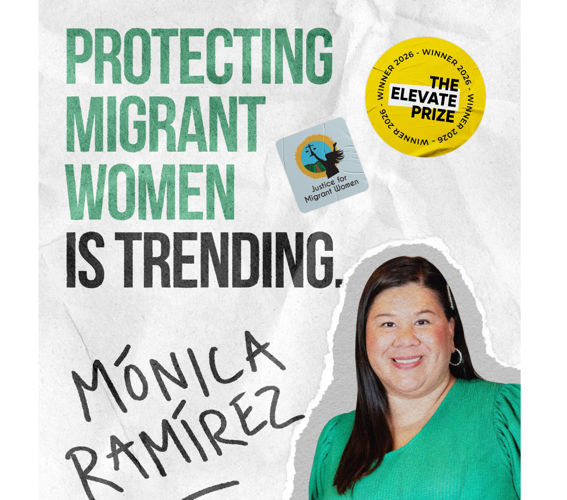




Mónica Ramírez, Founder and President of Justice for Migrant Women, has been selected as a 2026 Elevate Prize winner.(Photo courtesy of Ramírez.)
Mónica Ramírez, the founder and president for the nonprofit organization Justice for Migrant Women, has been selected as one of the 2026 Elevate Prize winners.
The global award recognizes social impact leaders whose work advances equity, safety and opportunity across communities. The winners will not only have financial support but also resources and access to a global network of partners dedicated to expanding their impact.
Justice for Migrant Women was founded to amplify and empower migrant women. The organization works alongside migrant women worker leaders and allies to provide education and equip them with the tools needed to advance the policy and advocacy priorities they have set for themselves, their families and their communities.
The nonprofit also leads educational campaigns, including Know Your Rights presentations for workers and The Bandana Project, a public awareness initiative focused on addressing workplace sexual violence against migrant farmworker women in the United States.
“The Elevate Prize is a tribute to the rural and migrant women at the center of our mission. They model what it looks like to lead with courage and compassion. It is our honor to support them as they use their power and expertise to advocate for, as well as, shape the decisions that affect their lives. We are grateful for this award and the opportunity to continue to advance our mission as a part of the Elevate Prize community,” said Ramírez
This interview has been edited for length and clarity.

The Elevate Prize 2026 finalists. (Photo courtesy of Elevate Prize.)
What was your reaction when you learned you were the 2026 Elevate Prize Winner?
“When I learned I was the 2026 Elevate Prize Winner, I literally started crying. I was overwhelmed, immensely grateful and I felt an incredible sense of validation. Not for myself but for the community members who work in agriculture and other essential industries, whose stories and leadership are at the heart of everything we do.
“This recognition is truly for them. For decades, migrant women have been organizing, speaking out and fighting for safety and dignity in industries that often render them invisible. To see their courage honored on a global stage felt deeply emotional and affirming. It reminded me that even when progress feels slow, the work matters and people are paying attention.”
How will the Elevate Prize accelerate your mission?
“The Elevate Prize gives us the tools and the opportunity to lean into our bold ideas and to take risks to advance change for our community that we would not have been able to take before. In many ways, I feel like this is our chance to shoot our shot. To dream big and to be audacious as we test innovative strategies to make change for migrant and rural women. We will use this prize to lean into our culture and storytelling work. This includes expanding our capacity to document and uplift the lived experiences, leadership and expertise of migrant and rural working women across essential industries, from the food supply chain to construction, hospitality and tourism. When women’s realities are visible, it becomes harder to ignore unsafe working conditions and systemic inequities.
“We also plan to invest in survivor-informed community education and leadership development initiatives, ensuring that women most impacted are not only protected but positioned to shape the policies and workplace standards that affect their lives. This support allows us to meet urgent needs while building long-term cultural and structural change.”
How does this recognition validate or strengthen your work?
“Farmworkers touch our lives every day through their life-sustaining work, and yet they continue to be invisible to not only the people and communities where they work and live but within the larger American food system. Migrant women employed in other industries are also subject to this same marginalization. A key tenet of our work at Justice for Migrant Women is to showcase the cost of that invisibility but also, the power that comes with being recognized. Winning the Elevate Prize brings awareness to these women’s stories on a global level, proving that migrant women are essential workers, not expendable labor.”
What inspired you to begin the work that you are doing at Justice for Migrant Women?
“I grew up in a big family in Ohio, where many people in my family had worked as farmworkers. Other people migrated to Ohio in search of work, like my father and his family, who arrived to work in agriculture, as well as factories in the area. Learning from them about their experiences, both good and bad, made me realize at a young age the importance of advocating for those sustaining our country’s food supply. Later, when I was in high school, I had the chance to write articles for the local newspaper about farmworkers and the Latino community to shed light on some of the issues that they were confronting and the challenges that they were dealing with.”
Who or what has been your greatest source of strength during this journey of advocating for others?
“My first inspiration and the person who I have dedicated all of my work to, my sister, Luisa. My sister was a survivor of sexual violence. The violence impacted her life in profound and longstanding ways. Still, she was one of my biggest protectors, teachers and cheerleaders. She made me strong enough to do my work. I also dedicate my work to all of the women who I have had the honor to serve. They are one of my greatest sources of strength, and they have always guided my work. I have sat with survivors who, despite immense trauma, continue to fight not only for themselves but to keep other people safe. Their courage humbles me. Their leadership motivates me.
“My family and community have also grounded me throughout this journey. My work, both my anti-violence and civil rights work, can be heavy, especially when confronting injustice that has existed for generations. Staying connected to love, culture and collective care reminds me why we continue forward, even when the road is difficult.”
How can others support or get involved in your mission?
“People can support our mission in several meaningful ways. First, seek out and share accurate information about migrant and rural working women. Challenging harmful narratives is an essential part of creating safer communities. Second, support organizations led by and accountable to the communities most impacted. Sustained investment makes long-term change possible. Finally, advocate for policies and workplace standards that ensure people who work in essential industries should have the right to safety, dignity and protection from violence and retaliation. Our collective well-being depends on it.”
What advice would you give to emerging changemakers?
“Stay rooted in community and in your values. Change does not happen overnight and it rarely happens alone. Build relationships. Listen deeply. Be willing to learn and to grow. And remember that narrative matters. The stories we tell shape what people believe is possible. When we center truth, dignity and collective well-being, we lay the groundwork for lasting change.”





(0) comments
Welcome to the discussion.
Log In
Keep it Clean. Please avoid obscene, vulgar, lewd, racist or sexually-oriented language.
PLEASE TURN OFF YOUR CAPS LOCK.
Don't Threaten. Threats of harming another person will not be tolerated.
Be Truthful. Don't knowingly lie about anyone or anything.
Be Nice. No racism, sexism or any sort of -ism that is degrading to another person.
Be Proactive. Use the 'Report' link on each comment to let us know of abusive posts.
Share with Us. We'd love to hear eyewitness accounts, the history behind an article.