
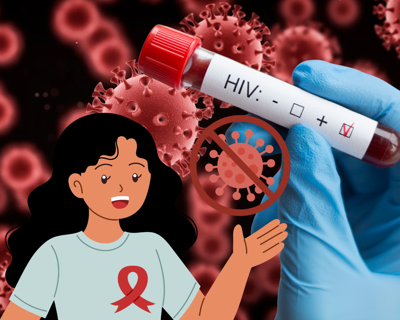


(Canva art by Amairani Hernandez.)
Over the past five years, Latinos have had the biggest rise in new human immunodeficiency virus (HIV) cases and are 72% more likely than the overall U.S. population to be diagnosed with HIV.
The Latino community is already disproportionately impacted by HIV, accounting for 32% of new HIV diagnoses in the U.S., despite only making up 19% of the population. If these trends continue, Latinos will account for the highest percentage of new HIV cases in the future.
Latino Health leaders are actively seeking ways to better engage and support their communities through forward-looking conversations about improving HIV prevention and care as the virus can lead to acquired immunodeficiency syndrome (AIDS), which is the most advanced stage of HIV infection if not treated.
Karla Torres, Senior Medical Liaison at ViiV Healthcare said that their mission aligns with the current challenges they see around HIV. “Our mission is to leave no one behind, no one who…is at risk of HIV or who is living with HIV behind,” Torres said.
She shared that one of the biggest barriers to raising awareness in the community is stigma, which limits open conversations, especially around mental health and sexual health. “You add in other layers, like language barriers, and even though many of us are bilingual, conversations that are important or difficult kind of resonate better in our first language. So sometimes that adds another barrier of difficulty,” she said.
Torres emphasized that having access to educational materials on sexual health in both languages is crucial. “Our community needs education in English and Spanish,” she said. “ViiV’s Healthcare has done a great job providing resources that address not only language needs but also material that is culturally appropriate in addressing the specific needs of the community.”
She also noted that Latinos use a wide range of terms and come from many different backgrounds. “It’s not only Mexicans—we also have Venezuelans, Colombians, and many others, and there are subtle differences that make it both a language and culturally sensitive issue. That sensitivity can be a barrier to addressing sexual health,” Torres said.
According to Planned Parenthood, about 1.2 million people in the U.S. are living with HIV, and more than 38,000 new infections happen every year. Most HIV infections happen through anal or vaginal sex or by sharing needles or other injection equipment. For some people, symptoms can take years to appear, so they may feel healthy and not realize they have HIV.
Torres told CALÓ News that there's a lot of arrogance and shame around the diagnosis, which makes it difficult for individuals to stay on treatment. “If you have a bottle of pills that you need to hide from people, that may make it difficult for people to take their medication and stay engaged in care,” she said.
Once someone tests positive with HIV, the virus stays in their body for life. Unfortunately, there’s no cure for it, but medicines can help individuals stay healthy. HIV medicine lowers or even stops the chances of spreading the virus to other people.
Torres shared that at ViiV Healthcare, they are bringing injectable options to the forefront. “I know my community struggles with stigma, the option of an injectable could be a really important tool,” she said.
Currently, they offer Apretude for prevention and Cabenuva for treatment. For many people, injectable treatment can feel like a more private and manageable option, especially for those who prefer not to disclose their diagnosis or who find it difficult to take a daily pill.
Karloz Torres, Vice President at Impulse Group, works to connect gay men with community resources. At Impulse, the organization focuses on four key areas: social justice, substance use, sexual health and mental health. They currently operate in 13 countries and have 26 chapters.
He shared that currently the level of HIV and sexual awareness within the Latino community is rough as there’s still a lot of stigma surrounding it. “People just don't talk about it and they avoid going to the doctor or they avoid getting tested,” he said.
At Impulse Group, they aim to bridge that gap by hosting events where people receive information on sexual health, drug interactions and consent before entering. “Go ahead and have fun, but don’t regret it later. That’s our main message,” Karloz said.
He also shared that a lot of people don't know the difference between HIV and AIDS. “They don't know that the medicine has gone so advanced that you can be undetectable and untransmittable and live a happy, normal life and that it's not a death sentence, it's just a manageable condition now,” he said.
According to Planned Parenthood, people usually look and feel healthy for a long time after they’re infected. It can take about 10+ years for HIV to show any symptoms and much longer for those who take HIV medicine.
Karloz said that changing the perception of HIV is crucial in bringing awareness into the Latino community. “It's important to let people know that with prevention and treatment, we can eliminate this disease because there's no reason why anybody should be getting it anymore other than they just didn't know [they have it],” he said. “If everybody's on the medicine or everybody is just aware of what's going on, we should be getting rid of this in just one generation.”
He also emphasized that getting tested regularly is really important, especially when individuals have had unprotected sex or shared needles. If someone becomes infected with HIV, they may feel like they have a fever, an ache and are sick. These flu-like symptoms are the body’s first reaction to the HIV infection. But HIV can be spread to other people, whether or not you have symptoms or feel sick.
Karloz shared with CALÓ News that there are still some misconceptions about getting tested for HIV. “People still think that if they see a testing van, they're going to be in there for an hour and they're going to get their blood drawn and they're going to be put in some database and all that. None of that is true anymore,” he said. He also noted that it now takes about five minutes to get tested and it's completely anonymous.
Karloz said one of the most effective ways to promote HIV awareness and reduce stigma in the Latino community is simply by starting conversations. He believes that today, people are craving genuine human connection now more than ever. “People are constantly on the phone and people just don't talk to each other anymore,” he said.
He also shared that they got rid of tabling at events because they were not working at all in promoting educational sexual health. Instead, they replaced it with little games that not only help build connection but also trust.
“We play a game that's educational, and you learn something you didn't know, and that's pretty much how we trick people into just having a quick conversation. It doesn't have to be long. All we need is two minutes and it'll really change people's perceptions and it could also change someone’s life,” Karloz said.








(0) comments
Welcome to the discussion.
Log In
Keep it Clean. Please avoid obscene, vulgar, lewd, racist or sexually-oriented language.
PLEASE TURN OFF YOUR CAPS LOCK.
Don't Threaten. Threats of harming another person will not be tolerated.
Be Truthful. Don't knowingly lie about anyone or anything.
Be Nice. No racism, sexism or any sort of -ism that is degrading to another person.
Be Proactive. Use the 'Report' link on each comment to let us know of abusive posts.
Share with Us. We'd love to hear eyewitness accounts, the history behind an article.