


(Canva art designed by Amairani Hernandez.)
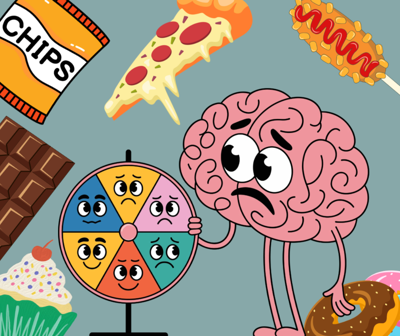
Everyday stress can trigger negative emotions that often lead to emotional eating, a habit that’s far more common than many people realize. In a recent interview with the Mayo Clinic,38% of adults say they've overeaten or chosen unhealthy foods in the past month because of stress.
Dana Henderson, a registered dietitian atL.A. Care Health Plan, said that cultural dynamics for all types of families contribute to emotional eating patterns. She also noted that these dynamics around food can be positive or negative.
When it comes to children, she explained that food is often used as a reward, creating an emotional connection to eating. At the same time, it can also be used as a form of punishment, reinforcing that emotional relationship with food even further.
“This can all vary based on the culture of the family, but because of this, everybody grows up with their own kind of unique connection with food, and whether food is a good or a bad thing can change emotional eating patterns for people,” she said.
Henderson told CALÓ News that emotional eating really comes from having such a deep emotional connection to food that it becomes a fixation rather than how someone's actually feeling in their own body. She explained that the most common stressors she sees leading to emotional eating in patients are stress, loneliness and boredom.
According to a study by theNational Library of Medicine, there’s an association between food insecurity and emotional eating among Latinos in the U.S., which is highly contributed to by stress.
Dr. Lisa Palmer from the National Association of Anorexia Nervosa and Associated Disorders (ANAD) shared that eating disorders in the Latino community don't get enough attention and also explained that emotional eating is not just a “white girl problem.”
For many Latinos, food carries deep cultural and emotional significance, often serving as a way to connect with loved ones without having to say words like “I miss you” or “I love you.” She also said that the relationship with food gets complicated for those raised between two cultures.
Palmer explained that many who were raised in a Latino household are often called out for not eating enough. But in mainstream U.S. culture, that message flips to “Eat less. Look smaller. Be thinner. Be perfect,” she said.
Henderson said she sees patients of all ages in her practice, but believes women are often more aware of when emotional eating is happening. “I think women just address eating in a different way than men. So typically, I see that women are more open to talking about it,” she said.
When it comes to addressing emotional eating without dismissing the cultural importance of food in Latino households, Henderson said it ultimately comes down to asking the right questions to better understand a person’s eating patterns, meal times, portion sizes, food quality and overall attitudes toward food.
“It starts with the actual nutrition quality of the diet and then really diving into the attitudes around food and then helping the individual to improve their attitude around food so that they don't emotionally eat,” Henderson said.
When it comes to distinguishing between physical hunger and emotional hunger, she said it’s often much harder than it sounds, but it first starts with listening to your body. “The big thing I tell people to do is really just pause and check in with how you're feeling. Is your hunger in your stomach, or does it feel like it's more in your head?” she said.
Henderson also added that another way to tell the difference is by recognizing when you’re craving something specific, which can often point to emotional hunger rather than physical hunger. “Outside of just the stomach, there are a lot of other signs that show physical hunger. Sometimes people feel really irritable; they might feel lightheaded or feel like their blood sugar is going low,” she said.
Some coping strategies to help manage emotional eating include stress-reducing activities such as exercising, practicing yoga or doing deep breathing exercises, Henderson said. When it comes to loneliness or sadness, she suggested journaling or calling a friend as helpful coping strategies. “The most important thing is that people identify their coping skills in general and know that those same coping skills are things they can lean on if they’re thinking about going to food when they don’t necessarily need it at that time,” she said.
She additionally shared that consulting a dietitian and a therapist go hand in hand, especially when it comes to emotional eating. “A really good dietitian will not try to be your therapist. A really good dietitian will refer you to a therapist if they feel it's necessary, and vice versa. A really good therapist will not try to be a dietitian,” Henderson said.
L.A. Care Health Plan and Blue Shield Promise Health Plan currently operate 14 Community Resource Centers throughout LA County where community members can access a variety of free classes, resources and support services, all designed to promote physical, mental, and social well-being.








(0) comments
Welcome to the discussion.
Log In
Keep it Clean. Please avoid obscene, vulgar, lewd, racist or sexually-oriented language.
PLEASE TURN OFF YOUR CAPS LOCK.
Don't Threaten. Threats of harming another person will not be tolerated.
Be Truthful. Don't knowingly lie about anyone or anything.
Be Nice. No racism, sexism or any sort of -ism that is degrading to another person.
Be Proactive. Use the 'Report' link on each comment to let us know of abusive posts.
Share with Us. We'd love to hear eyewitness accounts, the history behind an article.