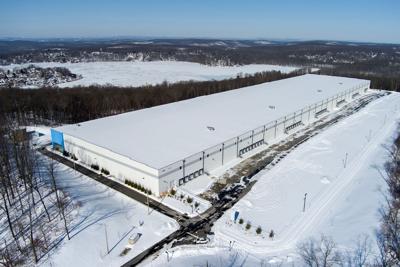
The warehouse is located in New Jersey’s Highlands region, a bucolic 1,300-square-mile stretch in the northern part of the state that spans from the Delaware River in the west, all the way to the New York border. The area is protected under 2004 legislation that created rules for water and wastewater usage in the area and limited development. Despite this, DHS in a January letter to the New Jersey Department of Environmental Protection (NJDEP), described extensive plans to transform the warehouse, including upgrading existing water and sewage systems or installing new ones.
The region is overseen by the New Jersey Highlands Water Protection and Planning Council, a body in charge of reviewing development applications for compliance with the legislation. Ben Spinelli, executive director of the council, told Bolts that the warehouse should have never been built in the first place because of its proximity to vernal pools and forest that are key to maintaining the quality and quantity of water that feeds into the state’s drinking water supply.
“Because this is a site that contains significant, important natural resources, that should have kept it from ever being developed anything close to the warehouse level, let alone a place where you’re going to house [people]—we have a number of towns in the region that don’t have 1,500 people living in them,” said Spinelli.
The warehouse’s previous owner, the Texas-based real estate investment firm Dalfen Industrial, bought the building in 2023 as a “last-mile” delivery site, but it has remained vacant since.
The facility has just four toilets and is approved to supply 12,000 gallons of water each day. But increasing the capacity for 1,500 people would require roughly 187,500 gallons each day and add more than fifteen times the amount of sewage currently processed by the facility, according to the lawsuit. Despite DHS needing approval from the New Jersey Department of Environmental Protection and the Highlands Council to complete the project, Spinelli said that the agency has not filed plans for changing the water system. The review of the site could happen quickly, he explained, but there would likely be new legal challenges to the final decision filed by the losing side that would stretch on for years.
“It’s not as easy as just signing off on a permit,” Spinelli told Bolts. “It’s a very complex multi- input system that you’re dealing with here.”
The lawsuit faults DHS for not getting the necessary approvals from the Highlands Council and NJDEP, as well as for violating the National Environmental Protection Act (NEPA), which requires federal agencies to work with state and local governments to ensure a project doesn’t harm the environment. That can include an extensive environmental impact report or a shorter assessment. DHS has done neither, according to the lawsuit.
Roxbury and New Jersey also claim that the Trump administration violated the Intergovernmental Cooperation Act, which stipulates that the federal government consult with state and local leaders about its plans. According to the suit, “DHS accounted for none of these views here, declining to discuss its plans with state and local officials before making its final decision, and failing to affirmatively solicit their views.”
In response to the lawsuit, the US Department of Justice, which represents DHS, said that it didn’t need to follow such approval policies because the project will have such minimal impact on the area that it qualifies for an exemption.They argue the increase in capacity could possibly require upgrades to the wastewater system but it’s too early to tell whether that will be the case and they’re not legally required to disclose those determinations at this point. DHS did not return requests for comment from Bolts.
DHS also has to contend with New Jersey laws aimed at preserving endangered species and the water supply that either prohibit development altogether or require a mitigation plan and public comment before approval.
According to a DHS memo on its warehouse conversion plan, the agency intends to open all of the new facilities nationwide by November 30, 2026. The Roxbury warehouse could be converted as early as June, according to the suit, though the lawsuit itself could delay things—on April 7, New Jersey and the town filed a motion for a preliminary injunction to stop work on the site. A hearing on the motion is set for May 12.
Though Roxbury has pointed to environmental concerns in its arguments against the warehouse conversion, local leadership has continued to support the Trump administration’s ramp up of immigration enforcement. Township Attorney Anthony Bucco, also a state senator, has sponsored the New Jersey Laken Riley Act, which would allow undocumented immigrants charged with crimes such as theft to be detained without bail. Advocates unsuccessfully called for Bucco’s removal as township attorney because of conflict of interest issues related to his support for pro-ICE legislation.
Representative Tom Kean Jr., a Republican representing Roxbury in Congress, has faced criticism from town leadership for his inaction on the project. Kean “did not engage to the level we had hoped to provide the advocacy our residents deserved,” the town wrote in its February press release announcing the DHS purchase. Since then, Kean has introduced The Local Taxpayer Protection Act, which would create a federal grant program for towns that lose property tax income or experience increased utility costs because of a DHS detention facility.
Earlier this month, Kean wrote a letter to Secretary of Homeland Security Markwayne Mullin imploring him to “take a deeper look” at the department’s plans for Roxbury. Potillo also extended an invitation to the DHS secretary but had not heard back as of publication.
Kean in 2022 defeated Democratic incumbent Tom Malinowski for the seat and is up for re-election in the swing district in November. His Democratic opponents have seized on his inaction, with one calling his sponsored legislation, which has not moved, a “bullshit bill.”
Roxbury’s fight against the warehouse mirrors similar battles state and local governments are engaging in as ICE attempts to carry out its plans to convert warehouses across the country into mega prisons. In many areas, local leaders have resorted to novel methods centered around environmental preservation to try to stymie construction.
In Social City, Georgia, a small town outside of Atlanta where ICE planned to incarcerate up to 10,000 detainees, residents put a lock on the water meter because the federal agency did not provide information about how water and sewage usage would impact the community.
Maryland Attorney General Anthony Brown in February sued over plans to create a processing facility in a Williamsport warehouse, citing similar concerns expressed in Roxbury about the facility’s effects on the local environment. Court filings showed the federal government’s environmental review, which determined that any adverse impact would be “minor,” took just a single day to conduct. A judge granted a request for a preliminary injunction earlier this month, ruling that the expedited review violated NEPA and ordering the federal government to conduct a more comprehensive environmental assessment.
Michigan also filed a lawsuit alleging that DHS ignored federal guidelines as it plans to build an ICE detention facility in the small city of Romulus, a suburb of Detroit—which local leaders similarly argue would harm the local water supply, economy, and public safety. Federal officials also completed a one-day environmental review there, finding that the property qualified for a streamlined analysis applicable to projects that “normally do not significantly affect the quality of the human environment.” They claim the detention center wouldn’t increase infrastructure needs, even as they note that it may need to expand the sewer system. The Michigan attorney general filed for a preliminary injunction in late March, with a hearing set for May 18.
“We’re seeing a lot of different uses—whether it’s through public pressure, economic pressure—the use of local government ordinances to say, ‘this is not the type of thing that’s going to be helpful to our communities,’” said Shayna Kessler, director of the Advancing Universal Representation Initiative at the criminal justice reform organization, Vera Institute of Justice.
In New Jersey, advocates are now pushing for nearby towns to pass ordinances restricting future warehouse conversions if ICE’s efforts in Roxbury fail and the agency chooses to build there instead. Project NINJA, the immigrant advocacy group opposing the warehouse, has compiled a list of 280 similar warehouses or vacant industrial buildings in the area for sale. The town of Sparta, about 12 miles north of Roxbury, unanimously passed an ordinance in March prohibiting the development of detention facilities. Sparta Mayor Dean Blumetti told Bolts in an email, “I will pass on the opportunity to discuss further. I will just state that we, the governing body, are always proud to have the opportunity to take action that reflects the wishes of our residents.”
Angus of Project NINJA said it’s been difficult to convince North Jersey Republicans to be proactive about stopping future ICE development in the area.
“There are things that they can do to protect their residents… but that has not found a very receptive audience, and it’s mainly because Republicans don’t want to criticize the Trump administration,” he said. “They’d rather stay out of it.”











(0) comments
Welcome to the discussion.
Log In
Keep it Clean. Please avoid obscene, vulgar, lewd, racist or sexually-oriented language.
PLEASE TURN OFF YOUR CAPS LOCK.
Don't Threaten. Threats of harming another person will not be tolerated.
Be Truthful. Don't knowingly lie about anyone or anything.
Be Nice. No racism, sexism or any sort of -ism that is degrading to another person.
Be Proactive. Use the 'Report' link on each comment to let us know of abusive posts.
Share with Us. We'd love to hear eyewitness accounts, the history behind an article.