
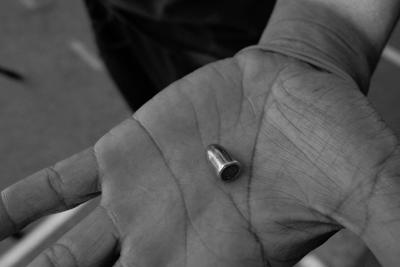


Jermaine Welch holding one of the bullets that missed him. Credit: Ben Camacho
This story is co-published with Inadvertent.
Los Angeles Police Department (LAPD) officer Nathaniel Beck exited his vehicle and charged across Broadway Avenue, baton in one hand and a .45-caliber Smith & Wesson in the other, toward the parking lots on 86th Place, where a block party had spilled into the early hours of June 3, 2020. He shot five times towards the crowds of partygoers, who had already been shaken up by another shooting about 6 minutes before LAPD showed up to the dimly lit neighborhood-adjacent lots. Beck, part of LAPD’s Community Safety Partnership (CSP), later struggled to keep his story straight during interviews with the department’s Force Investigation Division (FID) about who or what he shot at. Southeast Division detectives assigned to the incident circumvented any court oversight of a search warrant used to investigate a shooting victim and made the warrant untraceable.
LAPD made no mention of CSP’s connection to the shooting in early public messaging about the incident, despite the involved officers having intimate knowledge about the neighborhood — its gangs, its layout, its culture and people – through their work in the program. At the same time, CSP sat on the verge of becoming its own bureau, a move that would establish the community policing program as a core element of LAPD’s organizational structure. CSP’s connection to the shooting was never publicly mentioned until Inadvertent obtained records about the incident almost four years later through a lawsuit.
At the time of the shooting, LA was in the midst of a nationwide racial reckoning – the powder keg of racial injustice in the U.S. had once again been lit by police ultraviolence.
But before LAPD showed up to the party where the incident began, before the bullets flew, and before the fights broke out that night, it was June 2 in South Central Los Angeles, also known as Hood Day to the 62 (Six-Deuce) East Coast Neighborhood Crips.
In LA, Hood Day is a celebration. “It’s like a holiday for the hood,” said Jermaine Welch. “Get together, it’s a festival, just to see another homie that either just got out or either he got a job or he doing good, just to see another homie another year, because…what comes with the gang banging is you lose homies, so every year we celebrate the homies that we lost as well.”
Welch, 39 at the time, is a college graduate and former longtime member of Eastside East Coast Crips 76 Place Locs. He was in the parking lots that night on a marijuana delivery run when he found himself in one of several fights that broke out. Welch managed to get away from the crowd and into his car, a grey 2018 Dodge Charger. According to surveillance footage released through a separate lawsuit, he drove out of the south parking lot and turned left onto 86th Place towards Broadway Avenue when an unknown individual ran up to his car and shot him multiple times. Others joined in shooting at Welch as he drove away. He was hit six times: three times in his left hand, one time each in his chest, his face, and his back.
According to Welch, he took the nearby 110 South on-ramp while he was bleeding and beginning to lose consciousness and exited on Imperial Highway. Surveillance footage from a nearby gas station shows Welch stopped at a red light behind two Los Angeles Sheriff deputies. Welch stated that he flagged them down and told them he needed medical aid. The footage shows deputies pulling Welch out of his vehicle. LAPD records state that a radio call about a shooting victim came in at that time. Welch stated that the last thing he remembered was being on the ground with a deputy manipulating his thumb to unlock his phone.
“So I start asking, what are you doing, man? I’m shot. I’m bleeding and dying here and you’re treating me like a criminal,” Welch said during an interview.
Moments later, a neighbor called 911 to report the shooting. “There’s a lot of shooting going on,” said the unnamed, concerned Angeleno.
“Is it shooting or fireworks?” LAPD dispatch responded.
“No, they’re shooting, it’s going cling, cling, cling, cling, cling, cling, cling – because people are screaming,” said the resident.
When the report of this first shooting came in, Beck and his unit had been waiting at a red light on Broadway and Manchester Avenue, a block away from the party-now-shooting scene. They had been called back from the protests in Hollywood and were heading to a donut shop, according to LAPD records.
“That’s right here,” stated LAPD Officer Francis Coughlin, also part of CSP, as the dispatch alert about the shooting came through, according to FID interview transcripts. Officer Jeffrey Joyce, who was driving them that night, then made a right turn onto Broadway Avenue heading towards 86th Place.
According to his interview with LAPD detectives, Beck knew that this area was a “Hoover stronghold,” a reference to a nearby gang and their prominence in the area, and that there was an “ongoing rivalry” between some of the local gangs there. Coughlin had also been “working this area for twenty-five years,” according to his interview with LAPD detectives. Both were in the same car stopped at the intersection.
Both had their share of uses of force and police shootings prior to this incident and the CSP Bureau’s inception. And, according to department rosters, both are still assigned to CSP.
On July 28, 2020, about 7 weeks after the shooting, the CSP Bureau was announced. It primarily operates in the housing projects of the city of L.A. LAPD has been able to create a positive image of the bureau by organizing regular community events at the housing projects and largely avoiding coverage critical of the program. As a result, CSP’s involvement in the party shootout has flown under the radar. At the L.A. police commission’s meeting immediately after the shootout, the incident, and much less CSP’s role, was never mentioned. Buried in the FID interview transcripts that LAPD released in the lawsuit were sparse references to the Housing Authority of the City of Los Angeles (HACLA) and CSP.
Four years and two lawsuits later, LAPD was forced to comply with state law mandating disclosure of records pertaining to police shootings. Hundreds of records, including body worn camera footage, surveillance footage, property logs, investigative reports and officers’ FID interview transcripts showing how LAPD investigates its own uses of force, were disclosed. The scope of the records released appears to be one of LAPD’s largest disclosures of records pertaining to one incident, according to the city’s public records request portal. The records reveal key details about the incident that never made it to the public, and put into light the type of policing CSP officers take part in when the news cycle moves on.
LAPD’s public relations efforts obfuscated CSP’s role in shootout
In the weeks after the CSP Bureau’s formation, Deputy Chief Emada Tingirides had been generating buzz about the program in local media. The bureau’s inception came with a promotion for Tingirides – from captain to deputy chief and head of the bureau, all handed to her from then-Chief Michel Moore. She became the second Black woman in LAPD history to reach the rank of deputy chief.
In the media, neither reporters nor Tingirides brought up the shooting, despite CSP officers being involved and it happening near the Avalon Gardens housing project, a HACLA and CSP location. Missing from all of the relevant reporting about CSP at the time of it becoming a bureau was that an officer assigned to what was LAPD’s newest, shining example of community policing got into a shooting with residents at a neighborhood block party.
Had the public known this before, what would they have said about CSP, as it sat on the verge of becoming its own bureau?
Tingirides did not respond to repeated requests for comment.
The Community Safety Partnership began about 15 years ago under Chief Charlie Beck. In 2020, the Los Angeles Times reported that around the time of CSP’s inception, Chief Beck became aware of Tingirides’ community policing strategy that involved bringing police into schools to read to children. Tingirides lauded the CSP concept as “not just a police concept,” but as a way for the LAPD to address police violence.
Dr. Melina Abdullah, a professor at Cal State LA and co-founder of the Black Lives Matter LA chapter, stated in a phone interview: “If you talk about ‘community public safety’, that should begin with community, not police.”
She added that LAPD elevating CSP to a bureau and knowing about the incident, confirmed what she says people already know: “that the LAPD is an absolute, untrustworthy, lying organization with a history of lying, or current practice of lying.”
LAPD Media Relations Division stated that they are unable to say anything beyond what is in the reports released to Inadvertent and that they “do not have additional details regarding…the timing of the Community Safety Partnership’s involvement being disclosed.”
LAPD also said that the chief of police is made aware of incidents via a “chain of command that begins with the command staff from the bureau of occurrence.” LAPD did not answer a question about how soon Moore knew about the incident.
Moore did not respond to a request for comment.
Dontavis Marshall, who Officer Beck shot in the face that night, summed up his experience as he bled on the ground while LAPD arrested him: “This is exactly why there’s a gang of protests going on.”
In LAPD records, the June 3, 2020 shooting is documented as “FID 025-20,” a single incident that largely received coverage typical of television news networks. Newscasts on Fox 11 and KTLA that have historically shaped the public’s perception of L.A. south of the 10 freeway offered narratives such as: A shooting happened in South Central L.A.; LAPD responded; people have been arrested. News crews did not interview any witnesses and relied on LAPD for information.
Weeks after the incident, LAPD uploaded a critical incident video to their YouTube channel. Dubbed by the police commission as an effort to create “transparency” and “[foster] greater public trust,” critical incident videos are typically the first sources that the public has access to when looking for more information on police shootings beyond a press release. They feature body-worn camera footage, 911 call audio, mugshots, and a narrative read by an LAPD officer. CSP was not mentioned in the critical incident video pertaining to the shooting.
“This was what Los Angeles does, which is try to create an image of ‘gentle policing’, when in actuality all policing – but especially policing in Los Angeles – is absolutely brutal,” Abdullah added.
LAPD recounted moments from the shooting in the critical incident video but left out key information: Beck and at least five other individuals on 86th Place were having a shootout, and LAPD quietly let those shooters slip right past them moments later. Analysis of the footage, which included finding the correct timestamp on LAPD’s footage to be able to compare different angles of the events as they actually happened, made apparent why none of the other cops joined in shooting at the partygoers, despite all saying they heard bullets impacting a rollup door behind them upon approaching the scene: Shooting back would have meant shooting into a crowd and a neighborhood.
The same neighborhood where the resident who called 911 in the first place lived.
Despite all of that, Beck charged on and shot five times at a target that he struggled to describe consistently in various instances. His first description, primarily focused on what the target was wearing, was a male wearing a white shirt and a gold chain. His second description: a male wearing a blue shirt and a hat. Then, in interviews with detectives from LAPD’s Force Investigation Division (FID), Beck first said he could clearly see his target. But in his second description he said he was not able to see him. When describing the scene a third time, he mentioned it being “dark.” Ultimately, he, again, said he was able to clearly see him.
Minutes after the shooting Sergeant Paul Rodriguez asked Beck: “Who are the suspects that you got into a shooting with?”
Beck never answered the question but after a short silence said, “Honestly, sir, I was– they were firing over this way,” as he gestured with his hand in a right to left motion.
Other officers interviewed by FID could not specify who or what Beck was shooting at.
Beck did not respond to repeated requests for comment.
LAPD’s inconclusive investigation revealed through records released
The FID interview transcripts show how FID detectives look at inconsistencies in other officers’ stories about uses of force. In Beck’s second interview with FID, which was much shorter than the first one and happened ten days after Firearms Analysis Unit’s (FAU) bullet analysis issued a report concluding that Beck’s bullet was pulled out of Marshall’s face, FID Detective Macchiarella stated that he had “asked to conduct this second interview just regarding some things [he needed] some clarity on.”
He first asked Beck in the second interview about Beck’s non-answer of Rodriguez’s question about who he was shooting at, “...so if you could just give us more details on what you’re referring to as you pointed and described, you know, who it was you were shooting?”
Beck responded with, “As explained before, there were multiple people firing when we arrived. The guy that I addressed was in the direction that — that I had referenced in the video, sir.”
Macchiarella followed up with “So how is it that when the sergeant asked you who the suspect was you were shooting at, and you said, ‘He was firing over this way,’ and then later on you told us that the suspect was pointing his gun at you and firing, if you can explain?”
Before Beck answered the question, his attorney David Winslow said, “And explain what you saw, because he’s telling you what he saw in the video. Tell him what you saw you doing with your hands in the video.”
Beck prefaced his answer with a statement about the “chaotic” nature of the situation. He also is interrupted by his attorney as he is explaining why he has “differing” statements. Beck then said that his gesture was describing where the gunfire was coming from. His attorney asked him if he was trying to show the direction of the gunfire or where the suspect was. Only in response to this question, Beck said that he was describing where the suspect was, as well as all of the other shooting happening at the time.
Macchiarella also inquired during the second interview about Beck’s various statements about not being able to see the person he shot at. Beck answered stating that he only meant that he could not see the person’s face very well.
LAPD stated that there can be “a number of reasons” why an officer would be interviewed twice, such as Beck was. Despite multiple requests for specificity, LAPD refused to state why Beck was interviewed twice for this investigation. However, FAU’s report having concluded that Beck shot Marshall, and Beck’s multiple statements about not seeing his target, points to why FID returned to interview Beck; LAPD did not immediately know that Beck had shot someone that night, and it certainly was not clear from Beck’s description of events.
According to a report that lists LAPD shootings, the types of firearms used by police in the shootings, and whether someone was hit with a bullet, listed the June 3, 2020 shooting as a “No-Hit.” LAPD refused to directly answer why the shooting was recorded as one without any LAPD shooting victims, but the city attorney’s office said in a letter to Inadvertent’s counsel, “It was not until ballistics confirmed the round that struck Mr. Marshall was fired from Officer Beck’s gun that the incident was changed to an ‘OIS-Hit.’”
In the end, Beck stated that his target was in the middle of 86th Place, between the entrances to both parking lots, approximately 50 to 70 yards in front of him, precisely where the dark sedan full of shooters they let slip past was idling.
Officers Coughlin and Jesus Ruiz also stated that Beck appeared to be shooting in that direction.
After the shootout, Beck and the other officers positioned themselves at 86th Place and Broadway, facing the direction of the parking lots. The car with whose passengers Beck had a shootout approached slowly, and neither Beck nor the individuals in the car said or did anything as it slow-rolled past LAPD, turned south on Broadway and left the area without further incident. Moments after, Marshall managed to drive away from the parking lots with a bullet lodged in his face. In a recorded interview with detectives, he described it like being hit with a “sledgehammer.” Analysis of the surveillance footage showed two individuals jumped into the Marshall’s backseat. He drove east on 86th Place and made a left turn to go north on Main Street when LAPD Officers Yolotsi Jaral and Gregorio De La Rosa, who were on Main Street, saw him turn as he tried leaving the area along with everyone else at the party.
“That’s our guy,” said De La Rosa and began a pursuit.
In the critical incident video, LAPD highlighted guns that were thrown from Marshall’s car during the pursuit. An arrest warrant for Marshall showed that he, at one point, was wanted for assault with a deadly weapon on a police officer, however, the District Attorney (DA) did not find evidence of this due to the gun, a Ruger 9mm, that Marshall’s DNA was found on not being linked to the shots that were fired in the direction of Beck and his unit.
When Marshall got to 80th Street, he turned right. Halfway down the block, two firearms were thrown from the vehicle and landed on opposite sides of the street. LAPD and the DA’s office records regarding the locations of the firearms are inaccurate. According to them, the pistols, a 9 millimeter Ruger P85 and a 9 millimeter Taurus G2C, were located at 160 West 80th Street and 143 East 80th Street, respectively.
Marshall never drove on West 80th Street. The correct address for the Ruger’s location is 160 East 80th Street.
While seemingly innocuous typographical errors in record keeping, the incorrectly recorded locations of the pistols presented other questions that led to new insights about the shooting: LAPD struggled to provide the DA’s office with conclusive results about the incident. Despite dozens of bystanders, witnesses, and victims detained, dozens of police officers present, multiple gang detectives, the Firearms Analysis Unit, and Force Investigation Division working the case, the District Attorney’s office ultimately stated that they could only infer that “Marshall possessed a firearm” before Beck shot towards the crowds.
Underreported and rare: shadow warrants ripe for abuse
In the days after the shooting, LAPD began obtaining search warrants from the Los Angeles Superior Court (LASC) for physical and digital belongings such as cars, cell phones, and data. Welch, the shooting victim who was on a delivery run that night before LAPD showed up, received two search warrants on different days. The first search warrant, issued on June 3, 2020, was for his vehicle and alleged evidence inside of it. The second search warrant, dated June 25, 2020, was for his phone, texts, emails, notes, voicemails, attachments, images, location data, social media posts, Wi-Fi logs, internet history, financial information, address book/contacts, bluetooth devices, passwords and more.
LAPD misused the search warrant they used to investigate Welch, withhold his cell phone from him and access personal data. The California penal code requires police agencies to return search warrants to the court after use, experts say, in order to “audit” the search and ensure that the police’s search remained within the search warrant’s scope. This was not the case with the search warrant handed to Welch on June 25, 2020 – LAPD never returned the warrant to the court. Not doing so made the warrant virtually untraceable, a shadow warrant, because the court does not issue an identification number, Inadvertent found, for search warrants until after they are returned. The public cannot ask to see that warrant because the court cannot locate it without the identification number and LAPD’s search conducted cannot be audited by the court.
The Los Angeles City Attorney’s office claimed that LAPD never used the search warrant handed to Welch, despite video evidence showing LAPD using the June 25 search warrant as the reason for withholding his property.
Data Inadvertent obtained through a public records request shows that LAPD failed to return search warrants to the court at least 34 times in 2020. From 2017 to 2021, the Southeast division failed to return a search warrant 52 times. Updated data from LAPD was never released.
The LAPD’s Detective Bureau, through the public information officer, refused to comment on the unreturned search warrants.
The Los Angeles Superior Court (LASC) stated that they do not keep statistics on search warrants, whether returned or unreturned. The court also declined to answer questions regarding the requirements to obtain a search warrant, how many search warrants are issued annually by LASC and how the court keeps track of unreturned warrants.
To LAPD, Welch was a suspect. His car, clothes, and phone were seized on the night of the shooting. Notably, his shoes feature a portrait of Nipsey Hussle. On June 25, 2020, Welch went to the LAPD Southeast station to demand his phone and clothes be returned to him. At the time, no search warrant had been issued nor given to him. Inadvertent documented the exchange between Welch and the detectives on video. Welch asserted that LAPD was violating his Fourth Amendment rights because he was a shooting victim, and no warrant existed for his phone and data.
At first, Detective Aaron Harrington stated: “Yes, we have a search warrant for your phone. It’s getting signed by a judge right now.”
Harrington would continue to withhold Welch’s property and engage in heated conversation with him. As Welch continued to demand the return of his property, insisting that his Fourth Amendment rights were being violated, Harrington changed his statement to “We’re getting a search warrant for your phone.”
At one point, Harrington went back into the station and his superior, Peter Verscherun, emerged with a search warrant. The warrant showed a judge’s electronic signature and a timestamp of 11:52 a.m.
Welch’s demands began at approximately 11:38 a.m, almost 14 minutes before the warrant was issued.
Welch backed off from his demands after being handed the warrant.
“That made me feel violated, it made me feel cheated, it made me feel like despite my efforts of trying to give back to the community and do right, they still treated me as like the lowest of the lowest,” said Welch during an interview, referring to his advocacy promoting college to the youth.
“One of the problems is all judicial records are presumed to be public records – so you have police going to a judge, having a judge sign off on a warrant, and then at that point, that judge isn’t responsible, and the court system isn’t at all responsible for keeping track of that warrant,” stated Colleen Flynn, a civil rights attorney.
“It’s only when you put the trust in the officer that they’re going to go execute the warrant and return the warrant and only at that point does the warrant get a warrant number and then become a document that the clerks can actually find and give to the public – is hugely problematic,” Flynn added.
Where are things now?
Six years have passed since California’s Right To Know Act (SB 1421) went into effect, the law that opened up records pertaining to police shootings and certain types of misconduct to the public. SB 1421 is one of the only tools that the public and reporters can use to better understand the inner workings of police departments — agencies that are typically heavily funded by taxpayers and whose employees enjoy legal protections not granted to other public employees or civilians.
The LAPD did not provide an answer as to why they do not disclose police shooting records in full and typically only release executive summaries or just critical incident videos. To this date, the LAPD, one of California’s largest police departments and responsible for policing a population of over 3.8 million, fails to meet SB1421’s requirements in almost every request.
“It’s only when you put the trust in the officer that they’re going to go execute the warrant and return the warrant and only at that point does the warrant get a warrant number and then become a document that the clerks can actually find and give to the public – is hugely problematic,” said civil rights attorney Colleen Flynn.
The full scope of records relating to the June 3, 2020 shooting were withheld for almost four years, long past any statute of limitation that the public may have had in relation to bringing a civil rights claim. The delay, which the LAPD never explained, shuts the public out from learning, outside the LAPD’s narrative, about how communities are policed in the city of Los Angeles. Unless the public contracts lawyers or is informed about their rights under the California Public Records Act, and the department complies, the access to records pertaining to police shootings and serious misconduct is still limited despite state law.
Since the start of this investigation, the LA Superior Court has moved to a digital system for tracking search warrants, but their identification numbers are still assigned only after the warrant has been returned. This means that police agencies can still misuse warrants and avoid search audits, all while the public has no way of even knowing that a search warrant was issued.
Shadow warrants are still largely underreported, with the only coverage being a 2006 article in the Baltimore Sun titled “Unreturned warrants indicate a bigger issue.”
A 2023 self-audit of its search warrant practices found that LAPD had met its standard of timely service of and return of search warrants. However, the self-audit did not look into specific aspects — such as inconsistent information or the legality of executions of warrants — that would still allow for the creation and use of shadow warrants.
This project was made possible with the LA Press Club’s Charles M. Rappleye Investigative Journalism Award. A short documentary about “shadow warrants” can be found here.




(0) comments
Welcome to the discussion.
Log In
Keep it Clean. Please avoid obscene, vulgar, lewd, racist or sexually-oriented language.
PLEASE TURN OFF YOUR CAPS LOCK.
Don't Threaten. Threats of harming another person will not be tolerated.
Be Truthful. Don't knowingly lie about anyone or anything.
Be Nice. No racism, sexism or any sort of -ism that is degrading to another person.
Be Proactive. Use the 'Report' link on each comment to let us know of abusive posts.
Share with Us. We'd love to hear eyewitness accounts, the history behind an article.