

This story was originally published by LAist.
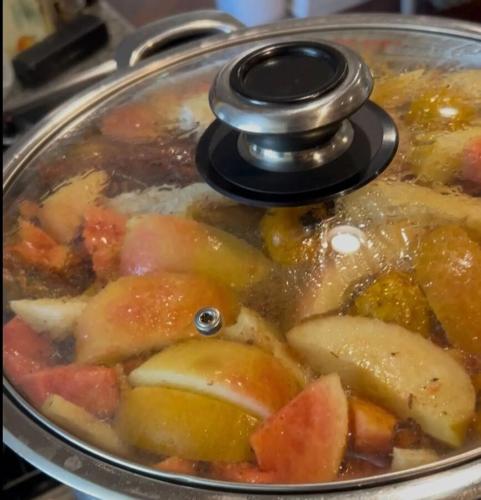
Last Sunday, I took out my big 16-quart pot to make a batch of ponche for my family, friends, and a few LAist colleagues. It’s something I’ve made regularly over the years — a warm fruit punch simmered for five hours that’s popular from Central America to the U.S. The nine days before Christmas, through Jan. 6 are traditionally peak ponche-making days.
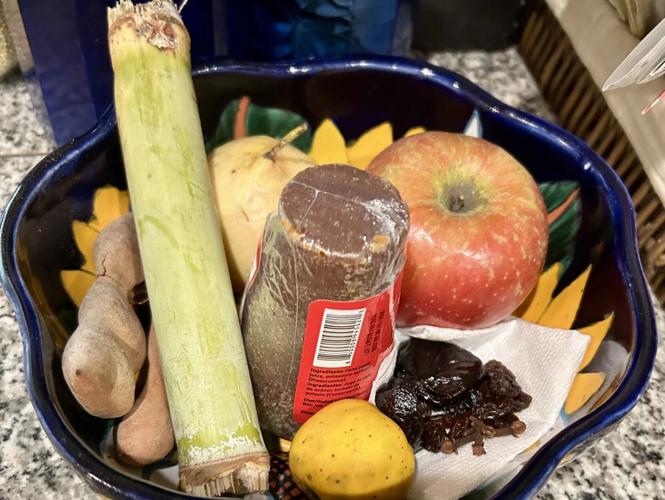
My recipe, one of many variations, includes guayabas (guavas), apples, tamarind, cinnamon sticks, raw sugar cane, piloncillo (unrefined sugar), prunes, tejocotes (Hawthorn apples), raisins, and cloves.
Smelling the result of the long simmering of these ingredients makes me play a game: What fruit aromas do I recognize, and which ones are blends of multiple ingredients?
(You can find the full recipe at the end of the article. Feel free to modify as you please).
My strongest ponche memories are from my teens and 20s, going to my aunt’s house in Tijuana during the Christmas season and on trips to Mexico in December. Many of those relatives have since died or have moved far away.

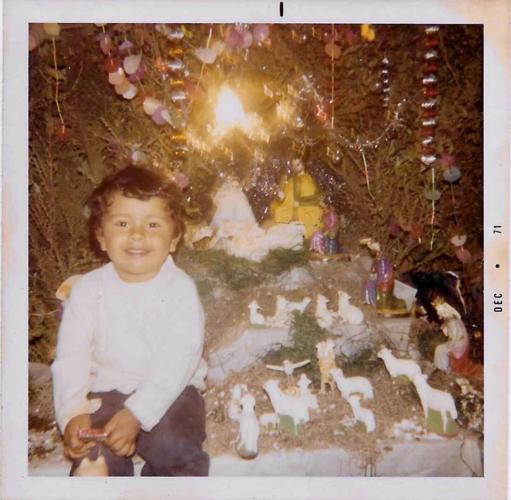
LAist correspondent Adolfo Guzman-Lopez, as a young boy in Mexico during the holidays. (Courtesy Adolfo Guzman-Lopez)
When I moved to L.A. County, at 31, leaving behind my immediate family in San Diego, I reached out to my Mexican relatives to get their ponche recipes. I wanted to recover those supportive feelings of family conversations, relatives who'd known me since I was a kid, and talks with cousins about being Mexican away from Mexico.
What I found is that making ponche in my new home over the years did much more than that. It’s become a way to create new, good memories with my wife and children, friends and colleagues.
Ponche is a melding of traditions
By some accounts, ponche’s origins are embedded in the name, which is said to be rooted in the word in India for five, a reference to the five ingredients in a drink Europeans brought back to their countries hundreds of years ago — alcohol, lemon, sugar, water and spices.
That drink was brought to what is now Mexico and Central America, where people incorporated what was grown locally.
Which may explain why the drink has such an eclectic set of ingredients today. Think about the trek those fruits and spices have made: prunes originally from Asia, raisins from the Middle East and guavas from Southern Mexico and Central America, to name a few.
The annual challenge

Fruit-filled ponche is simmered for about five hours. (Adolfo Guzman-Lopez/LAist)
When I set out to make this year’s batch of ponche, I immediately encountered the usual challenge: finding ripe, fragrant guavas at the end of December. Supermarket guavas, more often than not, are sold green and don’t give my ponche the zing I look for.
The search for ripe guavas pushed me to foraging in recent years. There were guava trees in front yards in my neighborhood and I’d pick the fruit and freeze it about a month before making ponche.
But now one of those trees has been cut down and the other is barely a stump. So this year, I felt like I had no choice but to buy supermarket guavas.
I was on my way to Gonzalez supermarket in Long Beach, when, a block away, I spotted a different guava tree in someone’s front yard. I parked and talked to the man sitting on the porch. He told me he was originally from Mexico, is a landscaper and says he waters and gives the tree vitamins. He was gracious and picked a bagful for me to take. He said people come and take the fruit but he likes it when people ask.
A warm hug
Armed with peak guava, I began my prep on Sunday morning, washing and chopping the apples and guavas and painstakingly peeling the tamarind. By the afternoon I was ready to welcome guests, like my colleague Yusra Farzan, who covers Orange County.
“This ponche is like a warm hug. I'm feeling it in my fingers, in my toes,” she said, adding that she liked chewing on the sugar cane slivers in the drink.
Gab Chabran, LAist's food and culture writer, grew up in a Latino household but didn’t try ponche until he was an adult, because his parents aren’t big fans of warm drinks. Still, he said there was something distinctively familiar about it.
“It was the flavors of cinnamon and apple, which reminded me of the holidays, mixed with the tropical nature of the guavas and the tejocotes along with the tamarind,” he said. “Something about them mixed together, it's just so comforting and warm. I feel like I could drink it all year long.”
For others it was a new spin on an old tradition. “It's different from what I make,” said Erwin Cox, who grew up in Guatemala. The ponche he drank as a kid had a pineapple base, instead of guavas. He liked mine — I want to try making his.
As for the food that went with it — for many years when I was growing up, ponche went along with tamales. But now some of my traditions have changed. On Sunday I made latkes to celebrate the first night of Hanukkah, part of the Jewish traditions I’ve adopted from my wife and her mother and father’s families.
And there was ponche, accompanying me along the way, seeing time pass and changing along with me.





















(0) comments
Welcome to the discussion.
Log In
Keep it Clean. Please avoid obscene, vulgar, lewd, racist or sexually-oriented language.
PLEASE TURN OFF YOUR CAPS LOCK.
Don't Threaten. Threats of harming another person will not be tolerated.
Be Truthful. Don't knowingly lie about anyone or anything.
Be Nice. No racism, sexism or any sort of -ism that is degrading to another person.
Be Proactive. Use the 'Report' link on each comment to let us know of abusive posts.
Share with Us. We'd love to hear eyewitness accounts, the history behind an article.