
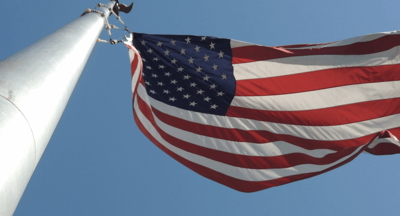


White nationalist ideas once at the margins of U.S. society are increasingly shaping mainstream political debates and legislation.
How are these ideologies rooted in Christian nationalism becoming normalized in public discourse, and what does their spread mean for American democracy?
“The immediate cause was the election of the first nonwhite president in U.S. history, Barack Obama, but white nationalism had been gaining prominence in mainstream politics before that,” with roots in Christian nationalism, explained Sanford F. Schram, lecturer in political science at Stony Brook University. “A lot of people in this group embrace the idea that white identity is threatened.”
Sanford F. Schram, Adjunct Lecturer in Political Science, Stony Brook University (SUNY) and co-author of “Hard White: The Mainstreaming of Racism in American Politics,” discusses white identity politics and its role in shaping the current Republican party.
Schram explained that decades before Barack Obama’s election catalyzed white nationalist backlash, however, Reagan-era figures like Pat Buchanan were already introducing “a sanitized version” of Ku Klux Klan leader David Duke’s rhetoric into GOP politics: “Eventually, you get the Tea Party rising up in reaction to Obama, and Trump taking it all the way to the White House in a rising tide of white resentment politics, especially regarding immigration.”
Christian nationalism has been driving this acceleration, particularly over the last decade since President Trump’s first winning campaign.
“If you’re a Christian nationalist, it means you want a theocracy in America in some way, shape or form,” explained Heath Druzin, journalist and host of the podcast “Extremely American,” covering the mainstreaming of extremist movements. “You don’t simply want to be free to practice your religion … You want the government to be based explicitly on Christianity.”
“The rise of social media has made things happen in months rather than years,” he added. “People get echo chambers and say things that you might not say if you’re talking to somebody face to face … you can be anonymous, and you don’t have to deal with face-to-face backlash.”
Until the early 1990s, about 90% of U.S. adults identified as Christian. Today, about two-thirds of U.S. adults identify as Christian.
A 2020 Gallup report found that U.S. church memberships had dropped below 50% for the first time in the 83 years since measuring began.
Heath Druzin, journalist and host of the “Extremely American podcast,” covering the mainstreaming of extremist and militia movements as well as Christian nationalism, discusses patriarchal and misogynistic beliefs within the Christian nationalist movement.
“When the religious right in the 1980s and 1990s said ‘We’re the moral majority, and if we can just get Christians voting the way that we want them to vote, we can take over American politics,’ that wasn’t a crazy thought,” said Dr. Matthew D. Taylor, a senior scholar of Christianity at the Institute for Islamic, Christian, and Jewish Studies (ICJS).
“The people who are still identifying as Christian, especially the ones who want to hold on to notions of Christian nationalism and some essential Christian character to the United States … They’re feeling more and more like a minority,” he added.
A 2023 Pew poll found that 35% of U.S. adults don’t identify with the religion in which they were raised.
“MAGA is that intersection of the white majority and the Christian majority saying ‘We don’t want to become minorities, and we’re going to do everything we can to claw back our cultural dominance,’” said Taylor.
Since 2015, he continued, the MAGA movement has drawn upon a Calvinist form of Christianity promoted by Evangelical pastor Douglas Wilson, a self-described Christian nationalist based in Moscow, Idaho.
Trump-appointed U.S. Defense Secretary Pete Hegseth has particularly close ties to Wilson — who has voiced opposition to same-sex marriage and women’s suffrage — as part of a church that the latter cofounded.
Devin Burghart, Executive Director of the Institute for Research & Education on Human Rights (IREHR) and co-author of “Breaching the Mainstream: A National Survey of Far-Right Membership in State Legislatures,” explains why fringe, far-right ideas have been embraced by many in mainstream politics.
A 2022 report published by the Institute for Research & Education on Human Rights (IREHR) documented 875 state legislators serving in 2021 who joined “at least one of 789 far-right Facebook groups” including militia organizations, COVID-19 conspiracists, QAnon theorists, white nationalist groups and antisemitic groups.
These lawmakers represent 11.85% of all state legislators in the U.S., and all 50 states.
“When you have state legislators providing that stamp of approval to these groups … it provides a pipeline for those ideas once confined to the margins to be directly pumped into the mainstream and now to become public policy,” said Devin Burghart, executive director of IREHR.
“For instance, when I started doing this work, I used to hear (about politicians) out in a backwoods militia meeting talking about chemtrails,” he continued. “Now, two states have adopted laws against geoengineering using the same conspiracy theories that were once considered laughable at best.”
Alongside Tennessee and Florida, at least six other states have introduced chemtrail-coded legislation to prohibit geoengineering.
Matthew D. Taylor, Ph.D., Senior Christian Scholar at the Institute for Islamic, Christian, and Jewish Studies (ICJS) and author of “The Violent Take It By Force: The Christian Movement That Is Threatening Our Democracy,” describes the three dominant forms of Christian nationalism that guide the far-right, including the Trump administration.
“The larger ideological underpinning that provides so much glue to so much of this is middle-American nationalism,” Burghart explained. “It’s the idea that white middle Americans are being squeezed from above by elites and from below by the multicultural hordes, and out of that comes the grounding for the conspiracism that we hear today, as well as the pushes for massive militarized crackdowns on undocumented immigrants, or pushes for legislation attacking the LGBTQ community … and the larger civil rights struggle.”
“Of instances where far-right populist movements wedded to religious nationalist movements are overturning democracy, the U.S. is just one outpost of a broader global trend. We’re seeing this in India, in Turkey, in Russia,” added Taylor.
“What works to defeat those things is the biggest tent coalition you can build of people who want to protect democracy and protect the equality of everyone, and that coalition needs to not have any purity tests or shibboleths,” he added. “If we don’t have a democracy, all those other disagreements are basically moot, because no one on our side will like what the far right does when they are in power.”





(0) comments
Welcome to the discussion.
Log In
Keep it Clean. Please avoid obscene, vulgar, lewd, racist or sexually-oriented language.
PLEASE TURN OFF YOUR CAPS LOCK.
Don't Threaten. Threats of harming another person will not be tolerated.
Be Truthful. Don't knowingly lie about anyone or anything.
Be Nice. No racism, sexism or any sort of -ism that is degrading to another person.
Be Proactive. Use the 'Report' link on each comment to let us know of abusive posts.
Share with Us. We'd love to hear eyewitness accounts, the history behind an article.