
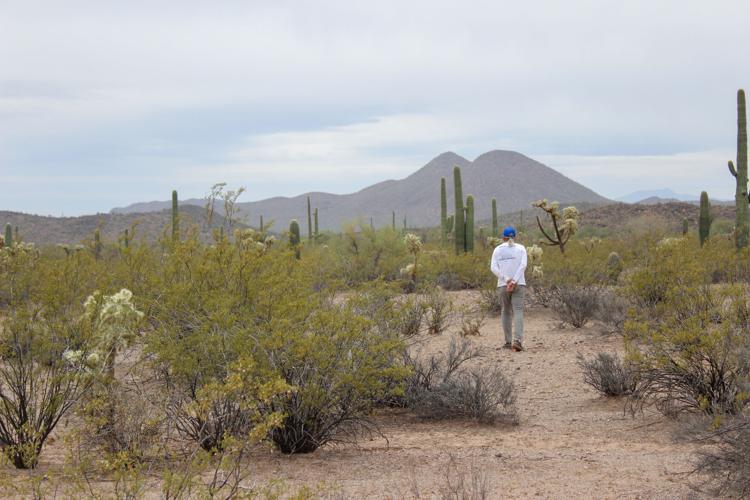
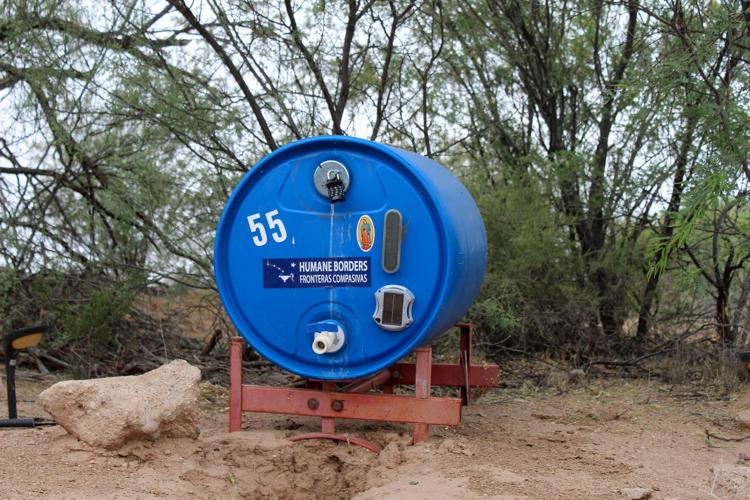
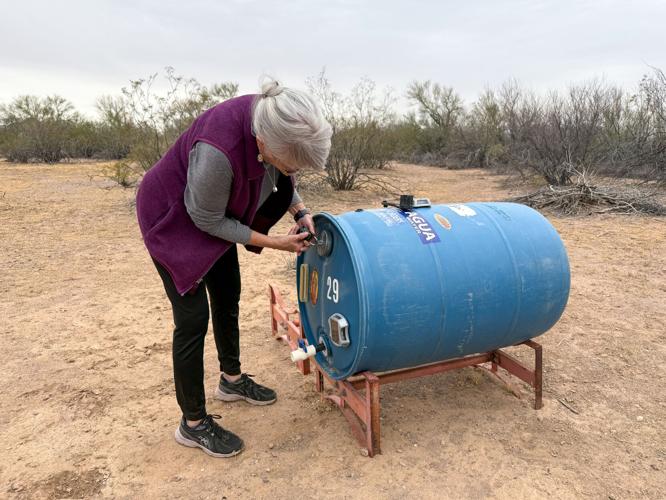



Humane Borders, a Tucson-based nonprofit and nonpartisan organization, sets stations of blue water barrels in remote areas of the desert in an effort to prevent migrant deaths. (Genesis Lara/ACLU of Arizona)
After navigating a maze of dirt roads and gates, Steve Chapman drove a group of volunteers to a Humane Borders water station in the desert near the western edge of Tucson.
He walked new volunteer Sheilah Britton through replacing a bright blue water barrel, while board chair Laurie Cantillo scanned the desert for signs of recent crossings.
Migrant apprehensions along the southwest border have remained at record lows, according to data from U.S. Customs and Border Protection (CBP), even as they ticked up 25% last month. But some humanitarian workers along the border are focused on another piece of data: the number of people dying in the desert.
Humane Borders, a Tucson-based nonprofit that installs water stations in the desert, was founded in 2000. In its Fiscal Year 2000, CBP recorded approximately 1.6 million migrant encounters along the southwest border. That calendar year, at least 75 migrants died in Arizona, according to Humane Borders’ migrant deaths map.
In 2025, there were roughly 443,600 migrant encounters along the southwest border. Despite far fewer crossings, there were at least 108 deaths.
“We still have a lot of people dying in the desert and our sense of outrage, our sense of shock, our sense of horror seems to be gone,” said Humane Borders operations manager Joel Smith, referring to the public sentiment.
Smith, a Marine Corps veteran whose father served in the Air Force, spent part of his childhood in Germany — an experience he said gave him a firsthand understanding of what it means to be a foreigner in another country.

Sheilah Britton unlocks a barrel to test the water for particles and temperature — a process that helps Humane Borders ensure that the water remains safe for drinking. (Genesis Lara/ACLU of Arizona)
“Over there, I was the outsider. I was the one from somewhere else and that’s something most Americans have never experienced,” he said.
Now, his work with Humane Borders helps Smith return to an ideology that he grew up with — helping others.
“We were never scared of foreigners. We were trying to help the world at one point in time,” he said of the United States. “Somewhere along the line, something went horribly wrong. We went from wanting to help the world to wanting just to be away from the world.”
The making of a 1,951-mile death trap
In the 1990s, the United States focused on “prevention through deterrence”: heavily militarizing urban border areas to block unauthorized entries. That strategy — which included policies like Operation Safeguard in Arizona — has redirected millions of migrants to more treacherous, deadly paths that persist today.
Sarah Mehta, the deputy director of government affairs for the ACLU’s Equality division, pointed out a major flaw in those types of strategies.
“You can’t have a deterrent effect that is effective for people who are coming to seek safety, who have no other choice but to come here,” she said, of people fleeing violence in their home countries. “And I think, for some, cruelty is the point.”
Humane Borders updates its migrant deaths map based on data compiled by the medical examiners in Pima and Maricopa counties. Greg Hess, the Pima County chief medical examiner, whose office oversees bodies recovered from Pima, Santa Cruz and Cochise counties, noted that keeping an accurate count of migrant deaths is inherently difficult.

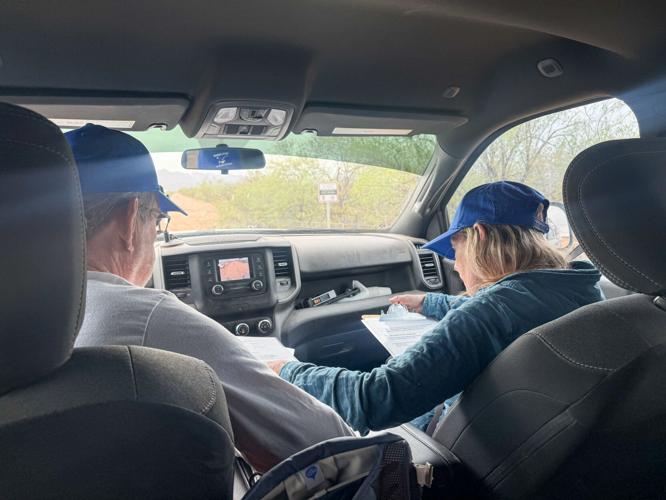
Steve Chapman and Laurie Cantillo look through a series of maps and instructions to navigate the route from one water station to another. (Genesis Lara/ACLU of Arizona)
Given the approximately 400 miles of U.S.-Mexico border in Arizona alone, many bodies are never recovered from the Sonoran Desert. And with no comprehensive federal system to track migrant deaths after entry, an unknown number go unaccounted for entirely.
Mapping and following the data
When migrant remains are discovered in the desert — often found by U.S. Border Patrol agents, outdoor recreationalists and humanitarian workers — local authorities are alerted and the death is added to the Humane Borders map. It is one of the few tools working to fill a critical gap.
The map offers a small glimpse into the last moments of thousands of lives. It helps Humane Borders determine where to install more water stations to prevent additional deaths in the desert. And it allows the Pima County Office of the Medical Examiner (OME) to maintain a more accurate count of deceased undocumented travelers.
During the first three months of 2026, Humane Borders mapped a total of 28 deaths — five more than the same timeframe in 2025. Every person matters, Chapman emphasized.
“That’s my biggest challenge with doing this work, is realizing that while we may be helping, we’re not solving the problem,” he said. “We haven’t eliminated the suffering and the loss of life.”
Mehta noted that while the federal government’s legal obligation to prevent these deaths may be a more complex matter to navigate, there’s certainly an ethical and moral obligation to ensure people have avenues to enter the United States safely.
“I think it’s important to remember that all of this is avoidable,” she said. “People would take a safer journey and would come lawfully to the United States if those pathways were available.”

Steve Chapman scans the area surrounding a water station for signs of migrant traffic to gauge a sense of the routes they might be traveling through. (Genesis Lara/ACLU of Arizona)
In fact, she added, people have already proven that they’d prefer to opt for legal routes. The Biden administration, for instance, saw large numbers of families requesting asylum at the ports, but were forced to wait for months in Mexico, oftentimes in dangerous circumstances. More recently, the Trump administration has attempted to shut down that legal pathway.
Scouting the desert
Mehta said the ACLU has found that border apprehensions are slowly beginning to rise, particularly in Texas and California, data the Trump administration has not been vocal about considering it wouldn’t align with its current narrative.
“This administration has pointed to what it terms as ‘success’ in closing the border,” she said. “So there isn’t a lot of incentive for them to reveal that, in fact, that was temporary.”
In an effort to meet migrants’ needs, Humane Borders looks beyond its established routes. Smith, who began his volunteerism by maintaining trucks in 2008, now scouts the most remote areas of the desert to identify where stations are needed most.
He developed that skill in the 1990s while searching for ghost towns, often encountering signs of migration and later applying that knowledge to his humanitarian work.
“If I come to an area where there’s a lot of recent traffic, that would be an ideal spot for a water station,” he said. “But if I come to an area that’s full of old remnants that have been there for years, it’s too late for that because the routes keep shifting.”
As Humane Borders continues adding water stations in the desert, they sometimes face backlash – including vandalism of water stations and online harassment from vigilante groups who accuse them of facilitating unauthorized immigration. But in many cases, Chapman argued, crossing the desert is considered a misdemeanor.

Elizabeth Pineda’s piece, “Reverencia: Arizona Migrant Death Mapping, 02,” depicts the archive of the Pima County Office of the Medical Examiner Human borders on 10 silk scrolls. They were displayed at the Phoenix Art Museum in 2025 for the 2024 Arizona Artist Awards. (Photo courtesy of the artist)
“Paying for that with your life is a very steep punishment,” he said. “I would rather interact with those travelers with compassion and helpfulness and humanity and a welcome because I think that’s just a better way to be as a human.”
Keeping their mission in mind
Humane Borders’ work is grueling — demanding physical labor, improvisation in a harsh landscape and, at times, encountering people when it’s too late.
“You pick up a bag of bones, so to speak,” Smith said. “You go home and you don’t want to tell your kids how you spent your day. You’re not even happy telling your wife. It weighs upon you.”
Such encounters are relatively rare for any individual, which helps limit the cumulative toll. But for volunteers like Chapman, who joined in 2022, the mission remains steady. After a health setback paused his work, he pushed to return not just to place barrels, but to support the bigger purpose of what Humane Borders represents.
“We provide water to those who are passing through the desert, with the underlying objective of saving lives,” he said. “It isn’t political. It isn’t confrontational. It isn’t aggressive. It’s just trying our best to save lives.”
The group continues to draw new volunteers. Sheilah Britton, who went on her first water run in April, joined after seeing an exhibit at the Phoenix Art Museum, where artist Elizabeth Pineda displayed silk panels bearing the names of those who died in the desert.
Britton, whose family moved around a lot for her father’s military service, noted that those experiences have also shaped how she sees migration and cultural differences.
“There’s so little we can do in this world when things are as dire as they are right now,” she said. “But really being able to go out and do this thing that could actually save lives, I just felt so good about that.”
Genesis Lara is a writer for the ACLU of Arizona, focused on uncovering the impacts of U.S. immigration and border policies. She has extensive experience in journalism, including previous stints as managing editor of the Nogales International and staff reporter at the Arizona Daily Star.













(0) comments
Welcome to the discussion.
Log In
Keep it Clean. Please avoid obscene, vulgar, lewd, racist or sexually-oriented language.
PLEASE TURN OFF YOUR CAPS LOCK.
Don't Threaten. Threats of harming another person will not be tolerated.
Be Truthful. Don't knowingly lie about anyone or anything.
Be Nice. No racism, sexism or any sort of -ism that is degrading to another person.
Be Proactive. Use the 'Report' link on each comment to let us know of abusive posts.
Share with Us. We'd love to hear eyewitness accounts, the history behind an article.