
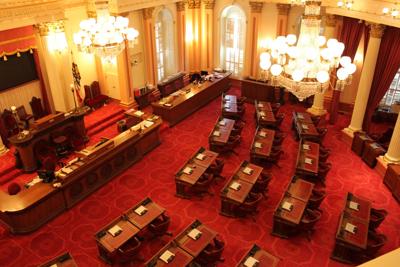


Senate Chamber at the California State Capitol. (By BenFranske/Wikimedia Commons)
While Governor Gavin Newsom was down the hall painting a sunny picture of the state’s budget forecast, the Senate and Assembly Appropriations Committees were sealing the fate of hundreds of bills based on how much they will cost the state. The rapid-fire hearings ultimately cut about a quarter of the bills in both state houses.
The suspense file is known for its secretive and often cutthroat decision making, with legislators deciding behind-the-scenes which bills they will OK and which they will axe. The public then essentially is just filled in on which bills the committee passes to a floor vote and which are shelved, or “held,” in committee. Bills that would cost the state at least $50,000 in the Senate and $150,000 in the Assembly are sent to the elusive file.
“These decisions have only been made after careful analysis and thoughtful consideration of both our current fiscal realities and long-term obligations to the people of California,” said Sen. Sabrina Cervantes (D-Riverside) during the May 14 hearing. Cervantes was appointed the Senate Appropriations Chair this year by Senate President Pro Tem Monique Limón (D-Santa Barbara).
Sen. Caroline Menjivar’s (D-San Fernando) bill to disqualify individuals who were employed by and participated in federal immigration enforcement from later becoming peace officers in the state, moved forward to a floor vote. A similar bill in the Assembly, the Get the Feds Out Act from Assemblymember Mark Gonzalez (D-Los Angeles) and Assembly Speaker Robert Rivas (D-Salinas), also moved forward in the Assembly.
Some of Menjivar's other bills, however, did not meet the same fate.
A bill that would set statewide protocols for when immigration officers accompany patients in the hospital was held, as well as a Latino Caucus priority bill that would create a temporary program to allow physicians licensed in El Salvador to practice for up to three years at nonprofit community health centers in the state.
The Senate voted to progress a bill, put forth by Sen. Lena Gonzalez (D-Long Beach), chair of the Latino Legislative Caucus, to ban certain flashbang weapons from being used for crowd control by local and state police.
Also related to law enforcement, Sen. Scott Wiener’s (D-San Francisco) follow up to last year’s mask ban on federal agents was passed in the Senate committee. A federal judge found the original bill unconstitutional and discriminatory against federal agents. Wiener’s new bill made sure to expand the scope to state law enforcement as well.
The committee also passed a bill to expand full-scope Medi-Cal to eligible undocumented adults, introduced by Sen. María Elena Durazo (D-Los Angeles), a long-time advocate of Medicare for All. The Legislature last year approved widespread cuts to Medi-Cal for this population; cuts that the governor is advocating the state double down on in order to keep the budget balanced.
“The proposed state budget does not stop the loss of health care for immigrants. The governor and the Legislature must do better,” Durazo said in an Instagram post Monday. “[SB 1422] is moving forward. The budget must move with it.”
The committee chose to hold another one of Durazo’s bills that would have created temporary eviction protections for tenants whose incomes have been affected by federal immigration enforcement.





(0) comments
Welcome to the discussion.
Log In
Keep it Clean. Please avoid obscene, vulgar, lewd, racist or sexually-oriented language.
PLEASE TURN OFF YOUR CAPS LOCK.
Don't Threaten. Threats of harming another person will not be tolerated.
Be Truthful. Don't knowingly lie about anyone or anything.
Be Nice. No racism, sexism or any sort of -ism that is degrading to another person.
Be Proactive. Use the 'Report' link on each comment to let us know of abusive posts.
Share with Us. We'd love to hear eyewitness accounts, the history behind an article.