
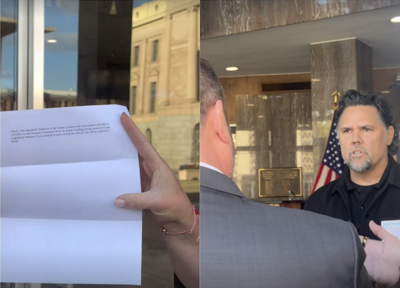

Arizona State Senate Sergeant At Arms Joe Kubacki (right) delivers trespass notices (left) to community members. (Screenshot, LUCHA Instagram)
Vivian Serafin is no stranger to civic engagement at the Arizona State Capitol. The communications coordinator for progressive advocacy group Living United for Change in Arizona (LUCHA) frequently shows up to organize press conferences, prepare community members for public comment and meet with state lawmakers.
Now, it’s been nearly two months since she was banned from entering the state Senate building.
“It is un-American and it’s anti-democratic,” Serafin told CALÓ News.
Her frustration stems from a February incident at the center of a federal lawsuit filed early April by LUCHA and eight individual plaintiffs against Senate President Warren Petersen (R-Gilbert) and Speaker of the House Steve Montenegro (R-Surprise). The lawsuit alleges constitutional rights were violated by bans that shut community members out of parts of the Capitol for the remainder of the legislative session.
The verified complaint, filed April 3 in the U.S. District Court in Arizona by Barton Mendez Soto PLLC, argues the bans violate rights to free expression, equal protection and due process.
Lawsuit cites events from February committee meeting
Serafin’s ordeal started at the Feb. 18 Senate Judiciary and Elections committee meeting, where several LUCHA members planned to speak in opposition to SB 1635, which makes it a misdemeanor for “unlawful alerting,” making it a crime to knowingly warn someone about law enforcement activity in their area if the intent is to “hinder, delay or prevent” an arrest.
The bill has since been amended,narrowing its parameters to target only those who notify someone they know is being sought by law enforcement.
In Serafin’s experience, she said committees will often leave controversial bills until the end of their agenda, especially if they see a significant public presence. And that’s exactly what happened that day, she said.
“They were stalling,” she said. “We were just all sitting around in the room for a long time, anxiously waiting.”
Just before 4:30 p.m., the committee recessed for close to an hour — a delay some of the committee members said was due to Sen. John Kavanaugh (R-Scottsdale) doing an interview with KTAR News. Believing the bill would not be heard that day, the group debriefed and filtered out. Then, Serafin said, a member monitoring the livestream shouted: “They’re hearing our bill!”
They sprinted from Wesley Bolin Plaza back to the Senate building, walking in gasping for air.
“We’re not gonna miss an opportunity to be in that room, so they know exactly how people feel about that bill,” Serafin said.
Rogers allowed two minutes to organize five speakers. During those two minutes, she consulted Sen. Shawnna Bolick (R-Phoenix) about the large number of people who left the meeting.
Just to her right, Sen. Analise Ortiz (D-Phoenix) responded, “They left because we repeatedly asked you if the bill was going to be today and you told me ‘no’.”
“No, I didn’t say no,” Rogers replied. “I wasn’t aware.”
However, the committee chair — in this case, Rogers — typically determines the order in which bills are heard and can change it at their discretion during the meeting.
During a passionate fourth and final testimony, Rogers demanded that the speaker stop. Attendees, including Serafin, could be seen standing up and chanting the common activist phrase, “No justice, no peace.”
As chants continued, members of the committee rose and exited the room for another recess, while protesters left the room at the orders of Sergeant-at-Arms Joseph Kubacki.
“We left very orderly, very peacefully,” Serafin said. “There was zero animosity, there was zero threatening behavior or tone.”
When Serafin returned to the Senate on Feb. 20 for a supplemental hearing, she said, the response had escalated to an outright ban.
“If you set foot in this building, you will be arrested,” she recalled being told by Kubacki as he handed her a vague letter explaining the reasoning for the ban.
She said the notices handed to her looked informal and gave almost no information. The letter cited a single violation of ARS § 41-1221(B).
“Those envelopes that they gave us did not have a name, they did not have a date, they did not have any letterhead,” she said. “It was a blank, white sheet of printer paper with two sentences at the top in 12-point, Times New Roman font.”
The lawsuit also details similar instances resulting in the ban of two other individuals representing LUCHA. One was banned from the Senate, and the other was banned from both chambers.
‘This is the people's house’
The lawsuit specifically notes that LUCHA members who were white and attended the same hearing were not banned from entering the buildings.
“They were letting other people in the room,” Serafin said. “Every single person banned was a person of color. We were all Latino.”
Jacqueline Mendez Soto, LUCHA’s attorney, told CALÓ News that there is already a legal precedent suggesting the bans go too far.
She’s referring to Reza v. Pearce. In 2015, the Ninth U.S. Circuit Court of Appeals designated Arizona’s Senate building as a limited public forum. It found major constitutional concerns around banning people from the Legislature. It further said that preventing them from opposing bills they disagree with goes beyond what the courts have considered a reasonable response.
Mendez Soto also argued that even if lawmakers believed protesters broke committee-room rules, the response should have ended when they were told to leave.
“Would you consider their reaction speaking out of turn? Perhaps,” she said. “But it was a non-threatening, peaceful reaction to what was going on. They obeyed everything.”
“You have to inform them of what it is that they did, and how to correct it,” she continued. “None of that was done. It went directly to being very punitive and arbitrary in order to silence their voice.”
In a press release announcing the suit, LUCHA Executive Director Alejandra Gomez called the bans unconstitutional and accused Petersen and Montenegro of using their power “to silence the very people they were elected to represent.”
Petersen and Montenegro did not respond to requests for comment. CALÓ News also reached out to the Arizona Senate Republican Caucus, but received no response.
The lawsuit seeks a preliminary injunction to lift the bans, but Mendez Soto said even if that doesn’t happen, they will not stop.
“The lawsuit continues until we get a declaratory judgment that their rights were violated, and that they will not do it in the future,” she said. “It is to hold them accountable, so that they cannot strip our people of their freedom of speech and expression.”
Serafin said she remains undeterred. She still spends her days at the Capitol, interacting with community members and legislators in any capacity she can. She said it is not just about her access or ability to speak.
“Our tax dollars pay for this building, our tax dollars pay for their salary, and this is the people's house,” she said. “We should be here. We have to be here.”
Lorenzo Gomez is a multimedia journalist based in Phoenix, Arizona. He reports on politics, borderlands, culture and minority communities. He obtained a Master of Mass Communication from the Walter Cronkite School of Journalism and Mass Communication. His work has been featured in the Associated Press, CALÓ News, LOOKOUT, Phoenix New Times and Cronkite News.







(0) comments
Welcome to the discussion.
Log In
Keep it Clean. Please avoid obscene, vulgar, lewd, racist or sexually-oriented language.
PLEASE TURN OFF YOUR CAPS LOCK.
Don't Threaten. Threats of harming another person will not be tolerated.
Be Truthful. Don't knowingly lie about anyone or anything.
Be Nice. No racism, sexism or any sort of -ism that is degrading to another person.
Be Proactive. Use the 'Report' link on each comment to let us know of abusive posts.
Share with Us. We'd love to hear eyewitness accounts, the history behind an article.