
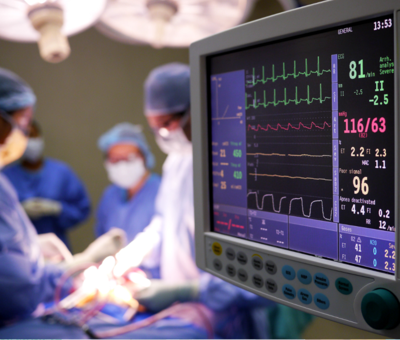


Doctors performing surgery. (Photo Credit/Canva library.)
Next week on Election Day, Los Angeles County voters will decide on Measure ER, a proposal to raise the sales tax by 0.5% for the next five years to fund community clinics, emergency departments and public health programs, generating an estimated $1 billion annually.
The measure is meant to prevent loss of essential healthcare services that have been cut in local funding by $800 million by the H.R.1, the “One Big Beautiful Bill Act” enacted last year.
Candy Cerezo, a West Covina single mother of two, told CALÓ News that while she believes the measure could be beneficial, she is concerned about how the funds would be distributed and who would qualify for the assistance to get the help needed. “We have families and independents still trying to get healthcare coverage right now,” she said.
Since the passing of the H.R.1, 200,000 L.A. County residents have been disenrolled from full-scope Medi-Cal coverage. One out of the five people who lost coverage is a child, including 787 infants, 4,000 toddlers and over 15,000 school-age children, according to the Department of Public Social Services (DPSS).
Manuel Martinez, a community activist from South Central Los Angeles, said he was unaware that Measure ER would include a sales tax increase, but still believes the proposal is necessary.
“Gaining a safety net for hospitals and emergency care, community clinics, public health programs, school-based services, in-home support for seniors and individuals with disabilities and other essential health and human services would cover the increasing lack of funding by the federal government,” he said.
As of now, the Torrance Public Health Center and six of L.A. County's public health clinics have already closed following grant cuts from the Department of Health and Human Services and the Centers for Disease Control and Prevention, with no expected path to reopening.
These grants are not expected to reopen these clinics and the patients who attended those clinics have been moved into facilities that face the same threat of closure. Every lost Medi-Cal dollar translates to $1.85 in lost economic output, and across L.A. County, the cuts put 63,800 jobs and $9 billion a year at risk.
Supervisor Holly Mitchell told CalMatters in an interview that she does not take lightly asking residents to consider a half-cent retail sales tax increase.
“This option is on the table because what’s at stake are safety net services unraveling for millions of residents — which would come at an even greater cost for the largest county in the nation,” she said.
The tax increase is expected to last up until 2031, and everyday items like groceries and prescriptions would be exempt. After the measure ends there is no automatic renewal. According to the Yes on ER coalition if voters don't act to extend it, it ends. Measure ER protects the following :
-Disaster Preparedness and Emergency Response
-Disease Tracking and Outbreak Response
-Planned Parenthood and Reproductive Health Services
-Public Hospitals and Emergency Rooms
-Community Health Clinics
-Mental Health Services
-Vaccinations and Immunization Programs
-Doctors, Nurses, EMT's and Paramedics
Dr. Reza Babapour, a physician practicing in South Los Angeles and founder of Reform LA Health, said that although the measure is set to last only five years, he believes the tax increase will likely be extended beyond that period.
Even though Measure ER is only a temporary fix, Dr. Babapour said he does not believe it is the ideal solution, but sees it as a way to prevent the situation from worsening.
Anna Roi, a Pico Rivera resident, said that while the proposed measure may seem intimidating, she believes it will be beneficial in the long run. “Our healthcare took a big cut due to the Big Beautiful Bill. [Because] Medicaid and Medicare cuts affected so many of us, the tax will affect other areas other than medication, groceries or medical equipment. I would vote yes in this,” she said.
On June 2nd, L.A. County voters will have the opportunity to vote on the measure. If passed, the sales tax will increase half a percent over the next five years from 9.75% to 10.25%.





(0) comments
Welcome to the discussion.
Log In
Keep it Clean. Please avoid obscene, vulgar, lewd, racist or sexually-oriented language.
PLEASE TURN OFF YOUR CAPS LOCK.
Don't Threaten. Threats of harming another person will not be tolerated.
Be Truthful. Don't knowingly lie about anyone or anything.
Be Nice. No racism, sexism or any sort of -ism that is degrading to another person.
Be Proactive. Use the 'Report' link on each comment to let us know of abusive posts.
Share with Us. We'd love to hear eyewitness accounts, the history behind an article.