
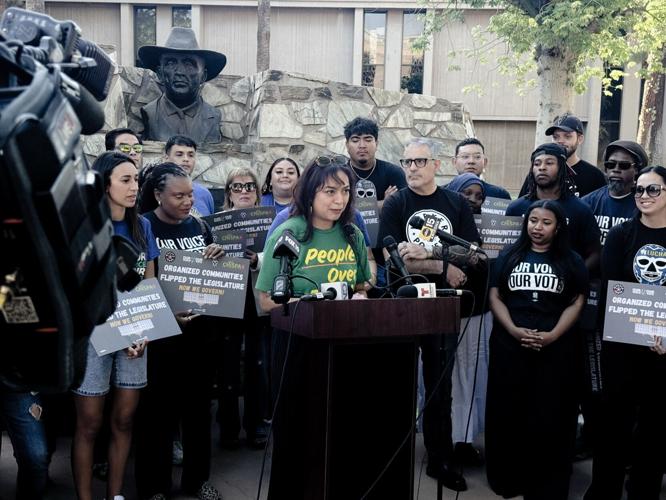




Vianey Olivarría, executive director of Chispa Arizona, stands at the podium during a coalition news conference hosted by Activate 48 outside the Arizona State Capitol in Phoenix on Nov. 4, 2026. (Miguel Torres/CALÓ News)
Two Democrats are poised to join the Arizona Corporation Commission (ACC), the commission that helps decide how much residents pay for electricity, as the latest results continue to widen the gap between candidates.
While the race had yet to be called by the Associated Press, the two Republicans trailing in the race conceded early Thursday to the Arizona Capitol Times, allowing Democrats Clara Pratte and Jonathon Hill to declare their win that same day.
With 92% of the votes counted as of Thursday night, Pratte and Hill led the race for two commission seats up for grabs with 1,177,129 and 1,131,661 votes, respectively.
Republican incumbent Kevin Thompson followed with 1,019,815 votes, putting him behind Hill for the second seat. Republican Ralph Heap had 955,159 votes and Green Party candidate Mike Cease had 64,359.
Pratte, a member of the Navajo Nation — and who could become the first Native American elected to the commission — said the panel had become “lap dogs for industry instead of watchdogs.”
“I'll never forget the elder who told me, through tears, that she was struggling to afford air conditioning while caring for her terminally ill husband… She is who I ran this campaign for,” she said in a statement released on election night.
Hill said that, should he and Pratte take office, they would ask how utility companies are spending Arizonans’ money.
“A few years ago, I started asking a simple question: Why are our utility bills so high? The answer was the corporation commission,” he said in an emailed statement to CALÓ News.
Heap and Thompson’s campaign offices did not respond to requests for comments.
The commission sets rates for regulated utilities, including Arizona Public Service and Tucson Electric Power. It does not set electricity rates for the Salt River Project or city-run utilities.
Pratte and Hill’s election would end the commission’s entirely Republican run panel, though the conservative party would still retain a 3-2 majority, with Lea Márquez Peterson, Rachel Walden and René Lopez remaining in office.

Event moderator Reagan Priest (right) asks Arizona Corporation Commission candidates Clara Pratte, Jonathon Hill and Mike Cease about utility rates, data centers and renewable energy, among other topics, during a candidate Q&A on Oct. 2, 2026, in Phoenix, Ariz. (River Graziano/CALÓ News)
Two Democrats to gain decision-making power on the ACC
Hill and Pratte ran similar campaigns calling for greater scrutiny of utility spending and continued public involvement, as well as protecting water resources and enhancing access to low-income and small communities.
Republican incumbent Thompson, on the other hand, emphasized eliminating mandates and subsidies, encouraging new technologies and maintaining reliable energy sources, while Heap focused on bringing “accountability, common sense, and conservative values” to the commission.
Vianey Olivarría, executive director of Chispa Arizona, an environmental advocacy group working with Latino communities, connected the Democrats’ lead to frustration over electricity bills.
Some of the Chispa members reported summer bills reaching $700 a month, Olivarría said. Those increases are linked to neighborhoods that struggle with energy use because they have little shade and have outdated homes that fail to keep out the heat, forcing families to use more electricity.
“The corporation commission’s responsibility is to represent the people, not corporate interests,” Olivarría said.
Two new commissioners could question utilities and pressure their colleagues to respond to residents, she added, and pointed to Democrats Anna Tovar and Sandra Kennedy, who previously served together, as an example. In April 2021, they joined Republican Márquez Peterson in a 3-2 vote to advance stronger protections against utility shutoffs during extreme weather.
But even with a possible progressive win this midterm, the current commissioners would make the next major decisions.
Rate cases for Phoenix, Tucson hang in the 2026 balance
Commissioners are expected to discuss and vote on Tucson Electric Power (TEP) request to raise electricity rates Nov. 17, commission spokesperson Nicole Garcia told CALÓ news.
Arizona Public Service (APS) has also asked permission to charge customers more.
That request goes through a formal review called a rate case. An administrative law judge hears testimony and examines evidence from the utility, commission staff and other participants, then recommends a decision. The elected commissioners make the final call and can accept, change or reject that recommendation.
The APS recommendation is expected this month, with a possible vote in December, Garcia said. Commission meetings are scheduled for Dec. 2 and Dec. 17.
Olivarría called on the current commissioners to reject further increases, saying families are struggling to cover housing, gas and electricity.
The TEP case illustrates what customers should watch out for, she said. The company’s proposal would add about $13.50 a month, or 9.8%, to an average residential bill, AZPM reported.
The judge in TEP’s case recommended adding about $12.93 a month, or 9.4%, and supported yearly rate adjustments, meaning that TEP could seek changes each year using updated financial information.
The Residential Utility Consumer Office, a state agency representing residential customers, is challenging the recommendations over concerns that include affordability, the company’s allowed profit and annual adjustments, AZPM reported.
Garcia said a commissioner generally could ask to reopen a decision like an approved increase, but a majority would first have to agree before voting on it again.
Newly elected members take office in early January 2027.
“Our utility bills will still arrive next month. Rate cases will still come before the commission,” Hill said in his Wednesday statement.
“Win or lose, our work doesn’t stop,” Pratte said.
A sentiment Olivarría agrees with.
She said Chispa is planning a leadership training Nov. 14 to help residents organize for change. “People who voted for change have to keep organizing,” she said.
Miguel Torres is a Phoenix-based illustrator and independent journalist who covers courts, crime and the systems around them. He spent five years reporting for The Arizona Republic and USA TODAY Network.








(0) comments
Welcome to the discussion.
Log In
Keep it Clean. Please avoid obscene, vulgar, lewd, racist or sexually-oriented language.
PLEASE TURN OFF YOUR CAPS LOCK.
Don't Threaten. Threats of harming another person will not be tolerated.
Be Truthful. Don't knowingly lie about anyone or anything.
Be Nice. No racism, sexism or any sort of -ism that is degrading to another person.
Be Proactive. Use the 'Report' link on each comment to let us know of abusive posts.
Share with Us. We'd love to hear eyewitness accounts, the history behind an article.