
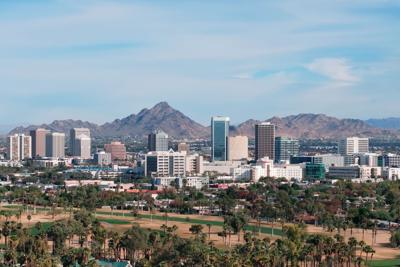

Midtown Phoenix, Arizona. (Ian Mcdonnell/Getty Images)
It’s been over a month since the Phoenix City Council voted to adopt a revised ordinance that would ban particular medical care in public parks, and, as it soon comes into effect, local leaders and healthcare professionals continue sounding the alarm of the potential health risks this can pose for vulnerable populations.
Phoenix City Council voted 8-1 on Dec. 17 to make it a Class 1 Misdemeanor to sell or exchange clean syringes and needles, to distribute harm reduction kits or to hold events designed to provide medical care in public parks without prior authorization from the city.
From 2015 to 2023, Arizona reported 12,384 overdose deaths, according to the Arizona State Unintentional Drug Overdose Reporting System (SUDORS). And in a state like Arizona, where summer temperatures can reach up to 120 degrees, substance abuse has been linked to heat-related deaths, according to a 2025 International Journal of Drug Policy study.
The ban, which goes into effect on March 30, has drawn backlash from concerned locals and healthcare providers who serve those being impacted.
“[We] are committed to the mission of providing quality, accessible health care services to all Arizonans. Achieving the accessible part of that mission means meeting Phoenix residents where they are while recognizing that many may not have the means or be in a healthy enough position to receive necessary treatments in a traditional facility,” said Michael Abramson III, the director of Legislative Affairs with the Arizona Alliance for Community Health Centers (CHC), during the public comment portion of the definitive Phoenix City Council meeting. “Restrictions on medical care fail to resolve homelessness or poverty and instead steepen the barriers faced by our vulnerable populations. Failing to allow care to be provided where residents are leads to delays in necessary treatment, which not only results in higher healthcare costs down the line, but most importantly, can and will lead to significantly worse health outcomes.”
Community members in favor of the ban cited concerns related to unhoused community members who utilize public parks, many of whom resort to using public spaces after being kicked out of private areas or open streets and being victims of harassment and targets of local law enforcement. Following a Department of Justice (DOJ) probe into civil rights violations by the Phoenix Police Department, the federal government found that local police unlawfully detained, cite and arrest people experiencing homelessness, according to the 2024 DOJ report.
This isn’t the first time Phoenix has passed an ordinance that criminalizes people experiencing homelessness. In September 2024, the city council voted unanimously to ban camping within 500 feet of a school, child care facility, shelter or public park in addition to a city ordinance that made it a Class 3 Misdemeanor to camp on sidewalks, canals and in alleys.
“The underlying issue that I think everybody is trying to address is people living in our parks and this ordinance does nothing to fix that… If what we're really wanting to tackle is making sure that we have safe parks… then what we need to really do is invest in solutions that are going to get folks into shelter and housing, right, where they have access to more services and wraparound services,” Councilwoman Anna Hernandez, who represents District 7 and was the sole dissenting vote in December against the ordinance, told CALÓ News. “The foundational issue here is that we do not have enough shelter space or housing for folks to live and folks don't have healthcare access. So mixing those two things together and now making a barrier for these providers to provide that care, I think is going to be detrimental to this community, and really to their community overall because if safety is really the goal here, I still stand firm that that's not what we're going to achieve here.”
Targeting not only unhoused peoples’ access to healthcare in public parks, the ordinance would once again make it illegal for volunteers to continue harm reduction initiatives that were only recently legalized by Senate Bill 1250 in 2021. Harm reduction programs offered throughout the Valley like Sonoran Prevention Works, RIOT Phoenix and Shot in the Dark, which aim to provide stigma-free access to no-cost harm reduction supplies such as clean injection tools, drug checking kits and nasal naloxone — commonly known as Narcan — would be impacted.
Shot in the Dark, a Valley-based radical harm reduction collective that stemmed from the Phoenix Harm Reduction Organization (PHRO) between 2010 and 2011, partners with other grassroots volunteer groups to deliver harm reduction supplies such as xylazine, fentanyl testing strips, condoms and clean injection tools to those battling addiction, experiencing homelessness or facing a healthcare crisis.
In addition to preventing the spread of diseases commonly caught from the lethal practice of sharing needles, these organizations also ask their participants to report back to them on overdose reversals in order to collect data that is then reported back to the state.
“[Our goal] is to — number one — reduce or eliminate, with Narcan, overdose deaths, because we really do believe it's a policy failure, and it's prior to this current administration. But we want to also provide safe connections and safe supplies for people to keep coming back to share with us what's going on in the community. Kind of like a growing relationship with our participants; giving them that autonomy, dignity and agency, but also reducing community spread of Hep C or HIV,” Tripti Choudhury, a volunteer site-runner for Shot in the Dark for over 10 years, said. “This ordinance is very heartbreaking… Our people are going to be exposed to elements that feel punitive. They're going to have a lack of access to any resources and safe supplies to reduce the community spread, so it's devastating.”
According to Point in Time (PIT) homeless count, Arizona saw a three percent increase of people experiencing homelessness and a 28% increase in people unhoused and out of shelters, exposed to the elements in one of the hottest cities in the nation. While there are many factors that have contributed to the growing population of people experiencing homelessness, the American Addiction Centers have found that around two-thirds of these people have had lifelong issues with drug and alcohol abuse disorders.
Without access to proper resources or clean supplies, even more unhoused individuals face more risk of infection and disease, especially against the backdrop of a 20% increase in HIV infections in Arizona, according to the Department of Health Services (DHS).
“I've already started having conversations with our city staff that is going to be working on this, and making sure that they know how important it is to bring in the community, which is what should have been done in the first place, but, you know, here we are,” Hernandez said. “So I think the next step is just to bring in those stakeholders, work on language fixes that [are] going to really address all the issues that were raised by the experts and the providers before that March 30 deadline.”
Analisa Valdez (she/her) is a freelance journalist based in Phoenix. Her reporting includes community & culture, social justice, arts, business, and politics.







(0) comments
Welcome to the discussion.
Log In
Keep it Clean. Please avoid obscene, vulgar, lewd, racist or sexually-oriented language.
PLEASE TURN OFF YOUR CAPS LOCK.
Don't Threaten. Threats of harming another person will not be tolerated.
Be Truthful. Don't knowingly lie about anyone or anything.
Be Nice. No racism, sexism or any sort of -ism that is degrading to another person.
Be Proactive. Use the 'Report' link on each comment to let us know of abusive posts.
Share with Us. We'd love to hear eyewitness accounts, the history behind an article.