
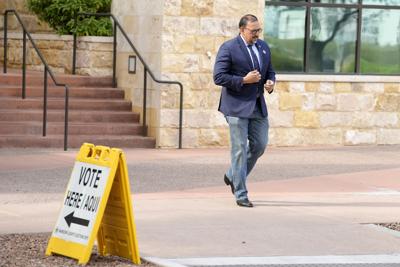

Arizona Secretary of State Adrian Fontes leaves Surprise City Hall after voting on the first day of early in-person voting in the general election Wednesday, Oct. 9, 2024, in Surprise, Ariz. (AP Photo/Ross D. Franklin)
This story was originally published by Votebeat.
Tensions between state election officials and the Trump administration are rising as we head into the heart of the midterm election season. Frustrations boiled over on Monday during a rare election security call hosted by the Cybersecurity and Infrastructure Security Agency for state officials. During the call, Arizona Secretary of State Adrian Fontes unloaded on the agency.
CISA used to be a go-to shop for many states looking for help ensuring that their elections weren’t hacked, targeted, or undermined by cyberattacks or foreign interference. CISA provided states with classified security briefings on threats, helped ensure that state voting equipment wasn’t vulnerable to cyberattacks, and worked with election leaders to game out potential risks.
All that changed when Donald Trump returned to the White House last year. The second Trump administration scaled back its support for states, cut back CISA staff, and launched an investigation of its former leader, whom Trump accused of disloyalty because he pushed back on the president’s false claims that the 2020 election was rigged. CISA has not had a permanent director since the start of Trump’s second term.
Changes at CISA have paired with the president’s broad focus on controlling how elections are run. The federal government is threatening to arrest election officials if they allow noncitizens to vote. Homeland Security Secretary Markwayne Mullin has vowed to withhold federal funds from states that don’t implement Trump administration election overhaul proposals. A coalition of Democratic states and officials has sued the Department of Homeland Security in a suit that accuses the Trump administration of withholding Federal Emergency Management Agency funding in an attempt to coerce states into enacting disputed election changes.
With all that as backdrop, CISA organized this week’s call – and things didn’t go too well.
After more than a year of near silence, elections officials wondered if CISA would step up to offer classified intelligence briefings on emerging cyber threats from hostile countries, specialized testing of election equipment, or training on how to prepare for potential problems on Election Day.
Instead, CISA leaders provided what one participant characterized as a generic “CYA” (cover your a**) briefing that offered state officials few assurances that the federal government would help thwart threats this November.
Participants said acting CISA Director Nick Andersen and Jim Harrell, the assistant director for integrated operations, offered no concrete support for the 2026 election, which is less than 90 days away. Instead, the participants said, CISA leadership seemed more focused on the 2028 presidential election.
“Fontes got testy with them,” said one participant on the call who asked not to be identified. “‘I don’t trust you,’ [Fontes told the CISA officials.] ‘Your boss came out there and said: We are going to criminalize the work you do. Why should we trust you?’”
When asked about the call, Fontes confirmed that he’d made those comments and expanded on his frustrations
“They don’t work with us, they work against us,” Fontes told Votebeat. “Why should I trust them?”
Fontes said it was difficult for state and local elections officials to have confidence they would get support from the federal government when the administration treats them like an adversary rather than a partner. He and others on the call said CISA leaders offered few assurances they would provide much support in the coming weeks.
“They just wholly and completely abandoned their duties and threatened prosecution,” Fontes said. “If they want to apologize for threatening us and ruining perfectly good systems, that’s a good start.”
CISA did not respond to requests for comment on the call.
Minnesota Secretary of State Steve Simon, also a Democrat, echoed Fontes’s frustrations.
“It’s unhelpful to have political leaders, including the secretary of Homeland Security, hinting at imprisoning election administrators who don’t do what they want,” Simon told Votebeat. “That’s just not helpful.”
Simon said Minnesota and other states have spent months working to fill the gaps left by the drop-off in CISA support.
Not everyone on the call came away with a sour taste in their mouth, though. Some participants described it as a tentative move that could help repair the strained relationship between state and federal leaders working on elections.
Washington Secretary of State Steve Hobbs, also a Democrat, described the call as a “positive step” in rebuilding relations between CISA and state election officials.
“While this engagement is encouraging, CISA and our other federal partners must focus on continuing to rebuild trust with election officials,” Hobbs said. “Over the last two years, we have watched this administration systematically dismantle many of the election security resources in place at the federal level.”
With the November election fast approaching, he said, “election officials need sustained commitment to supporting local elections, not renewed attention only as major elections approach. Meaningful support will do more to rebuild relationships than words alone.”








(0) comments
Welcome to the discussion.
Log In
Keep it Clean. Please avoid obscene, vulgar, lewd, racist or sexually-oriented language.
PLEASE TURN OFF YOUR CAPS LOCK.
Don't Threaten. Threats of harming another person will not be tolerated.
Be Truthful. Don't knowingly lie about anyone or anything.
Be Nice. No racism, sexism or any sort of -ism that is degrading to another person.
Be Proactive. Use the 'Report' link on each comment to let us know of abusive posts.
Share with Us. We'd love to hear eyewitness accounts, the history behind an article.