
On Nov. 3, Starr County, Texas, a county that is about 97 percent Latino, gave Democrat James Talarico roughly 77 percent of its vote in the U.S. Senate race. Two years earlier, the same county gave Donald Trump about 57 percent. Statewide, Gina Hinojosa, the daughter of Mexican immigrants with roots in the Rio Grande Valley, unseated Gov. Greg Abbott and became the first Latina governor-elect in Texas history. Talarico carried nine border counties that Trump won in 2024.
Pull the tape back two years and the commentary sounds nothing like this. After 2024, when Trump drew nearly even with Kamala Harris among Latino voters, the verdict was that Latinos were realigning toward the Republican Party. Before that, Joe Biden had won Latino voters by 25 points in 2020 and Latinos were the Democratic Party’s demographic destiny. Now the verdict is whiplash: Latinos are “volatile,” “swing voters,” impossible to predict.
If you’re sick and tired of hearing “Latinos are not a monolith,” it’s because it has become a way to avoid a hard conversation instead of having it. Being a diverse group is a constant — we’re always from different countries of origin, religions, etc. It doesn’t explain going from a 25-point Democratic lead to three points and back to 25 in six years.
That said, we’re not a volatile swing vote. Volatile implies randomness, a vote that lurches without pattern — up one cycle and down the next for no reason anyone can name. The Latino vote has a pattern. Over four decades it has moved like a wave. The gap between the share of Latinos who vote Democratic and the share who vote Republican widens, narrows and widens again. The crests and troughs are not accidents. They track something specific: whether, at a given moment, the country’s anti-immigrant politics pushes U.S.-born Latinos toward solidarity with immigrants or toward resentment of them.
I am not making an argument about polling — although I think we should get into it about polling at some point. I am making an argument about identity. The reason Latinos have not settled into predictable partisan habits, the way white voters and Black voters have, is that we do not share the thing that organizes so much of American politics — a racial identity.
Wondering why the share of Black Texans who voted for Hinojosa is higher than the share of Latino Texans who did? That is the same question. The Houston Chronicle’s analysis of Harris County found she carried 85 percent of the vote in Black precincts and 72 percent in precincts where Hispanic residents are the largest group. Precinct returns are not individual surveys, so treat that as a clue, not a verdict. But a Latina from the Rio Grande Valley did better with Black voters than with voters who share her heritage, and that is what a shared racial identity looks like when one group has it and the other does not.
The wave

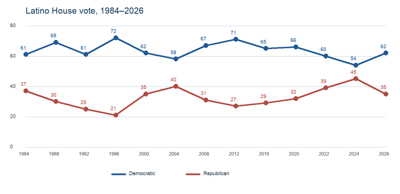
Latino House vote estimates, 1984–2026. 2026 is preliminary. Source: AS/COA
The gap between Democratic and Republican support among Latinos widens, narrows, and widens again. It was 24 points in 1984, 51 in 1996, 18 in 2004, 44 in 2012, and just nine in 2024, the narrowest in the series. In 2026 it is back up to 27. The crests, 1996 and 2012, sit about sixteen years apart. These are exit-poll estimates, not ballot counts, and the series mixes presidential and midterm years; Pew’s method puts the 2024 gap at three points. The shape holds either way. And much of Trump’s 2024 gain came from who turned out: Hispanics who voted in 2024 but not 2020 went 60 percent for Trump.
Behind the numbers
Some things hold steady:
Age: in 2026 estimates, Latinos 18 to 29 backed Democrats 78 to 19, while those 65 and older split 53 to 45.
Gender: Latinas voted 66 to 31 Democratic, Latino men 56 to 41.
Religion: before the 2024 election, Pew found 65 percent of Latino Protestants leaning Trump, while Catholics and the unaffiliated leaned Harris.
Education matters less than it does for white voters: Pew found a smaller gap between college and non-college Hispanic voters, and none among Black voters.
These patterns tell us who sits higher or lower on the swell, not why every group rose and fell together.
More than “not a monolith”
White voters and Black voters have settled into durable partisan habits. In 2024, 83 percent of Black voters backed Harris. Latinos have not settled, because we do not share what organizes so much of American politics: a race. The Census treats Hispanic origin as an ethnicity and Latinos check white, Black, Indigenous, Asian or several boxes at once. Congress ordered data collection on “Hispanics” in 1976, and in 1980 the Census first asked everyone for both an ethnicity and a race. No single box could hold us.
Then add history. In Mendez v. Westminster and Hernandez v. Texas, Mexican American lawyers had to argue whether their clients were white or a distinct class. Assimilation here has rewarded whitening and Latin America has its own version. When I went to school in Mexico City, I was taught there were no white, Black or brown Mexicans, only mestizos. Billboards and television told a different story: “güero” over “prieto,” and no greater insult than “indio.” We arrive carrying two racial systems at once.
Black Americans faced one consolidated history of exclusion: cut out of New Deal programs, redlined, segregated and shut out of democracy until the Voting Rights Act of 1965. That is not only the legacy of slavery — it is the legacy of the policies that built the American middle class. Latinos were excluded too. Mexican farmworkers lost out under the same carve-outs, and hundreds of thousands of people of Mexican descent, many of them citizens, were repatriated in the 1930s. But those exclusions ran through nationality, language and immigration status, not one legally enforced caste. The political memory never consolidated into one racial identity, so it never consolidated into one partisan identity.
That is the answer to the question I asked at the start. Race is a powerful political predictor. Black Texans have it. Latino Texans, by our own history, do not.
Immigration is the hinge
If race does not organize Latino politics, immigration does. Not as a pro-immigrant reflex, but as something stranger. Some of us arrived last year. Some have families who were here before the border crossed them. Puerto Ricans are citizens at birth. What U.S.-born Latinos share is that strangers read our names, accents and complexions as evidence of who we are. Anti-immigrant politics does not check birth certificates.
When that politics lands as “that could be my mother,” Latinos move toward solidarity and the party opposing enforcement. When it lands as a desire to separate from newcomers who bring scrutiny down on everyone, we move toward the party promising order. The same stimulus, opposite reactions.
California’s Proposition 187 in 1994 galvanized a generation, and Bill Clinton won 72 percent of Latinos in 1996. Then the trough: George W. Bush’s share rose from about 35 percent to 40 percent in 2004. Outreach mattered, but Pew tied his gains to religion, and political scientists found moral values and national security roughly equal in explaining them. After September 11, his migration deal with Mexico collapsed into a security debate. My interpretation: many US-born Latinos reached for the flag, seeking a place in the national “we.” Pew found them more supportive of the Iraq invasion than the foreign-born. Enforcement was not yet aimed at us, so we could stand with the in-group.
In 2005 a House bill would have criminalized unlawful presence, and in 2006 roughly a million people marched in Los Angeles. Democratic support among Latinos rose from 58 percent in 2004 to 69 percent in the midterms. Then came SB 1070, the DREAMers coming out as undocumented and unafraid, Mitt Romney’s “self-deportation,” and Obama’s DACA announcement. He won Latinos 71 to 27 in 2012.
The peak of that wave changed the language. The Drop the I-Word campaign, launched by the Applied Research Center (now Race Forward), quarterbacked by Mónica Novoa, with José Antonio Vargas as its most visible voice, pushed newsrooms to stop calling people “illegal.” I was among the many who contributed. The AP changed its stylebook in 2013, and the Library of Congress later retired “illegal aliens” as a subject heading.
Then the conversation faded. A generation grew up without firsthand memory of 187 or SB 1070, and from 2021 to 2024, record border arrivals dominated the news. In border communities feeling the strain, the lesson became “they are making it harder for the rest of us.” The same wave, running the other way.
Bicultural cognitive dissonance
Latinos carry racial hierarchies from both sides of the border. We are blessed with many cultures and cursed with the racial baggage of two worlds: one where a single drop of non-European blood makes you “the Other,” and another where any sign of European heritage makes a person of color white. That is why a person can feel solidarity with immigrants and contempt for Blackness at once. It is also why the leader of the Proud Boys is a dark-skinned Afro-Cuban. Enrique Tarrio, insists there’s “nothing white supremacist” about him and then burns a Black Lives Matter banner stolen from a historic Black church.
Nick Fuentes, whose father is half Mexican American, built a white nationalist following while declining to treat his Mexican heritage as meaningful. Valentina Gomez, a Colombia-born Republican candidate for Texas’s 31st congressional district, went viral burning a Quran with a flamethrower. Far-right groups court Latinos with European ancestry, telling them Spain makes them white enough for the club. Some accept.
George Zimmerman hunted down Trayvon Martin after a 911 operator told him to stay in his car. He saw a Black teenager through American racism and mocked Mexicans on MySpace through Latin American racism. He’s not white presenting. The media called him a “white Hispanic.” His Census answers match those of millions of Latinos. 30% of ICE agents are Latino— most are Brown with Spanish surnames. Notre Dame’s David Cortez found economics, more than ideology, explained why many joined. But economics does not explain how a person with a face like the family in front of him decides, in half a second, who is the threat. That requires a framework in which the person across from you is not “us.”
Latinos are a population holding more than one racial framework that can be moved by whichever one the moment activates.
2026 under 30
The economy drove much of 2026, and I won’t pretend otherwise. In a poll of 3,014 Latino voters, 58 percent put cost of living in their top three issues, and 34 percent named jobs and the economy. Immigration and ICE ranked lower overall, but 37 percent of Latinos ages 18 to 29 named them, against 20 percent of those 60 and older. G. Elliott Morris found that among Trump-2024 voters who no longer back Republicans, immigration ranked first for those under 30, and second among Latinos in the group. That is a narrow slice, not all young voters, but it shows where the movement came from.
The numbers on ICE itself have moved fast. Pew found 67 percent of Hispanic adults view ICE unfavorably, up from 54 percent a year earlier, though a bare majority of Hispanic Republicans, in a small sample, still view it favorably. In the poll of Latino voters, 82 percent said ICE’s actions had gone over the line or were violent and needed to stop.
Behind those numbers are people. In July, an ICE officer shot and killed Lorenzo Salgado Araujo, a 52-year-old Houston homebuilder who had lived in this country for more than 35 years, during a vehicle stop. DHS said officers saw a van with a man who “resembled the target.” Rep. Sylvia Garcia said the acting ICE director confirmed Salgado Araujo “was not a target.” His son called it “a hard moment to be an American.” Events like that do not stay in the news cycle. They stay in the kitchen.
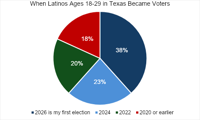
It matters because more than four million young Latinos, the fastest-growing electorate in the country, were set to vote in a midterm for the first time. They are the most Democratic Latino cohort, and ICE is most salient to them. So I would not say immigration alone drove 2026. The economy gave voters a reason to leave, and enforcement gave the youngest of them a way to understand who they were leaving. In the UnidosUS/BSP poll, 17 percent of Latinos who voted for Trump in 2024 backed Democratic House candidates in 2026, a survey estimate that Pew’s pre-election numbers suggest could run lower. Final turnout figures are not in, so these numbers are provisional. The direction of the swell is not.
The heritage claim behind the next swell
The right is repeating its mistakes of 1994, 2005, and 2010. “Heritage Americans,” a phrase popularized in MAGA circles, ties belonging to ancestry rather than civic ideals. In his 2025 Claremont Institute speech, JD Vance argued that people whose ancestors fought in the Civil War have a stronger claim to the country.
Latinos should read that carefully. Spanish-speaking families lived in Florida and New Mexico before Jamestown. Mexicans became Americans in 1848 without crossing a border. Puerto Ricans have been citizens since 1917. Latinos fought in the Civil War. An inheritance test asks whose grandfather arrived first, and whether you are the right kind of American. If the pattern holds, that kind of claim hands a new generation of US-born Latinos a reason to recognize one another, and the gap will widen again.
But the wave will recede, too. We should not expect Latinos to realign permanently the way Black voters did, because the engine is identity, and ours is contested. In years when we find solidarity, the gap widens. When we stop asking who we are and what we owe one another, it closes. Interrupting the cycle means confronting the anti-Blackness, anti-Indigeneity, antisemitism, and Islamophobia we absorb from both US and Latin American worldviews, and building solidarity with our Black, Native, Jewish, Muslim, and Asian neighbors.
In 2003, I wrote that neither immigration nor race could unite us. Philosopher Jorge Gracia calls Latinos a historical family, joined not by essence but by relationships over time. A family that stops talking becomes strangers. The DREAMers began our last great conversation, and we have coasted on it for well over a decade.
When Latinos recognize one another, the country changes. When we stop, what we won can wash back out. The next swell is rising. What we do with it is up to us.





(0) comments
Welcome to the discussion.
Log In
Keep it Clean. Please avoid obscene, vulgar, lewd, racist or sexually-oriented language.
PLEASE TURN OFF YOUR CAPS LOCK.
Don't Threaten. Threats of harming another person will not be tolerated.
Be Truthful. Don't knowingly lie about anyone or anything.
Be Nice. No racism, sexism or any sort of -ism that is degrading to another person.
Be Proactive. Use the 'Report' link on each comment to let us know of abusive posts.
Share with Us. We'd love to hear eyewitness accounts, the history behind an article.