
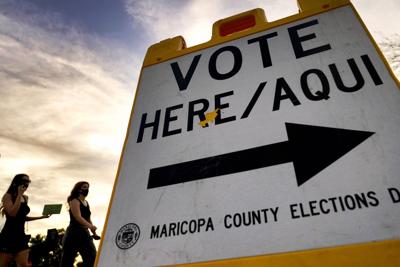

FILE - Voters deliver their ballot to a polling station in Tempe, Ariz., on Nov. 3, 2020. (AP Photo/Matt York, File)
This article was originally published by Votebeat.
Arizona could remove hundreds of thousands of voters from its automatic mail ballot list under the provisions of a state law coming to bear next year.
The 2027 removals will be the first under the law, signed in 2021 by former Gov. Doug Ducey, a Republican. The statute requires county recorders to remove voters from the early voting list if they don’t cast their mail ballot in federal, state, or certain municipal elections for two consecutive cycles — a four-year period.
That means a voter who didn’t mail or drop off their early ballot in 2023, 2024, or 2025 could be at risk of being removed if they again don’t do so this year, even if they voted in person in one or more elections. But that clock restarts if they choose to cast a mail ballot this November.
The Arizona Secretary of State’s Office was unable to provide an estimate of how many voters statewide could be kicked off the list. Spokesperson Calli Jones said the office was working with INEXL Consulting, the developer behind the state’s voter registration database, to develop coding that would allow them to come up with a list of impacted voters, but did not expect the project to be complete before the general election.


Democratic election officials, including Arizona Secretary of State Adrian Fontes, criticized Homeland Security leaders for lackluster support as the midterm election looms.
A 2022 study from the Brennan Center for Justice found that about 340,000 Arizonans could have faced removal if the law were implemented at that time. That’s about 12% of the voters who were on the early voting list in 2021. The study also found that nonwhite voters were at higher risk of being removed.
There’s a difference between a voter being removed from Active Early Voting List, or AEVL, and having their registration canceled entirely. Those impacted by the new law will still be able to vote, and they can stay on the list by responding to notices sent by officials in advance of their removal.
Those who don’t take those steps and are ultimately removed from the state’s early voting list would no longer automatically receive a mail ballot for each election, although they still may request to rejoin the list, or make ad hoc asks for mail ballots in future elections.
But research suggests that similar laws in other states have caused voters to turn to other methods of voting, or to stop voting entirely.
For example, Texas’ Senate Bill 1, a sweeping voting law enacted in 2021 that made it harder for voters to apply to receive a mail ballot, changed voting patterns in the next election cycle, according to a report last year from the Brennan Center. In Arizona, where the vast majority of voters cast ballots by mail, those impacts could be amplified, potentially shifting more people to in-person voting and putting additional strain on election infrastructure.
“A policy like this is going to have those sorts of effects on voters, and it’s rooted in misinformation about the prevalence of mail voting fraud,” said Kevin Morris of the Brennan Center, adding that research and audits have consistently shown that voting fraud is extremely rare. “It is really troubling.”
Meanwhile, the law is also posing communications challenges for local election officials. Pima County Recorder Gabriella Cázares-Kelly said it’s complicated to explain to voters that the law won’t remove them from the rolls.
“That is something that I think people are scared of,” said Cázares-Kelly, a Democrat, adding that some are referring to the early voting list removals as a “purge,” which is “creating more fear.”
How Arizona changed its early voting list
Arizona established its mail voting list — initially called the Permanent Early Voting List, or PEVL — in 2007.
As the name suggested, once on the list, voters generally stayed there unless they requested removal. Officials could also scratch them off if they moved, died, or their registration was moved to inactive status or canceled.
Then, Arizona Republicans began pushing for a plethora of election policy changes in the aftermath of the 2020 presidential election, which President Donald Trump falsely alleged was rigged. The law that changed PEVL to AEVL — Senate Bill 1485 — was introduced by former Sen. Michelle Ugenti-Rita of Scottsdale, who said it would help prevent fraud by reducing the number of mail ballots sent to people who had moved, died, or didn’t want them.
In Arizona, there are several other ways to ensure voter lists stay clean. Officials use information from the U.S. Postal Service, the Arizona Department of Health Services, and other agencies to flag voters who have moved or died, keeping the rolls up-to-date.


A significant share of voters who dropped off their ballots on Election Day opted to show ID to skip the time-consuming signature verification process.
Still, Ducey, who signed the bill into law about an hour after the Arizona Senate passed it on a party-line vote, called it a matter of “election integrity.”
“Let’s be clear — despite all the deceptive and heated rhetoric being used by some partisan activists to lobby against this reform, not a single Arizona voter will lose their right to vote as a result of this new law,” he said in a video on May 11, 2021.
Meanwhile, Democrats described the law as a voter suppression tactic. Then-House Minority Leader Reginald Bolding of Phoenix called it “reprehensible” in a letter to the NFL, which he hoped would commit to pulling the 2023 Super Bowl from Arizona.
The move had been inspired by an incident in Georgia — after Gov. Brian Kemp, a Republican, signed a law that imposed several new voting restrictions, the MLB withdrew its All-Star Game from Atlanta.
What will happen to voters removed from the list?
Under the law, voters won’t be removed from the state’s early voting list without notice.
In odd-numbered years, county officials are required to send impacted voters a letter to inform them that they could be removed from the list. In 2027, that notice must be sent to voters on or before Jan. 15.
Officials can also opt to also try reaching voters by phone, text, and email, but are not required to do so. Cázares-Kelly said it was “the common understanding that everyone is going to send a notice to their voters,” but that she hadn’t determined whether her office would attempt any other outreach to individual voters impacted by the law.
“We’re focused on the upcoming election,” she said, adding that her staff were also creating “plain language resources” about the law to share broadly next year.
Once the mandated letters are sent, voters have 90 days to confirm in writing if they wish to remain on the list. To do so, they’ll also need to sign a form with their address and date of birth. If they don’t, they’ll be removed.
Still, Morris said there will almost certainly be voters who don’t notice that they’ve been removed from the mail voting list. Some may find out during the following election cycle, when their mail ballot doesn’t show up as usual. Others, he said, may not realize at all.
In Texas, officials were also required to send voters notice if their mail ballot application was rejected under SB 1. But Morris said those messages are “easy to miss in the mail.” His research found that many Texans didn’t reapply for a mail ballot in the general election that fall. He said those effects could be amplified in Arizona.
“The pool of voters that could be impacted by this is an order of magnitude larger than in some of the other states, where maybe only 10% of people are casting a ballot by mail,” Morris said.
He added that the law could ultimately have “downstream effects” at the polls.
“If all of these people suddenly aren’t getting the mail that they were expecting, they are going to start showing up at the vote centers,” Morris said, noting that could cause longer lines, voting materials shortages, and other complications that officials will have to handle moving forward.
Cázares-Kelly said she opposed the law as it made its way through the Arizona Legislature. But she said the version that resulted wasn’t “as terrible as most people think.” When asked if she would’ve opposed the law in its current form, she hesitated.
“I don’t know,” she said, adding that her “kneejerk reaction” was that she’d still be against it. As a voter, she said she’d want to receive her mail ballot “every time, whether or not I choose to use it by mail or if I vote in person.” A mail ballot, she said, also gives voters a chance to review contests in a simpler format than a sample ballot.
To give a fuller answer, Cázares-Kelly said she would need to see how many people the law could impact in Pima County and calculate its financial impact.
“We’re just going to have to wait and see what those numbers look like,” she said.








(0) comments
Welcome to the discussion.
Log In
Keep it Clean. Please avoid obscene, vulgar, lewd, racist or sexually-oriented language.
PLEASE TURN OFF YOUR CAPS LOCK.
Don't Threaten. Threats of harming another person will not be tolerated.
Be Truthful. Don't knowingly lie about anyone or anything.
Be Nice. No racism, sexism or any sort of -ism that is degrading to another person.
Be Proactive. Use the 'Report' link on each comment to let us know of abusive posts.
Share with Us. We'd love to hear eyewitness accounts, the history behind an article.