
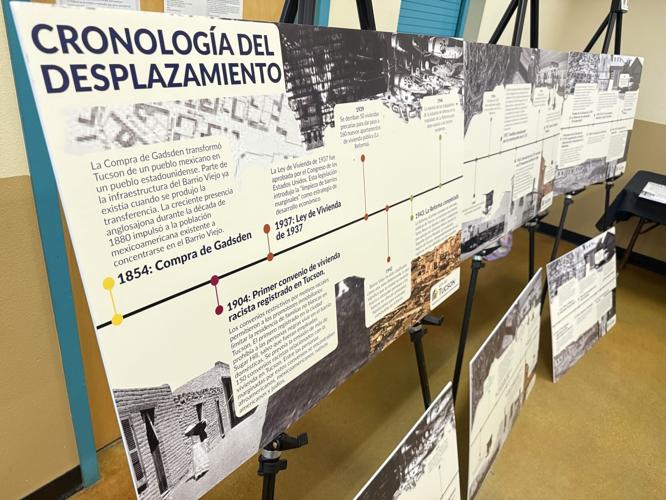

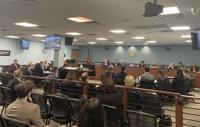
A Spanish-language timeline traces Tucson’s housing displacement history, including racially restrictive housing covenants. The display was part of a city listening session on a possible Community Preference Policy at the Santa Rosa Neighborhood Center in Tucson, Ariz., on Nov. 19, 2026. (Miguel Torres/CALÓ News)
Residents concerned with housing and the cost of living helped drive Democratic wins in Arizona this election cycle. Two weeks after the midterm, voters and organizers are continuing to push those issues as they stay involved in the actions their newly elected officials will pursue.
For a family already short on money, one missed paycheck can mean losing a home, said Sena Mohammed, executive director of Our Voice, Our Vote Arizona. That kind of loss goes beyond keeping a roof over their heads, but it impacts health, their ability to keep working and how they care for their children.
When people pay more for rent, they have less for food and child care, Mohammed said. She wants lawmakers to keep that in mind as they write bills.
That’s why the group backed candidates who promised to change Arizona’s housing policies. It worked with Activate 48, a coalition consisting of Our Voice, Our Vote Arizona, Living United for Change in Arizona (LUCHA) and Chispa Arizona that organizes voters and pushes for policy changes.
The coalition’s political committee endorsed Democrats Alberto Flores and Lisbeth Arescurenaga, who won state House seats in District 24, which stretches from Maryvale in west Phoenix up into south Glendale. Democratic gains across Arizona put the party on track to control both the House and Senate when the Legislature convenes in January.
Since Nov. 3, the group has continued meeting with members and working to put together the Tenant Bill of Rights, which Mohammed said includes “eliminating junk fees” and “expanding access to civil legal aid.” The group is demanding that people be alerted ahead of time by their landlords if their rent is going up and that the state allow local governments to do more to mitigate rent increases.
They are also pushing for more Arizona residents to get civically involved beyond voting and make their voices heard through its #RentisRigged campaign.
Part of that campaign involves holding the newly elected leaders to their promises as they face pressure from powerful groups, Mohammed said, but their members will be watching to see whether those leaders push back and deliver “real change people can feel.”
Not waiting for the Legislature, Tucson moves forward with housing projects
At a Nov. 17 meeting with LUCHA, state Rep. Oscar De Los Santos and Tucson Mayor Regina Romero addressed the housing problems affecting Arizonans.
De Los Santos, a Democrat first elected in 2022, won his reelection this month representing District 11, which stretches from downtown through south Phoenix and takes in Laveen and Guadalupe. He and fellow Democrat Junelle Cavero finished well ahead of Republicans Joseph Charles Dailey and Cesar Aleman for the district’s two House seats. House Democrats have since chosen De Los Santos as their next speaker.
He said his party wanted to “lower costs and build an Arizona we can afford,” adding that House and Senate Democrats were still working out which bills could address housing.
Romero, on the other hand, said that the southern Arizona city started working based on a housing plan in 2021.
Through El Pueblo Housing Development, the city is building housing on city land. Romero said nine housing projects in the works would add 1,200 affordable housing units. One proposed development, on South 10th Avenue,has drawn pushback from barrio residents that were rooted in mistrust of city officials and past housing projects.
The city has also made more room for casitas and duplexes and has rules against turning away people who use housing vouchers, she said.
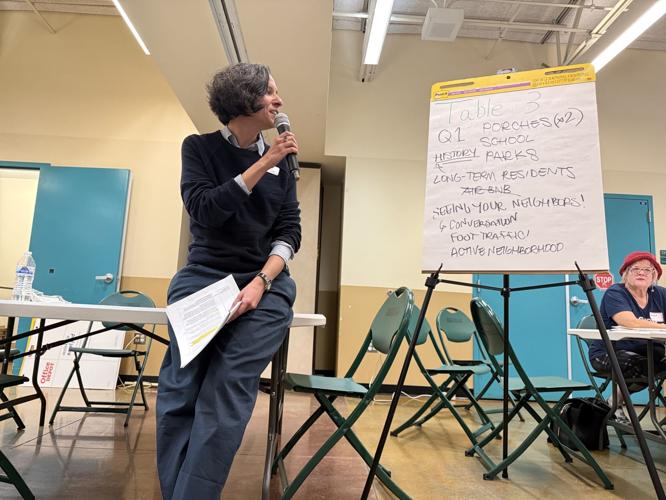
Some of the city’s housing projects are in historic barrios, said public information officer Ernesto “Neto” Portillo. In order to address the history of displacement in those barrios a policy is being proposed outside of the housing plan, Portillo said. The Community Preference Policy would give preference points to people who can show displacement or certain past barriers to housing, like a family that lost a home through urban renewal, the construction of Interstate 10 or the loss of public housing. Redlining, which kept people of color in some parts of the city from getting home loans, could also count. Those families would have a better chance at future affordable housing built by the city, he said.

Evren Sönmez, a lead planner with El Pueblo Housing Development, speaks next to a notepad with notes from a small-group discussion during a city listening session on a possible Community Preference Policy at the Santa Rosa Neighborhood Center in Tucson, Ariz., on Nov. 19, 2026. (Miguel Torres/CALÓ News)
The city is asking people to share what happened to their families as it works on a plan to bring to the mayor and City Council in late spring 2027, Portillo said. It is trying to reach families who left years ago, including their children, and has put out information in English and Spanish.
Anthony Nelson attended the city’s Nov. 19 listening session at the Santa Rosa Neighborhood Center because he’s watched his Tucson neighborhood change through gentrification. He said people in his community had raised a similar idea before, and he was glad to see the city considering it.
Speaking about what Democrats’ gains in the state elections could mean for Tucson’s proposal, Nelson said, “Something like this probably has a better chance of reaching people.”
Nicole, who is from Tucson, came to hear what others had to say about displacement as she considers doing her own research on the issue. She said city officials might have been more cautious about making promises if the election had gone differently.
“I don’t know if we would be having this conversation right now,” she said.
A home people can afford
At a Tucson Community Town Hall on Nov. 12, Tara Jackson asked about 120 people whether they or someone they knew had trouble finding a home they could afford.
Every hand went up, she said.
Jackson, president and CEO of Arizona Town Hall, heard the same worry in meetings across Arizona over the last year. In her view, housing costs helped drive the shift toward Democrats in this election.
“Almost everyone I’ve heard has said it’s about the cost of living,” she said.
Jackson has spent more than 20 years listening to people from different walks of life across Arizona. She has seen time and again how shared struggles can bring people together to push for political change. This year was no different. She heard multiple times from people who worked full-time and still could not see how they would buy a home, even with two people working.
The median age of a first-time homebuyer in the U.S. went from 32 in 2016 to 40 in 2026, according to the National Association of Realtors. First-time homebuyers made up 35% of all homebuyers in the 2016 report and 22% in the 2026 report.
At the town hall, people talked about solutions, including turning a closed school into housing.
Jackson said that election years bring more people out, and conversations revolve around a desire to change policy and keep candidates accountable by participating.
Arizona Town Hall encourages its participants to continue the momentum from these sessions. As part of the meeting, it asks participants to write down one thing they’ll do next.
Some said they would go to local meetings or help people understand landlord-tenant rights. One said they would work on local zoning and money for housing and eviction prevention.
“If you’re waiting for someone else to take the action to solve the problem, you might be waiting a really long time,” she said.
Tucson residents can share their stories from 9 to 11 a.m. Saturday, Nov. 21, at the Donna R. Liggins Recreation Center, 2160 N. Sixth Ave. People can take part in Spanish and go in person without having to register. For more information, see other city meetings or register for the Nov. 23 meeting on Zoom.
Our Voice, Our Vote Arizona is planning a tenant press action in Phoenix on Dec. 5 to call for stronger protections for people who rent.
Miguel Torres is a Phoenix-based illustrator and independent journalist who covers courts, crime and the systems around them. He spent five years reporting for The Arizona Republic and USA TODAY Network.








(0) comments
Welcome to the discussion.
Log In
Keep it Clean. Please avoid obscene, vulgar, lewd, racist or sexually-oriented language.
PLEASE TURN OFF YOUR CAPS LOCK.
Don't Threaten. Threats of harming another person will not be tolerated.
Be Truthful. Don't knowingly lie about anyone or anything.
Be Nice. No racism, sexism or any sort of -ism that is degrading to another person.
Be Proactive. Use the 'Report' link on each comment to let us know of abusive posts.
Share with Us. We'd love to hear eyewitness accounts, the history behind an article.