
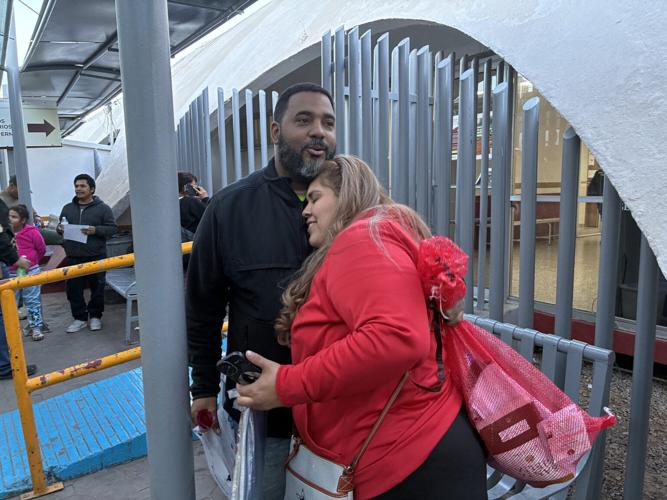




Armando and Rosita reunite after a month and a half at the DeConcini Port of Entry in Nogales, Sonora. (Credit: César Barrón)
This story was produced with support from Altavoz Lab, an organization dedicated to supporting community journalists, as part of From an Encounter with ICE to Detention: A Resource Guide in Arizona.
El Gallinero, much like its English translation “henhouse,” resembles a stable for livestock — cramped and overcrowded. The space, painted an impersonal gray, is cold and industrial.
There’s one clear distinction, however. Instead of housing chickens, El Gallinero houses humans.
It is the first place where hundreds of immigrants are held before they are assigned and transferred to long-term detention centers. Every day, people enter gallineros across the country — most still in the clothes they wore when they were arrested — uncertain about what their future holds.
That’s where Armando Urgelles Alemán found himself in Florence, Arizona, on Tuesday, Dec. 2, 2026, hours after he was pulled over by masked, unidentified men while he was on his way to his landscaping job that morning.
Armando, originally from Cuba, traveled through Nicaragua, Honduras, Guatemala and Mexico to seek asylum at a U.S. port of entry in 2019. However, during that time, the Trump Administration had enacted the Migrant Protection Protocols, most commonly known as the “Remain in Mexico” policy, which required non-Mexican asylum seekers who cross the southern border to wait outside of the U.S.
He didn’t enter through the San Luis Port of Entry seeking asylum until 2021. He was inspected and paroled into the country, meaning an immigration officer inspected him and permitted him to enter the U.S. without determining whether he could be admitted, a discretionary act exercised on a case-by-case basis, according to U.S. Customs and Immigration Services.
Armando said that until then, he was required to check in with immigration every year, but it was always deferred to the following year.
The day before his arrest, he noticed a car he’d never seen before parked in front of his house and began to have his suspicions that he was being tracked.
“Deep down, I knew they were already looking for me because I don’t hide. I’m under ICE supervision. I have a political asylum case pending, I have no reason to hide,” he said.
According to Armando, the men who arrested him weren’t wearing anything that identified them as federal immigration officials. They didn’t even enter the ICE field office. Instead, they just handed him over to uniformed Immigration and Customs Enforcement (ICE) agents.
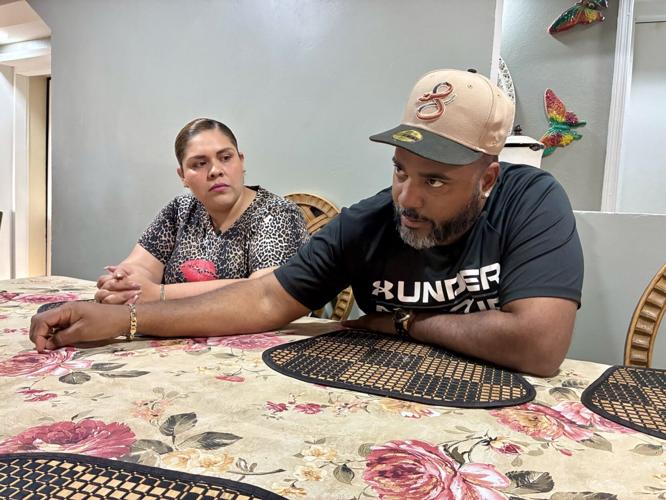
“The first thing you feel is fear. To anyone who says otherwise, my respects, but it is frightening. They’ve got you now," he said, sitting across from reporters at his mother-in-law's dining room table in Nogales, Sonora. "No matter how confident you might be, you know the process you’re about to go through is a long one."
He is one of more than 65,000 people detained in immigration detention centers across the United States, according to Transactional Records Access Clearinghouse (TRAC), a data-gathering organization at Syracuse University. Since the start of Donald Trump’s second term, his administration has detained over 610,000 people. Like 70% of the people in detention as of July 11, he has no previous criminal conviction.
As ICE arrests tripled in Arizona alone during fiscal year 2025, people are being sent to and held in immigration detention centers at unprecedented rates. That has raised concerns over the treatment of people being detained, the safety measures — or lack thereof — private prison companies have implemented to meet the influx of people, and the rapid expansion of ICE operations to meet the demands of President Donald Trump administration’s mass deportation agenda. In August, asylum claim denials rose to 94%, according to a TRAC report.
The Trump Administration has taken an aggressive stance on legal and illegal immigration, taking major steps to fundamentally reshape immigration policy, according to the New York City Bar. It has thrown various immigrant communities into uncertainty and made it virtually impossible to do it the “right way,” as so many conservative voters have asked of immigrants. Armando is just one of thousands who’ve had the rug pulled out from under them.
Back home, a call changes a family’s future
That morning on the first Tuesday of December, Rosa Hernández was awoken by a phone call at 5:30 a.m. She had been sleeping with her five-month-old baby beside her.
“(Armando) said to me, ‘Love, don’t be scared.’ And the moment he told me not to be scared, well, I got scared,” she said, sitting next to Armando in her mother’s dining room during an interview in February. “He told me, ‘I was detained,’ and I asked, ‘Who detained you? ICE?’ ‘No.’ ‘The police?’ ‘No.’ And that was all he told me.”
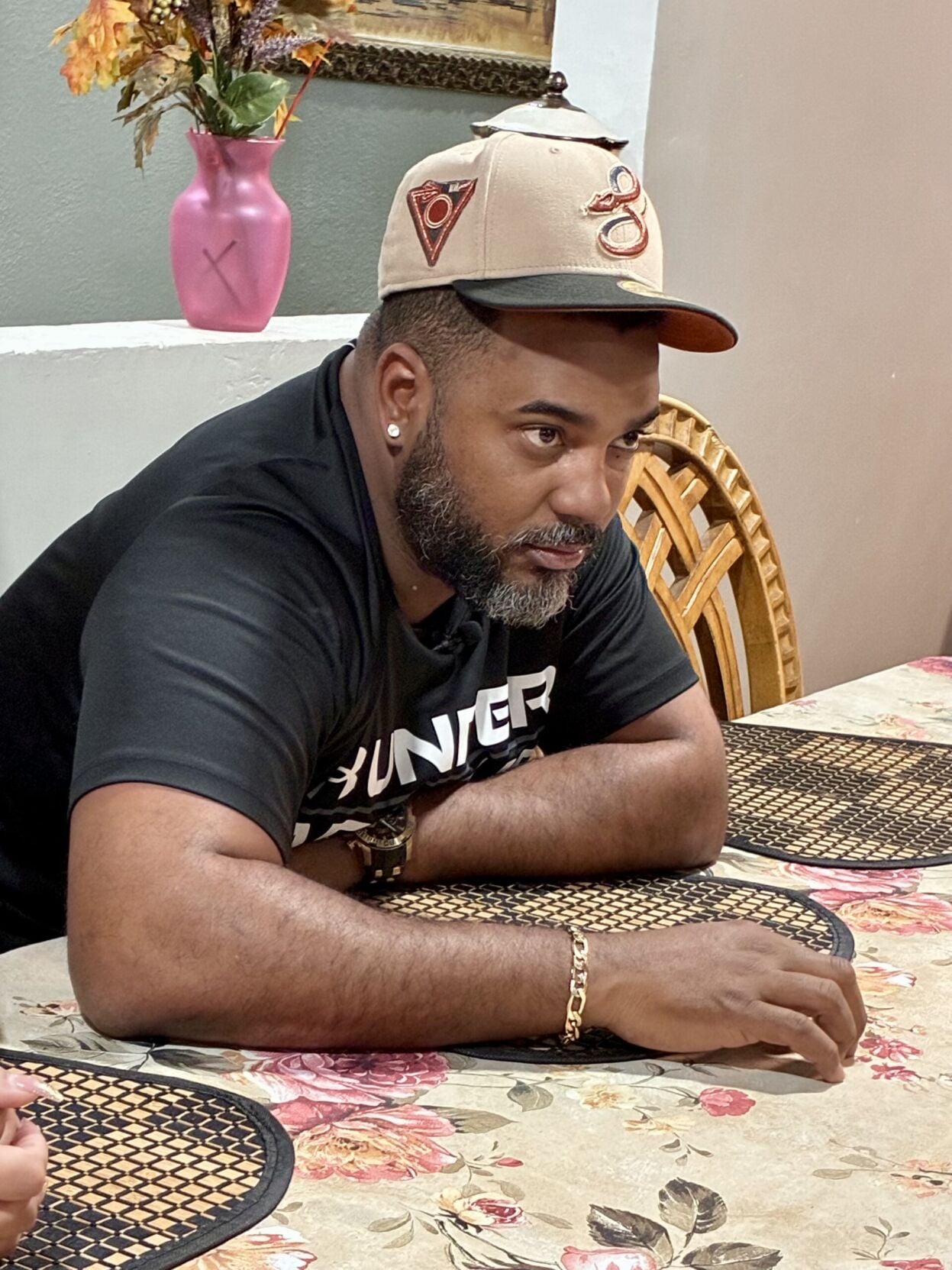
Armando Urgelles, of Cuban origin, was deported to Mexico on Jan. 16, 2026. (Credit: Liliana López Ruelas)
Armando said he doubted they were ICE agents. His skepticism isn’t isolated.
As immigration enforcement operations have picked up, impacted people have reported being confronted by masked individuals, often traveling in unmarked vehicles and wearing tactical gear with no apparent signage of which agency they belong to. ICE has said that this is done to protect the identity of its agents. This lack of transparency, however, has also been accompanied by more cases of regular citizens posing as fake ICE agents. A Noticias Telemundo investigation found at least 31 such cases in 2025, compared with an average of 5.3 incidents per year over the past decade.
Rosita immediately broke down crying. Her two high school kids were getting ready for school when she got the call, but fear kept them from leaving the house that day. She called her mom who lives in Nogales, Sonora, soon after to let her know what had happened. Her older kids locked the outdoor gates of the mobile home where they live in North Tucson. Then they began to pray.
It would be three more days until she heard from him again. That call came from inside the Florence Correctional Center.
‘We’re just numbers here’
Armando spent 15 days in a holding facility — El Gallinero —before he was transferred to the Florence Correctional Center, the detention center where he would spend just over a month until a decision was made in his case.
In the detention center, he estimated that an area meant for 100 people held nearly three times that many.
Every day, he would see a prison guard go around with a clipboard to write down the names of those who chose to self-deport. But he never saw people leave; only more arrived, he said, making the space a breeding ground for measles, COVID-19 and other transmissible diseases.
The detention center ran on a strict schedule: breakfast at 4 a.m., lunch at 11 a.m. and dinner at 5 p.m. When Armando was there, every meal was the same: potatoes and beans, he said. He was constantly hungry and he was tired of the monotonous and restricted situation he was in. He saw how the conditions affected him and the men around him.
Armando said many men were anxious to get out.It was a constant physical, emotional and psychological distress. He remembers certain guards turning on the fire alarm in the middle of the night “just because.”
“The stress in there was so intense that I was already thinking, ‘If they send me to Africa, I’ll go — I just want to get out of here, because the stress inside is unbearable,’” Armando shared. “The guys who had been there longer would tell me, ‘We can’t take it anymore, we want to leave.’ But you do it for your family. You have to hang in there — for the family, for the kids.”
The increase in detention is no coincidence. The detention industry has gotten billions of dollars from H.R.1, best known as the One Big Beautiful Bill, a federal spending bill approved in 2025 that authorized $170.7 billion for immigration and border enforcement-related spending.
The daily cost of detaining a person in prison is $152, according to ICE, a cost that private prisons are benefiting from. According to Core Civic’s yearly report — the private prison company that owns the Central Arizona Florence Correctional Complex, known as FCC — the company saw increased investment and expected continued growth from anticipated federal contracts.
ICE records show people were held for an average of 70 days in June, down from 80 days in March through May. Conecta Arizona documented how people were detained in one Phoenix processing center — or a gallinero — for periods extending the 12-hour limit, which was temporarily raised to 72 hours after ICE admitted that people were being held for longer than ICE National Detention Standards.
“A guard told me: ‘Look, every day you spend in detention is money the company is charging the government,’” Armando said. “We’re just numbers here. Any immigrant — anyone at all — is a number: the number that has to be reported to the government.”
The prolonged detentions have led many, like Kamel Maklad, to file for a writ of habeas corpus, a legal proceeding not previously seen in immigration court that demands a person's release if there is no reasonable cause to keep them detained. But many immigration lawyers don’t practice habeas and it requires hiring another attorney who specializes in this legal process, leaving only those who can afford it with the option to fight for their release.
Since January 2025, over 61,000 habeas cases have been filed for people detained for long periods in detention centers, according to ProPublica.
Armando met many immigrants, including asylum seekers, who’d won their cases in court but were still detained. Many of them had no criminal record, he said.
Trying to move forward
Back in Tucson, Rosita began looking for ways to move forward while her husband — the family’s breadwinner — was detained. She called the detention center number immigration officials gave her, but they never answered. If they did answer, they asked for an A-number Rosita did not know at the time, she said.
She had to navigate a new mental health state and be there for her four children, aged 15, 14, four years old and five months old. While the older two understood the situation, Rosita wanted to protect her four-year-old from their new reality.
“I used to tell her he had gone to Phoenix for baseball… but at one point, she grew to resent baseball. She said her dad was never going to play baseball again and that he didn’t love her.” She took a deep breath, trying to manage her emotions, but her next words came out raspy. “That he had abandoned her. And every night, she and the baby would cry, not knowing.”
One of the first forms of help she received was a $500 gift card through theJuntos Fund, a mutual aid and relief initiative started by the Sunnyside Foundation that provides direct cash assistance to families facing deportation. The fund provides up to $1,500 per household, and part of that money can go toward legal fees.
Lawyers, she soon learned, were expensive — one even charged $1,000 for a half-hour in-person consultation with Armando, though they couldn't afford to hire an immigration attorney.
She was directed to the Coalición de Derechos Humanos, a human rights organization that’s been on Tucson’s front lines aiding the immigrant community, and was connected to several people willing to help her, including La Ristra, a nonprofit organization, which brought groceries to her home. One person linked to the Coalición held a benefit concert in her honor and raised $120 in donations. From there, she would occasionally receive Zelle donations, including one random $100 donation.
“The word was spreading and I’m very happy about that, because despite knocking on the doors of so many people we knew, they didn’t turn their backs on me,” she said.
Although the financial pressure was significant, and she said there were days when the money simply wasn’t enough to eat properly, the community’s help allowed Rosita to pay two months of rent and bills and deposit money into Armando’s account so they could speak with him. Calls were short, but just long enough for them to be together every day, even if just for a couple of minutes.
Rosita was also referred to a lawyer who could give her legal advice. Rosita said he was always busy and, although he spoke with her several times by phone, Armando faced the immigration judge by himself before he was deported.

Rosa Hernández listens to her husband, Armando Urgelles, as he recounts his time at the Florence Correctional Center, where he was held by the Department of Homeland Security for more than a month in late 2025. (Credit: Liliana López Ruelas)
‘El estrés ahí adentro no se aguanta’
Armando initially migrated to the U.S.-Mexico border in 2019, fleeing a dictatorial government in Cuba. In November of that year, he entered the U.S. seeking asylum, but because of the Remain in Mexico policy, officials returned him to Mexico to await his immigration appointment in 2021.
Currently, Cuba is facing an economic and humanitarian crisis exacerbated by U.S. blockades. Food and fuel shortages leave millions of Cubans facing daily hardships.
“You leave many things behind, your family,” he said. “Above all, because you want to free yourself from that government that is suffocating Cuba.”
Previously, a law known as the wet-foot, dry-foot policy gave Cubans a fast track to citizenship once they stepped onto U.S. soil. In 2017, the Obama administration ended the policy and began treating Cuban immigrants like those from other countries, with no easy pathway to U.S. citizenship.
While fighting his case from inside the detention center, Armando failed to pass a credible fear interview conducted over the phone.
Armando’s day in court while he was detained in Florence was “dehumanizing”, he said. It lasted less than five minutes and ended with the judge upholding ICE’s decision without even giving Armando a chance to speak. He was there without legal representation. And with that, it was only a matter of time before he got deported.
Nearly two weeks after his day in court, Armando realized his commissary account — an account people can put money into for detained people to spend on food or personal items inside the detention center — was no longer active and knew he’d be deported soon; at least that’s what other people told him.
The underground information network that lives in a detention center is a lifeline among people detained because many aren’t told by guards or officials what the next steps are. Instead, they learn it from other people being held.
“In detention center, no one tells you anything,” he said.
He was taken from Florence back to El Gallinero on Jan. 8,where guards gave him back all the clothes he was wearing when he was first detained and told him he would be deported, though they didn’t tell him when or to which country.
They handed him everything but his shoes, which he was told the detention center had lost. He spent a week barefoot until the guards provided him with foam slides. About five days into his second stay in El Gallinero — still wearing the clothes he was detained in — he was given hygiene products and allowed to shower.
Between the time he was transferred from Florence to El Gallinero, he lost contact with his wife for two days.
On the outside, during that time disconnected, Rosita was contacting people Armando had been detained with in Florence, people who’d recently been deported and even people who helped orient her to what the deportation process could look like.
Not knowing where her husband was or what to expect, she made the difficult decision to start packing up her home to move to Nogales, Sonora, where she hoped Armando would be deported.
Once they were able to call each other again — with Armando in El Gallinero waiting on the day he would be deported — he would call Rosita every morning to let her know he was still in the processing center. On Jan. 15, Rosita stayed up throughout the night unable to sleep knowing Armando would get deported soon. The next morning, she waited for a call that never came. That’s when she knew he was being deported that day.
A new life in a (somewhat) new land
On Jan. 16, she arrived early at the National Migration Institute (INM) offices in Nogales, Sonora, where people repatriated from the United States are received and processed. She wanted to know if her husband was among them.
That same afternoon, around 5 p.m., he walked out of the center. Rosita waited for him with a red rose in hand and hugged him as he approached. It had been six weeks since she had seen her husband in person — since she had held him in her arms.
“Freedom is priceless,” he told our reporter that morning.
Arriving in Mexico with practically nothing was not easy for the family. They had to start over.

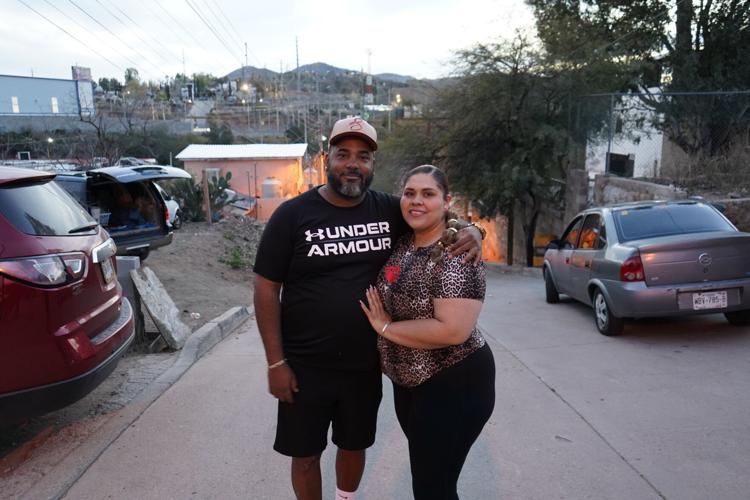
Armando Urgelles and his wife Rosa Hernández pose for a photo near their new home in Nogales, Sonora. (Credit: Liliana López Ruelas)
Obtain the right paperwork and transcripts to get their kids enrolled in school; file a marriage license so that Armando could become a Mexican resident and secure formal employment with access to social benefit programs.
In Cuba, Armando earned a master's degree in physical culture and sports. Although he is not a baseball player himself, he is passionate about the game. In Tucson, alongside his work in landscaping and construction, he offered private youth baseball coaching sessions. Now, in Nogales, he’s had to rely on that same talent to provide for his family.
Armando’s permit to legally reside and work in Mexico was approved this summer. The family is slowly rebuilding in a new town, just over an hour's drive south of where their older children were dreaming of getting an education, playing sports, living among their friends. For the younger ones, Tucson was their first home.
“It makes me very sad to think of the people who are going through — or are about to go through — the [immigration] process I experienced as a wife. I hope they find kind-hearted people to help them,” Rosa said.
From an Encounter with ICE to Detention: A Resource Guide in Arizona is a project led by journalist StephanieCasanova in collaboration with CALÓ News and Somos Tucson.
Independent reporter César Barrón contributed to this reporting.
Susan Barnett is an independent journalist in southern Arizona covering the immigrant and Latine community. She is a recent graduate from the University of Arizona, where she received her Master of Arts in Bilingual Journalism. She previously worked at La Estrella de Tucson and co-founded Tucson Spotlight.










(0) comments
Welcome to the discussion.
Log In
Keep it Clean. Please avoid obscene, vulgar, lewd, racist or sexually-oriented language.
PLEASE TURN OFF YOUR CAPS LOCK.
Don't Threaten. Threats of harming another person will not be tolerated.
Be Truthful. Don't knowingly lie about anyone or anything.
Be Nice. No racism, sexism or any sort of -ism that is degrading to another person.
Be Proactive. Use the 'Report' link on each comment to let us know of abusive posts.
Share with Us. We'd love to hear eyewitness accounts, the history behind an article.