
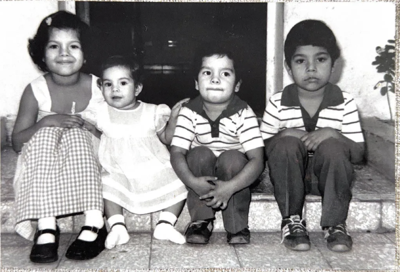

Francisco Vallecillos, middle right, and his three siblings: (from left) Maggie, Larissa and Ismar, before traveling to Mesa. (Courtesy of Francisco Vallecillos)
PHOENIX — Francisco Vallecillos remembers sitting in a truck in El Salvador, asking his mother to leave him behind. He was 7.
“They had tried for a week to get to the United States, but I couldn't get on the plane,” Vallecillos said. His immigration status was tied to his father’s, who had left earlier, and he did not have authorization to travel on his own.
“I said to her, ‘Why don't you just leave me here? Why don't you just go, get on the flights they bought you, and make it there?’”
“I said that to my mom, and tearfully she said, ‘Yeah, let's do that, that's fine.’”
Vallecillos had no idea how long he would be alone, fearing he might never see his mother again. Within days, his father returned home to bring him to the United States, but the uncertainty of that moment stayed with him.
Stories like his are not rare. As U.S. immigration policies have shifted, immigrants and refugees — especially those who relocate under the age of 12 — face heightened psychological vulnerability.
President Donald Trump has made an immigration crackdown one of his signature policies in his second term. Within his first year back in office, his administration expanded deportations, totaling over 390,000, and pushed ICE to increase arrests to 3,000 per day. Only about one-third of Americans approve of these immigration reforms, according to a study from the Harvard Kennedy School.
Zamzam Dini, an assistant professor at Alliant University who studies refugee families, said that reactions to these policy changes and heightened tensions “can look very different for each (immigrant) generation.”
A growing body of research found that immigration enforcement policies can have lasting psychological effects on children, including PTSD, anxiety and disrupted development, often compounding the harm from the conditions they fled.
Faviola Augustin, a licensed clinical social worker in Tucson, said she’s worked with children as young as 5 years old who consistently worry if their parents will return whenever they leave the house.
“Throughout the child's growing years, (trauma) can be developmental,” she explained. “And then you add the political violence, you add the systemic layers of that trauma. It's compounded.”
“I fear that we'll have intergenerational trauma impacting children that are second and third generation, because not only is the trauma not being resolved, it's being reinforced, and they're being re-traumatized,” Dini said.
“To be considered a refugee, there has to be a threat to your life,” Dini explained, referring to pre-migration stress. She said current immigration policies reinforce the feeling “that you are not safe,” which “gets in the way of any kind of healing process.”
But not all immigrant children experience this in the same way.
The 1.5 generation
Sociologist Rubén G. Rumbaut from the University of California, Irvine popularized the term generation 1.5, which refers to children who immigrate between the ages of 6 and 12.
In his 2012 publication “Generation 1.5, Educational Experiences of,” he explained his theory:
Rumbaut found that the central conflict of the generation often stems from “dissonant acculturation,” when the child adopts English and an American way of life quicker than their parents, according to his 2007 longitudinal study.
Dini observed a similar effect.
“They become the bridge between their parents and their younger siblings, but also their parents and the outside world,” Dini said. “And so, you have family roles that are shifted where the child who acquires the language skill faster is put in a parent role, where they're the interpreter, they're filling out paperwork.”
 Francisco Vallecillos, back left, and his three siblings: (from front left) Larissa, Maggie and Ismar, celebrate their El Salvadorian heritage. (Courtesy of Francisco Vallecillos)
Vallecillos, a 1.5 generation immigrant, left El Salvador for the first time when he was a young child.
He traveled with his parents and three siblings from El Salvador to Puebla, Mexico, where the family lived in poverty while scraping together funds to legally enter the United States to visit a temple. Vallecillos recalled that the people they lived with in Mexico “hated Central Americans,” making the transition difficult.
After reaching their temple in Mesa, the family returned to El Salvador. But the political landscape there had changed.
“By the time we got back, the Civil War was in full swing,” Vallecillos said. “There was a lot of civil unrest, and a lot of the big companies had pulled out. There were no jobs.”
He said the family knew they needed to return to the U.S.
Vallecillos’ father traveled alone back to Mesa, in hopes of finding work and opportunity. After some time, neighbors and members of Vallecillos’ faith, The Church of Jesus Christ of Latter-day Saints offered to fly the rest of the family to the U.S.
This is when Vallecillos told his family to leave him behind.
While retelling the story, Vallecillos could remember his mother in detail. “But after being through all that, to watch my family … leave me … and not know when I'm ever gonna see them again, was pretty difficult for me as a boy,” he said.
 The Vallecillos family celebrates a birthday together in their home. (Courtesy of Francisco Vallecillos)
The silver lining
Displacement and instability, compounded by shifting immigration policies and early responsibility, often shape children in the 1.5 generation, leading many to be “parentified” early. Yet research shows they are often highly resilient, performing well in school and adapting to both the environments they left behind and those they entered.
A study in the Child Development Academic Journal published by Oxford University Press found “a significant differential advantage between the 1.5 and second generations” as compared to other generations of immigrants. 1.5ers were proven, after assimilating, to use past experiences, even stressful or difficult ones, to their advantage academically.
Rumbaut found that 1.5 generation immigrants do not have to lose their accent, ethnic solidarity or personal identity to succeed in America. Instead, his research concluded that those who remain close with their ethnic ties yet embrace foreign opportunities were linked to high achievement patterns.
Vallecillos, now an adult with a family of his own, recalled that his parents wanted him and his siblings to remember to speak Spanish. “They wanted us to retain some things that were special.”
“But it was so important for them that we appreciated this country, and what it had offered us,” he said.
“There's always opportunity for healing,” Dini said. “Just because you experience trauma does not mean that's going to be your permanent state forever.” She said that refugee and immigrant families are very resilient, with the ability to navigate difficult situations, “and create something out of it.”
This article first appeared on Cronkite News and is republished here under a Creative Commons Attribution-NoDerivatives 4.0 International License.








(0) comments
Welcome to the discussion.
Log In
Keep it Clean. Please avoid obscene, vulgar, lewd, racist or sexually-oriented language.
PLEASE TURN OFF YOUR CAPS LOCK.
Don't Threaten. Threats of harming another person will not be tolerated.
Be Truthful. Don't knowingly lie about anyone or anything.
Be Nice. No racism, sexism or any sort of -ism that is degrading to another person.
Be Proactive. Use the 'Report' link on each comment to let us know of abusive posts.
Share with Us. We'd love to hear eyewitness accounts, the history behind an article.