
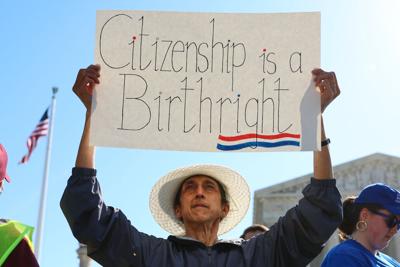


Demonstrators rally outside the U.S. Supreme Court as justices hear oral arguments on whether President Donald Trump can deny citizenship to children born to parents who are in the United States illegally or temporarily, on Capitol Hill in Washington, Wednesday, April 1, 2026. (AP Photo/Tom Brenner)
As the U.S. Supreme Court hears arguments in the highly anticipated birthright citizenship case, Trump v. Barbara, Democratic attorneys general of 24 states, including California and Arizona, released a joint statement early Wednesday morning reiterating their confidence in the constitutionality of birthright citizenship.
The statements came ahead of a landmark decision yet to be made on the merits of birthright citizenship. On the first day of his second term, President Donald Trump signed an executive order restricting birthright citizenship — the 14th Amendment that says children born on U.S. soil are entitled to U.S. citizenship, even if their parents do not have that status.
The Court began hearing arguments on Wednesday.
“The President’s executive order redefining birthright citizenship violates our Constitution, federal statutes, and the rule that has governed our Nation for more than 150 years,” the joint statement reads. “We are proud to lead the fight against this unlawful order, and grateful for the injunctions we obtained that prevented this action from ever taking effect. We are optimistic the U.S. Supreme Court will agree with every judge to consider this executive order on the merits and hold that it violates this fundamental constitutional right.”
What to know about Trump v. Barbara
Trump’s executive order declared that children born to parents who are in the country without authorization or under temporary status are not American citizens. This order would also withhold citizenship from children born to parents with green cards or permanent resident status.
More than 250,000 babies born each year would be impacted by the broad scope of the executive order, according to the Pew Research Center.
The Trump administration argues that the 14th Amendment, added after the Civil War, was only meant to apply to the children of enslaved people, not the children of immigrants. The push is an important piece in the president’s anti-immigrant agenda.
California Attorney General Rob Bonta and Arizona Attorney General Kris Mayes were among 22 state leaders who sued to block the order. The order was quickly struck down as illegal by many low-level courts.
The Trump administration first took this case to the Supreme Court last summer and on June 27, the Court ruled 6-3 that federal district courts cannot issue nationwide injunctions, but did not weigh in on birthright citizenship.
The American Civil Liberties Union then filed a class action lawsuit, Trump v. Barbara, to challenge the president’s executive order. The U.S District Court for the District of New Hampshire ruled in the ACLU’s favor, issuing an injunction blocking the order and covering what the court referred to as a class that “will be comprised only of those deprived of citizenship,” meaning the born and unborn babies who will be affected by the executive order.
The Trump administration petitioned the Supreme Court last September to challenge the New Hampshire decision.
While arguments in the case began on Wednesday, a definitive ruling by the Supreme Court is expected by early summer, according to the Associated Press.
Live updates of Wednesday’s oral arguments can be found on the Associated Press website.









(0) comments
Welcome to the discussion.
Log In
Keep it Clean. Please avoid obscene, vulgar, lewd, racist or sexually-oriented language.
PLEASE TURN OFF YOUR CAPS LOCK.
Don't Threaten. Threats of harming another person will not be tolerated.
Be Truthful. Don't knowingly lie about anyone or anything.
Be Nice. No racism, sexism or any sort of -ism that is degrading to another person.
Be Proactive. Use the 'Report' link on each comment to let us know of abusive posts.
Share with Us. We'd love to hear eyewitness accounts, the history behind an article.