

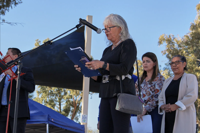

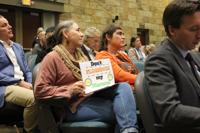
Yolanda Herrera reads from a resolution affirming the city’s commitment to address groundwater contamination on Tucson’s south side at the “Groundwater Embodied” mural unveiling at Mission Manor Park on Dec. 13, 2025. (Stephanie Casanova/Arizona Luminaria)
TUCSON – Yolanda Herrera dabs the corner of her eye with a tissue, wiping away tears as she talks about the people in her family who have died of cancer. This is the legacy she connects to decades of drinking water contaminated with trichloroethylene, also known as TCE, on Tucson’s south side.
Sitting at a concrete picnic table outside the Pueblo Neighborhood Center, Herrera, 73, remembers how water contaminated with TCE — from about the 1940s to the 1980s — impacted her family, and how it led to her involvement in advocating for clean water for more than 30 years.
For decades, families on Tucson’s south side have lived with the consequences of water contamination: burying loved ones, organizing for accountability and forcing federal and local agencies to reckon with the damage. Many of these families helped build Southern Arizona’s environmental justice movement. Now, as they age, longtime advocates like Herrera are focused on something else: ensuring that the history and unfinished fight for clean water are passed to a new generation.
Herrera’s mother, Josie Herrera lived to be 96, but was diagnosed in her 60s with a rare, deadly cancer.
“She went through surgery and treatment. She had a cadaver bone put in her jaw. Part of her hip was taken to put in her jaw, to rebuild the jaw, because the cancer just ate away, so she ended up with no teeth,” Herrera says.
“It was horrible watching my mother try to recover and eat,” she says. Her voice catches. She holds back tears.
Her mother later developed leukemia as well. Her last two years were the most painful, Herrera says.
She pauses for a moment, looks up at the sky, a moment of silence before she talks about her sister’s battle with cancer and about her many Sunnyside High School classmates who died of cancer.
Her sister, Becki Quintero, also was diagnosed with cancer. She’s in her 70s.
“She is a survivor, and I hope she continues to be a survivor,” Herrera says.
Quintero’s son, James, died of cancer. Non-hodgkin's lymphoma. He was in his 40s.
“He had the one that you can survive. But he did not,” she said. “After a year plus of treatment, he just didn't make it.”
Another sister, Cecelia Herrera, also is a cancer survivor.
Since at least the early 1950s, Hughes Aircraft, the U.S. Air Force and other companies discharged TCE and other contaminants, an industrial solvent that at the time was used to degrease planes, into areas of Tucson's south side. Some, including Herrera, say the pollution started in the 1940s, when three massive hangars — where military aircraft were cleaned — were built at the Tucson International Airport near San Xavier District of the Tohono O’odham Nation.
In 1942, Consolidated Vultee Aircraft Corporation (later a division of General Dynamics) built the hangars to modify B-24 bombers, according to the Tucson Airport Authority.
The contamination resulted in cancer cases and other rare illnesses from drinking the water until the wells were closed by 1983.
At the time, TCE in Tucson’s water source was just one of many toxic waste dumps across the country. As communities started learning about how toxic waste could impact their health and drawing national attention to it, Congress established the Comprehensive Environmental Response, Compensation and Liability Act in 1980, more commonly known as Superfund. The law created a tax on chemical and petroleum industries. It also established broad federal “authority to respond directly to releases or threatened releases of hazardous substances that may endanger public health or the environment,” using trust fund revenue generated from the taxes to clean up hazardous waste sites..
The Environmental Protection Agency added the Tucson International Airport Area to the Superfund list in 1983. The approximately 24-square mile site includes the airport, parts of Tohono O’odham Nation, South Tucson residential areas and Air Force Plant #44. The federally-owned military plant is a weapons manufacturing facility operated by Raytheon Missile Systems Company, formerly Hughes Missile Systems, according to the Arizona Department of Environmental Quality.
An EPA investigation cited one source of the contamination: Air Force Plant #44.
The contaminated groundwater at the site is part of the Santa Cruz Basin — the aquifer Tucsn uses as its principal source of water. Contaminated city wells in the area have been shut down.
The decades-long fight to clean up the contamination continues today with leaders like Herrera —- who co-chairs a Superfund community advisory board — involving young people in holding the government accountable for protecting their health and making their water safe to drink again.
Taking the torch from her father
In the early 1980s, Herrera’s father, Manuel Herrera Jr., and community organizer Lorraine Lee traveled to Washington D.C. to raise awareness about the rare illnesses they were seeing in their community.
“Dad ended up being a community advocate from age 55 until, pretty much until he passed away,” she says. Manuel Herrera Jr. died in 2021.
It took years of public pressure, including extensive community organizing by Tucson’s south side families, an investigative journalism series by Jane Kay with the Arizona Daily Star, and a series of lawsuits before Hughes Aircraft, city officials and other parties would admit to any wrongdoing.
 Founding members of Las Aguas, a nonprofit dedicated to educating people about the history of TCE contamination in Tucson’s water, pose in front of the “Groundwater Embodied” mural at Mission Manor Park on Dec. 13, 2025. From at least 1950 until the 1980s, TCE and other chemicals from military aircraft cleaners contaminated the groundwater on Tucson’s south side, which led to clusters of cancer cases and other rare diseases.
In June 1985, a month after Kay’s series was published, Tucsonans for a Clean Environment was formed. By then, community members already knew their drinking water had been polluted by the military industry. A school teacher kept a list of neighbors who had become ill, and hundreds of residents had shared their stories with Kay, as she reported on the contamination.
Members of Tucsonans for a Clean Environment would be the first in a long line of environmental justice advocates from Southern Arizona.
Manuel Herrera Jr. was a founding member of the Sunnyside Neighborhood Association in 1988. He also helped create the Unified Community Advisory Board in 1995, which allowed residents to have a formal voice in the EPA’s clean-up process.
The advisory group provides “a public forum for community members to present and discuss their needs and concerns related to the Superfund decision-making process,” as well as offers EPA officials an opportunity “to hear and seriously consider community preferences for site cleanup and remediation,” according to the EPA.
Yolanda Herrera joined the Sunnyside Neighborhood Association and started attending advisory board meetings in the early 1990s, after her father suggested she get involved. She is now the community co-chair.
In a video interview currently on display at Tucson’s Museum of Contemporary Art, part of the exhibit Living With Injury, Herrera tells the interviewer, environmental scientist Denise Moreno Ramírez, that the Unified Community Advisory Board was created so residents could speak to the government agencies responsible for the water contamination.
“And look them in the eye and ask them the hard questions and make sure that they weren’t going to try to lessen the effects that we were suffering,” Herrera says in the video. “We needed to be in front of them so that they know what they did to this community.”
The MOCA exhibit was co-curated by environmental scientist Sunaura Taylor, who wrote a book about southside Tucson’sTCE contamination and the struggle for environmental justice, titled, “Disabled Ecologies: Lessons from a Wounded Desert.” Taylor’s book examines the contaminations “ripple effects through the largely Mexican American community.
Fellow curator, historian Alisha Vasquez is co-director of the Mexican American Heritage and History Museum at the Sosa-Carrillo House. The exhibit features work by artists, journalists, and researchers including Alex! Jimenez, Franc Contreras, and Ramírez. It’s part of Survival and Resistance, a yearlong project that aims to acknowledge the harm Tucsonans experienced and to celebrate the progress and knowledge of southside organizers.
Herrera said it’s important to continue to pass down that knowledge. In her decades of volunteer organizing, Herrera has worked with national and local leaders to make sure residents’ voices are taken into account as the EPA continues to clean up chemical pollution left behind. She has also worked to educate younger generations so that they can step up and continue to advocate for clean, healthy water for Tucsonans.
“We do need to encourage younger people to pick up the torch, get involved, learn about what happened, because until they learn it, it runs the risk of repeating itself,” Herrera says. “We need somebody to continue to hold our elected officials' feet to the fire.”
El Pueblo Neighborhood Center became a hub for community members trying to organize and hold powerful companies accountable. It’s where the Unified Community Advisory Board first met and continues meeting quarterly. The El Pueblo Health Center hosted a TCE program where people impacted by the contamination could be screened and receive healthcare for certain illnesses.
In November, the El Pueblo 50 exhibition launched, commemorating 50 years of the neighborhood center’s history and its role as a community gathering space. Part of the exhibit highlights the fight for justice and accountability as TCE chemicals harmed families in the surrounding neighborhood.
 Roberto Jaramillo reads a portion of the resolution Tucson Mayor and Council passed in November affirming the city’s commitment to addressing groundwater contamination on Tucson’s south side at the “Groundwater Embodied” mural unveiling at Mission Manor Park on Dec. 13, 2025.
“The people who literally pay with their lives”
Herrera served on the curation team for El Pueblo 50, alongside a group of other longtime residents and city leaders. Raul Aguirre, a longtime Chicano community leader and organizer, was also among that group. Aguirre was a radio show host in the early 80s. His talk show was titled, “Tabúes y Realidades: Pláticas de la Vida.”
While he wasn’t in the meeting rooms where community members gathered to demand accountability, Aguirre used his radio platform to educate the community and hold local politicians accountable. He brought in doctors, scientists, advocates, and the local elected officials “that were supposed to be doing something about this,” Aguirre says.
Aguirre was a close friend of Lorraine Lee, the Tucson community organizer and leader who traveled in the 1980s with Herrera’s father to the nation’s capital to raise awareness about the rare illnesses in their neighborhoods. They met at Pueblo High School, where he was her unofficial campaign manager when she ran for class president.
In college, he recruited her to help him reactivate the University of Arizona chapter of MEChA, which stands for Movimiento Estudiantil Chicano de Aztlan, or the Chicano Student Movement of Aztlan, a student movement founded in 1969.
“She became very active in, you know, advocating for funding, advocating for investigations, advocating for the community of the south side,” Aguirre says.
By then, Lorraine Lee was a leader at Chicanos Por La Causa. In that role, she made connections with other national advocacy organizations. Aguirre credits her leadership and those connections at least partially to Tucson becoming a Superfund site.
Lorraine Lee died of throat cancer in 2007 at 52. She left behind a legacy of social justice and organizing work. As Aguirre walked through the Living with Injury exhibit on opening night in November, he felt sad knowing people had to die because of a lack of awareness or consciousness. He says it’s important to commemorate those who fought for a cleaner environment and suffered from the contamination.
“The memorials are important because those are the people who literally pay with their lives for lack of responsibility on behalf of, you know, some of the corporations and the institutions,” Aguirre says. “So I think it's very, very important that we honor the leadership of people like Lorraine, and people who are alive, you know that are still contributing.”
 The “Groundwater Embodied” mural at Mission Manor Park includes names of people who have died and were impacted by TCE water contamination on Tucson’s south side. The mural at Mission Manor Park by artist Alex! Jimenez was unveiled on Dec. 13, 2025.
“La lucha continua, the struggle continues”
In December, about a month after the Living with Injury exhibit opened at the MOCA, more than a hundred Tucsonans, many who grew up in the south side, gather near the playground at Mission Manor Park.
About a dozen people at the park hold a printed photo of their loved one who died of water contamination. They are here to see Alex! Jimenez’s new mural, “Groundwater Embodied,” a mosaic of colorful clay tiles depicting a body lying in the desert above water. Jimenez grew up on Tucson’s south side, and her artwork has centered the Sonoran Desert and water.
For the mural, Jimenez invited community members throughout the year to make clay tiles with their loved ones’ names or tiles in the shape of the body parts that were affected. The tiles with names, in the shape of a wave, were painted blue to depict water.
Before the mural unveiling, community organizers and elected leaders who grew up in the south side speak about the impact of TCE and of the region’s environmental justice movement. The sounds of creaking swings, children laughing, a basketball bouncing on the court, fills the background as Eduardo Quintana slowly walks up a ramp onto the stage and takes the microphone.
 Eduardo Quintana, co-founder of Tucsonans for a Clean Environment, talks about the importance of learning the history of water contamination in Tucson and continuing to fight for clean water, at Mission Manor Park on Dec. 13, 2025.
Quintana is a former employee at Hughes Aircraft and a union organizer. He helped found Tucsonans for a Clean Environment and has run for office under the Green Party several times.
“I'm shocked to be here with a megaphone in my hand and surrounded by all you people,” he says. “But needless to say, la lucha continua, the struggle continues, and it's because of the young people, the 40-year-olds like Alicia. They're not going to let it go, because they're either victims, or their relatives are victims or the people who died. They will never, ever be forgotten, and that's why the struggle will continue.”
Quintana is also featured in the MOCA exhibit. In a video interview, he tells Moreno Ramírez that the goal of Tucsonans for a Clean Environment was to get justice. He said that hasn’t happened yet.
“People lost family members,” he said. “There were deaths. People have been sick for decades, suffering.”
Before the city and aircraft companies admitted wrongdoing, members of Tucsonans for a Clean Environment knocked on doors and surveyed their neighbors. They used pins on a map to track where people were getting sick. That map almost mirrored the EPA’s map of the plume, where the highest concentration of illnesses were found closest to the wells.
“This is generational”
Eva Carrillo Dong spent a lot of time at Mission Manor Park with her close friend Dorrie Ann Duarte in high school. They played in a girls softball team at the park. And they drank water from the park’s fountains. This was in the early 1970s, before they knew the water they were drinking was contaminated and would make them sick.
Duarte was diagnosed with liver cancer and died months later. She was 23.
“She was the one I was supposed to grow old with and be on a rocking chair with, you know, talking about the good old days,” Carrillo Dong says, leaning on a cane and wearing a mask to protect herself.
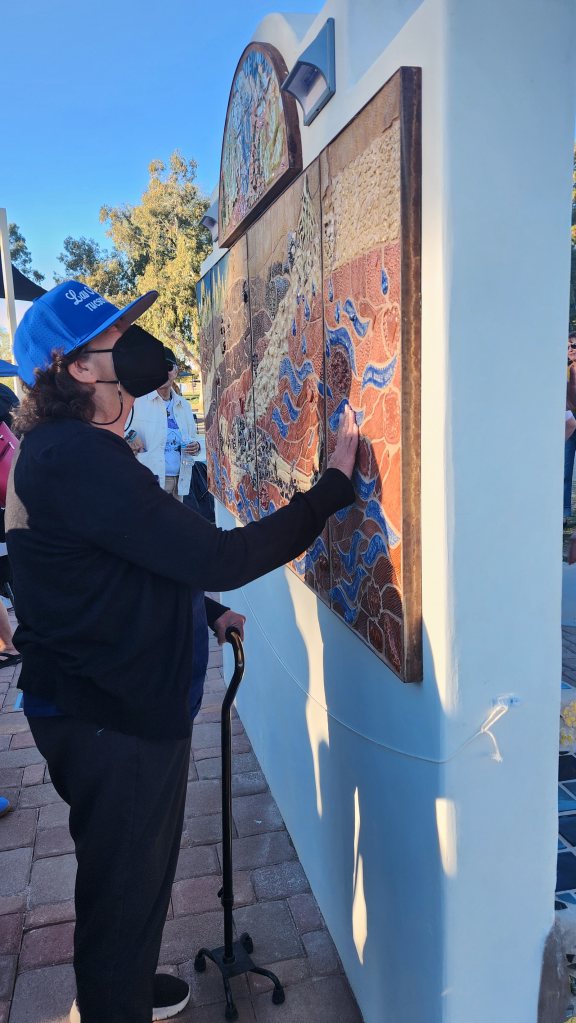 Eva Carrillo Dong touches a tile of the “Groundwater Embodied” mural with the name of a family member who was impacted by water contamination on Tucson’s south side. The mural, which commemorates those who were impacted by TCE contamination in Tucson, was unveiled at Mission Manor Park on Dec. 13, 2025.
Carrillo Dong has two autoimmune diseases. Because of the water contamination, family members have been diagnosed with brain tumors, liver tumors, and other cancers, she says.
That includes her father, Clemente Trejo Carrillo, and her brother, Tony Carrillo. Those who didn’t die early have seen their quality of life affected by autoimmune diseases like lupus and Sjögren’s Disease. Some women in the community have not been able to conceive, she says.
“We didn't know that when we were 15, 16 years old, and losing parents and losing grandparents, that eventually it would come to us too, and that we would eventually become ill,” Carrillo Dong says. “And now our children have, you know, different things that are going on with them. So this is generational. It's not just one generation, not just my parents' generation, but it's our generation. It's my children's generation.”
As generations continue to be affected by the water contamination, those same generations have organized and continue to hold leaders accountable.
Carrillo Dong watched and participated in discussions regarding water clean up, but she felt that things were moving too slow. So she worked with Roberto Jaramillo and other organizers to educate city leaders. In 2015, Carrillo Dong and Roberto Jaramillo founded Las Aguas, an organization that aims to educate people about water contamination in Tucson’s southside since the 1940’s.
Carrillo Dong is a former Sunnyside Unified School District board member. She says it’s important to continue educating youth about what happened with Tucson’s water. She hopes they continue to step up and hold elected leaders accountable for finally making their water safe to drink.
“I reflected a lot on my friend because we spent so much time at this park,” she says, holding back tears. “Having so much fun, so many good memories.”
Once the line of people taking photos in front of the mural subsides, Carillo Dong walks up to the mural and silently reads the names on the blue tiles. She places her hand on the tile with her childhood friend’s name, then on the names of family members, taking a moment to reflect on their memory.
This article first appeared on AZ Luminaria and is republished here under a Creative Commons Attribution-NoDerivatives 4.0 International License.







(0) comments
Welcome to the discussion.
Log In
Keep it Clean. Please avoid obscene, vulgar, lewd, racist or sexually-oriented language.
PLEASE TURN OFF YOUR CAPS LOCK.
Don't Threaten. Threats of harming another person will not be tolerated.
Be Truthful. Don't knowingly lie about anyone or anything.
Be Nice. No racism, sexism or any sort of -ism that is degrading to another person.
Be Proactive. Use the 'Report' link on each comment to let us know of abusive posts.
Share with Us. We'd love to hear eyewitness accounts, the history behind an article.