
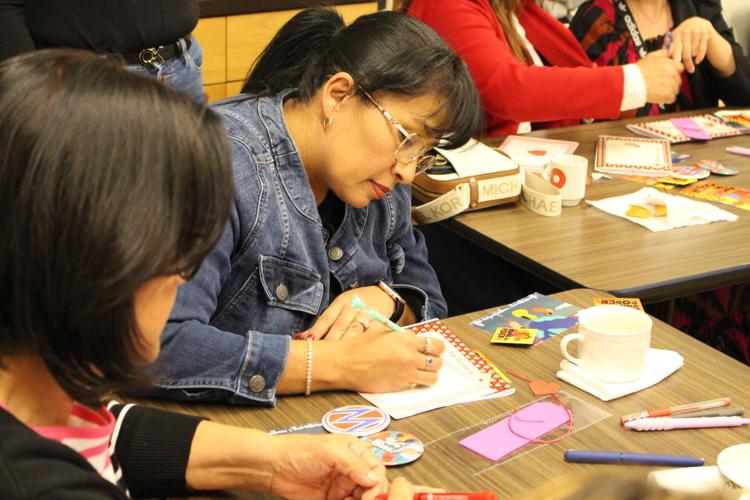

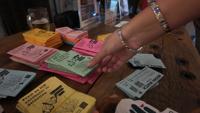
A participant of CreSer’s “Una Tacita de Té Para El Alma” discussion writes a Valentine’s card for her child on Wednesday, Feb. 18, 2026. The woman is part of a free weekly group that meets to talk about healthy relationships, finances and other topics based on social determinants of health.
TUCSON – Nersa Morimoto has participated in CreSer’s weekly support group, “Una Tacita de Té Para El Alma” (A Cup of Tea for the Soul), since October. Through the group, she has found women she can confide in, trust and be herself around.
That was Imelda Esquer’s goal when she first started CreSer last February. She wanted to create a space where families could feel safe being themselves, celebrating their culture and getting the resources they need to thrive. After working as a program manager running several programs for the Latino community in Tucson, Esquer decided to branch out on her own and create something for the Spanish-speaking community.
The nonprofit provides free basic computer classes, three levels of English classes, two annual community health fairs and two active support groups, where guest experts talk to members about financial, social, emotional, physical and romantic health, among other topics. Whether a person is looking to obtain their GED, find a job or find community, CreSer finds a way to make those connections.
All of the organization’s programs are free and are based on the social determinants of health — economic stability, access to quality education, access to quality healthcare, housing in a safe neighborhood and social and community connection.
“The unique challenges, limitations, and barriers that our community faces; they are so complex,” Esquer said. “And sometimes there aren't enough resources, or we don't understand how to connect our community with other resources or how to be the intermediary between the community and the available resources. So, [CreSer] was born out of that need.”
Morimoto moved to Tucson from Mexico about a year ago, and almost immediately started looking for social groups she could join, she told CALÓ News.
She said that in CreSer, she found a safe space that helps women like her improve themselves.
“CreSer is an institution that just started, but I see a bright future for it, because the founding women here truly have enormous hearts and a tremendous desire to help,” she said.
Esquer runs the organization with little funding and without a salary for herself, volunteering at CreSe while working a separate job to sustain herself, she said.
“It's difficult because oftentimes passion isn't everything. Working hard isn't everything,” she said. “You need resources, both financial capital and social capital, a building. What we have — and it matters deeply — is a community that believes in us.”
That community has sustained her in her first year. The South Side Presbyterian Church and Menlo Family Resource Center have allowed her to use their space for classes and meetings. And the women who participate in the programs have helped her build up the organization, Esquer said. She’s proud of how far CreSer has come in its first year.
“I believe that when there is unity, when there is desire, when there is sincerity, when there is passion, you can achieve many things,” Esquer said.

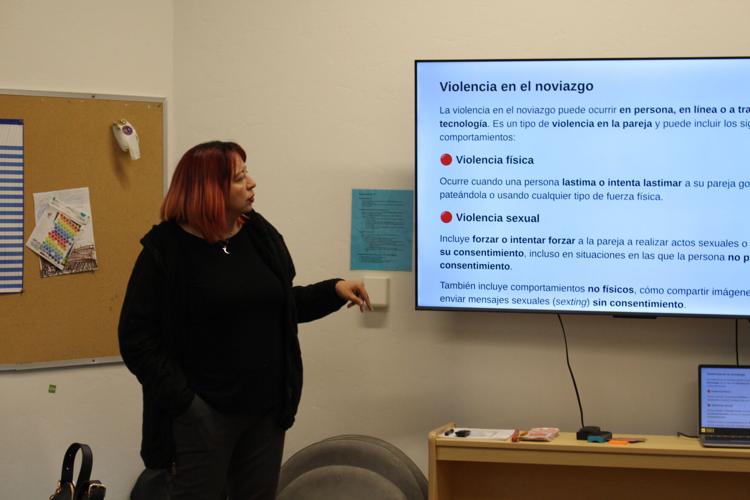
Judith Pereida talks about different kinds of partner violence and how to talk to youth about healthy relationships. Pereida works with Imelda Esquer, founder of CreSer, a nonprofit that provides free resources and support groups for Spanish-speaking women.
Championing conversations about family health
From conversations about drug abuse prevention and healthy communication with children to identifying signs of domestic violence, CreSer’s Tacita de Té series explores topics that help community members have more open conversations with themselves and their loved ones.
On a recent Wednesday evening, over a dozen women packed a small room at Southside Presbyterian Church. They were served anise and cinnamon tea as they prepared to learn about consent and how to talk to their teens about healthy relationships.
Ana Gonzalez, the Tacita de Té event coordinator, shared the objectives of the workshop: understanding partner violence, exploring ways to talk to youth about limits and consent, identifying signs of violence and learning how to respond to those signs.
“This workshop isn’t about judging anyone’s parenting,” Gonzalez said. “Everyone’s parenting style is perfectly fine. Learning new tools helps us improve our parenting. The workshops are meant to support and guide you.”
Judith Pereida has worked with Esquer as a promotora, a community member trained to help other community members access health and social health services. Pereida talked about the many types of ways youth, and people in general, may experience partner violence — physical, mental, emotional.
Physical abuse isn’t just someone hitting you, she told the women. It also includes someone throwing an object, even if it doesn’t hit you, or someone not letting you leave a room.
There is harassment, bullying and online stalking, Pereida said, which is when someone is giving someone unwanted and persistent attention that can lead to fear.
“Right now, with youth, the most common violence is virtual, right?” she said, adding that with phone use and social media being so common, that’s where bullying and violence can happen.
Two guest visitors from Mexico, nursing students from the Universidad Nacional Autónoma de México (UNAM), showed the class a video about consent that uses tea as an example. The video shows how easy it is to understand consent if you change the concept of consent to serving someone a cup of tea.
The nurses also talked about cultural norms in Latino communities that need to be broken in order to teach children about consent. Mexicans are used to telling their kids they have to hug or kiss their older relatives, which unintentionally may teach them they don’t have autonomy over their own bodies, Juliana Garcia, one of the nursing students said. She shared that 80% of sexual assault perpetrators are family or friends of the victim.
As the presenters brought up these topics, women jumped in sharing personal examples related to the topics. An older woman said she grew up with that culture of hugging and kissing relatives even when it doesn’t feel safe. Her daughter now warns her that her grandchildren are being raised differently and won’t be forced to interact with family in ways they don’t feel comfortable, she said.
After the presentation, the participants wrote Valentine’s cards to their children with a message of support. Esquer gave them a list of suggested question prompts they could answer in their letters.
Esquer tries to include art into the support group sessions, and incorporate the member’s ideas into CreSer’s programming. The sky is the limit when it comes to what they can and can’t try, she said.
They’re currently working on a screenplay titled “The Perfect Victim” based on three of the women’s experiences and breaking down the three responses to trauma — fight, flight and freeze. She’s also planning some dance events to help the ladies tune into their younger selves.
As she takes in the conversations, she comes up with program and event ideas, she said.
“When they see their voices or their ideas, or know that what they've shared is taken into account, they feel ownership,” Esquer said. “In other words, CreSer doesn’t belong to anyone, CreSer belongs to the community.”
Stephanie Casanova is an independent, bilingual journalist from Tucson, Arizona, covering community stories for over 10 years. She is passionate about narrative, in-depth storytelling that is inclusive and reflects the diversity of the communities she covers.






(0) comments
Welcome to the discussion.
Log In
Keep it Clean. Please avoid obscene, vulgar, lewd, racist or sexually-oriented language.
PLEASE TURN OFF YOUR CAPS LOCK.
Don't Threaten. Threats of harming another person will not be tolerated.
Be Truthful. Don't knowingly lie about anyone or anything.
Be Nice. No racism, sexism or any sort of -ism that is degrading to another person.
Be Proactive. Use the 'Report' link on each comment to let us know of abusive posts.
Share with Us. We'd love to hear eyewitness accounts, the history behind an article.