
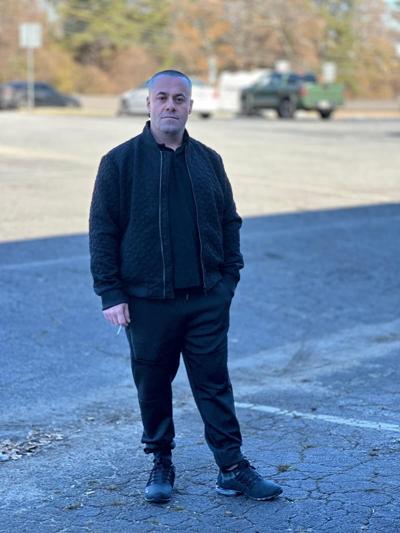


Kamel Maklad was released from Eloy Detention Center on Dec. 9, 2025, after a federal judge granted his habeas corpus petition. He is now in Atlanta, Georgia, with a cousin while he waits for a work permit. (Provided by Kamel Maklad)
TUCSON – A Syrian man was released from Eloy Detention Center in Eloy, Arizona, more than a year after winning his immigration court case, thanks to a federal protection that is being increasingly used in immigration cases.
Kamel Maklad, who prior to arriving in the U.S. migrated to and lived in Venezuela for over a decade, had already spent 14 months detained in Eloy when an immigration judge in November 2024 granted him “withholding of removal,” meaning he could not be deported to Syria because he would likely be persecuted. In previous years, migrants who were granted withholding of removal were released without a pathway to citizenship. They would live in limbo, often receiving a work permit while knowing there was always a possibility that they might be deported to a third country, Luis Campos, a longtime immigration lawyer, told CALÓ News.
But the current administration is changing course, keeping people detained even after they have won their immigration court case. Maklad spent a year in immigration prison after winning his case. Without upcoming court hearings, he grew exasperated, not knowing how long he would be behind bars.
On Dec. 9, Maklad was released from Eloy Detention Center. His case is one of thousands of immigration cases across the country where lawyers are turning to federal district courts for a solution.
After seeing how much President Donald Trump’s administration had changed the immigration legal system in the last year, Campos, Maklad’s immigration lawyer, decided the best way to get Maklad released would be through a habeas corpus petition.
He reached out to Keith Hilzendeger, an assistant federal public defender in Phoenix, to help him file the petition.
Habeas, one of the oldest legal protections, forces the government to explain why a person’s detention is legal or else release the person, Heilzendeger said.
Over time, the use of habeas has shifted, Hilzendeger said, increasingly being used to help release people from immigration detention this year. So far in 2025, Hilzendeger has filed 21 habeas petitions.
In Arizona, between Jan. 20, 2021, and Jan. 19, 2025, there were 25 habeas petitions filed, Hilzendeger said. Since January 2025, there have been 214 habeas petitions filed in Arizona.
A group of vetted volunteers has started tracking immigration-related habeas cases across the U.S. Their database lists 8,102 total habeas cases since Nov. 20, 2023 — 6,510 of them are active.
Justice for one, while thousands remain in limbo
Hilzendeger filed a habeas petition on behalf of Maklad on Nov. 18, court records show. By Dec. 5, Timothy Courchaine, a U.S. attorney in the District of Arizona, filed a response in court saying the federal government could not establish that there is a “significant likelihood of removal in the reasonably foreseeable future.”
Immigration and Customs Enforcement (ICE) and the federal government did not oppose Maklad’s request for release, a court response that Hilzendeger shared with CALÓ News shows. U.S. District Judge John J. Tuchi ordered that Kamel be released by Dec. 9.
“We were fortunate to draw a judge who saw the case for what it was and Kamel was released even more quickly than I expected him to be,” Hilzendeger said. “His case did not linger very long. And you know, ultimately, the right thing happened. Justice prevailed.”
Once a person has a final order of removal, also known as an order of deportation, the government, by statute, has 90 days to deport that person. Most of the time, that is a reasonable timeline, Hilzendeger said.
In the late 1990s, a couple of test cases were filed where people challenged the government’s ability to hold someone in immigration detention for more than 90 days after the government was unable to deport them. In 2001, the Supreme Court sided with the migrant in one of the main cases.
The reason why over-90-day immigration detentions are not allowed — “and this is important — this detention is not punishment for a crime,” Hilzendeger said. “[Immigration] detention is meant to either ensure that the person shows up to their deportation proceedings or, if they have a final order of removal, it's to make sure that the person shows up at the moment that they're going to be deported.”
Habeas petitions have to be filed individually, Hilzendeger added. “The Trump administration is relying on enough people not having the resources to find a lawyer and will be deported before they can file a habeas.”
Because the executive branch oversees the immigration court system, and immigration judges are appointed and can be dismissed by the president, it’s difficult to see the immigration court system as independent, especially in the Trump administration's “hyper-political climate,” Campos said. More than 100 immigration judges have either been fired by the Trump administration or have resigned.
“I know that there have been many successful habeas petitions out of Eloy,” Campos said. “Which leads me to believe the government is holding people without legal justification, and what it takes to get them out is put them into a habeas posture.”
From Syria to the U.S. by way of Venezuela
Maklad first left Syria in 2011 and moved to Venezuela, fleeing a civil war. He lived in Venezuela for 11 years, where he learned Spanish. But after his visa expired in 2022, he said police would threaten him.
He entered the U.S. in September 2023 at the Arizona-Mexico border with a group of migrants, including some of his cousins, he said. The group turned themselves in to U.S. Border Patrol agents immediately and began the asylum-seeking process. Until last week, Maklad had not experienced any semblance of freedom in the U.S.
When Campos told Maklad the judge had ordered his release, he couldn’t believe it. He dropped the phone. He picked it back up and asked Campos to repeat himself.
“I don't know what feeling I had at that moment, I was happy, I cried,” Maklad told CALÓ News. “I started shouting … that this trauma was finally going to end. Two years and three months detained for no reason, in an inhumane situation.”
On the morning of Dec. 9, immigration agents took Maklad to a processing center where they placed an ankle monitor on him before taking him to a church in Phoenix.
“That church welcomed me with all the love, all the affection and all the respect,” Maklad told CALÓ News in Spanish. “I say, God bless those people because they are truly angels of God on earth. They treat everyone without thinking about color, without thinking about nationality, without thinking about anything else, they treat everyone with the same affection, with love, with respect.”
He borrowed a phone and he called his family in Syria. Then, a volunteer took him out to an Arab restaurant in Phoenix. The next day, Maklad was on a plane headed to Atlanta to reunite with his cousin.
But a week after his release, Maklad told CALÓ News he still struggles, uneasy with the increase in ICE raids. He had a nightmare that people were after him, trying to kill him, he said.
He’s now working with Campos to obtain a work permit. He has to check in with ICE on Feb. 10 in Georgia. “That's what I'm waiting for to start my life,” he said. “To start seeing what I can do with my life.”
Still, he is grateful to be out of Eloy and to the many people who supported him, including Campos and volunteers from Eloy Visitation and Accompaniment, a Tucson nonprofit that visits and supports detainees.
“I am very happy. I am joyful, content. I don't know how to explain how I feel and the happiness of having this freedom because it's the most valuable, the most beautiful thing in life — it's freedom,” Maklad said. “It's the most precious thing, priceless: freedom.”
Stephanie Casanova is an independent, bilingual journalist from Tucson, Arizona, covering community stories for over 10 years. She is passionate about narrative, in-depth storytelling that is inclusive and reflects the diversity of the communities she covers.








(0) comments
Welcome to the discussion.
Log In
Keep it Clean. Please avoid obscene, vulgar, lewd, racist or sexually-oriented language.
PLEASE TURN OFF YOUR CAPS LOCK.
Don't Threaten. Threats of harming another person will not be tolerated.
Be Truthful. Don't knowingly lie about anyone or anything.
Be Nice. No racism, sexism or any sort of -ism that is degrading to another person.
Be Proactive. Use the 'Report' link on each comment to let us know of abusive posts.
Share with Us. We'd love to hear eyewitness accounts, the history behind an article.