
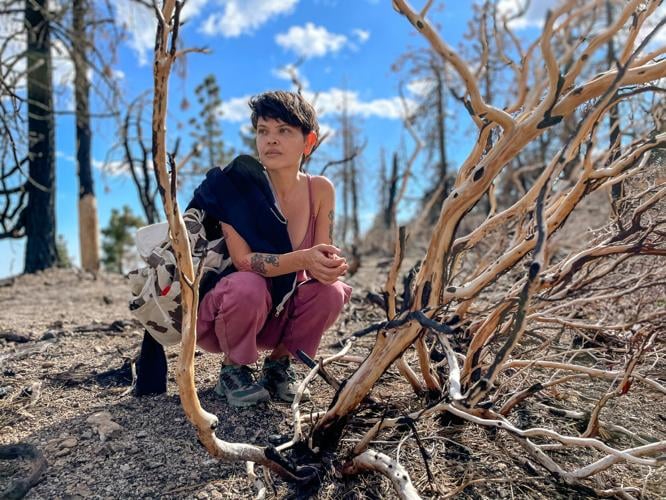

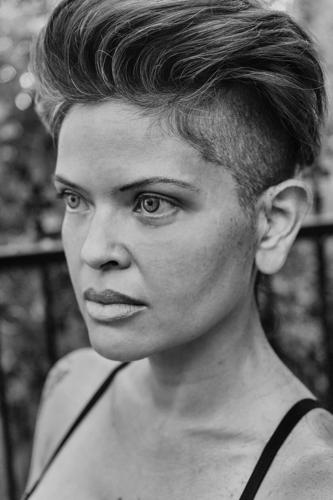
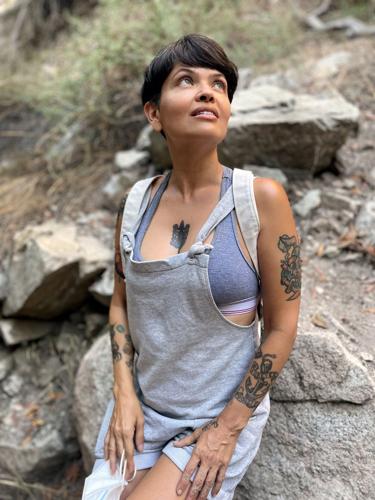
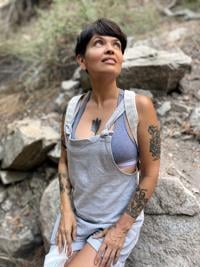
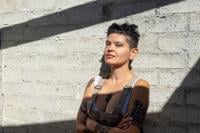


Joan Didion often featured herself on the covers of her books to assert her identity and presence as both the creator and the subject of her work. Photo courtesy of Myriam Gurba.
Return
Myriam Gurba's introduction to the solemnity of funerals came through the loss of her cousin, a casualty of teenage violence during his daily commute to school. Decades later, the fog of that moment revisited her, only this time as a teacher.
While Gurba was teaching history in a Long Beach high school, a student from the same school she was teaching at was murdered on his way home from school. With memories clouded in the fog akin to her cousin's murder, this prompted Gurba to do one thing the next day with her students: have a discussion on it.
“It tore my family apart, because losing a child, especially a child through homicide, it's incredibly disruptive,” Gurba said. “So having understood the impact that proximity to an event like that can have, I understood that everybody at our school was likely experiencing some form of vicarious trauma.”
The students of Gurba, which amounted to over a thousand strong by the end of Gurba’s teaching career, spoke. And Gurba listended. In the tricky reverse narration that impels our entwined stories, I was in one of those classrooms as a student of Gurba’s.
This is what Gurba is so good at doing. To never force, but to invite the elephant into the room. Now, it's almost become a given from Gurba, particularly in her approach to activism and, more prominently, her writing style.

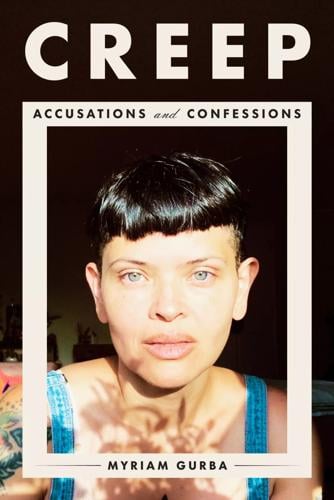
Book cover of "Creep" by Myriam Gurba.
In her latest collection of essays, "Creep: Accusations and Confessions,” Gurba delves into a myriad of experiences that have enveloped her life, spanning from childhood pranks to detailing the complexities of living with an abuser only a few years ago.
A "creep" may embody the archetype of a solitary malefactor, a realm that symbolizes fear. But in Gurba’s eyes, "creep" also encapsulates the essence of the fog, an insidious nature that envelops spaces to execute its malicious deeds.
The malicious deeds that the fog has brought Gurba have forever been pluralized. Detailing her initial experiences with sexual assault in her 2017 book “Mean” and her ongoing experiences with it in her latest entry of essays.
Gurba gravitates towards monosyllabic words like "Creep" and "Mean" for titles, showcasing her penchant for brief words that pack intricate meanings. Encouraging readers to delve into the versatility of language through one word, I chose to divide the article into three parts, to delve into various aspects of the subject matter.
“I hope that bisexual women who are experiencing the same violent circumstances that I did, can use the storytelling in ‘Creep’ to be able to understand their own predicament better, and to possibly use any sort of language that they would like to take from me in order to be able to explain on the conditions of their entrapment,” Gurba said.
Revisit
However, while my life and Gurba’s began to intertwine as student and teacher in the classroom, it soon ended at the end of the school year as do most student and teacher relationships.

Joan Didion's decision to appear on her book covers could be viewed as a deliberate artistic statement. Photo courtesy of Myriam Gurba.
But, an introduction of Gurba to the rest of the world, and a reintroduction for me, would come in the beginning of 2020. In a scathing review (the term review is used loosely as it was more equivalent to Gurba throwing a cup filled with ice water at somebody) of the controversial release of the 2020 novel “American Dirt” would propel Gurba to the front of the news cycle.
Mince no words, the attachment of Gurba's name to “American Dirt” will continue long into her career, but the opportunities gained and lost that came from the review eventually solidified Gurba’s name as one to stay.
“Gossip can also take the form of a book review, and I used mine to warn audiences about the narco-thriller masquerading as a work of social realism," Gurba writes in her essay On Art and Activism in the collection of “Letters to a Writer of Color.”
"Interviewers asked me if I thought my viral essay had played a part in boosting book's sales and I answered, ’No.’ I explained that the publishing industry has a machine in place that creates bestsellers, Oprah Winfrey's Book Club imprimatur being a vital part of that machine."
Three years later, you can find the same review that Gurba wrote word-for-word in “Creep,” a piece of literary criticism that opened the door for Gurba to examine other pieces of literature.
While Joan Didion’s name is forever sketched in the stone that holds the literary movement that Didion propelled in California, Gurba places herself on top of that stone and examines Didion’s work as a way of circling back to the present.
The antecedents that Gurba finds in reexamining Didion’s past work shows how a book like “American Dirt” can eventually be published, let alone be a bestseller, a technique that is used throughout “Creep.”
In the second essay of “Creep,” titled “Cucuy,” Gurba recalls introducing one of her classes with the mugshot of Ernesto Miranda, the man pivotal in the Supreme Court decision mandating that criminal suspects must be informed of their right against self-incrimination and their right to seek counsel before police interrogation.

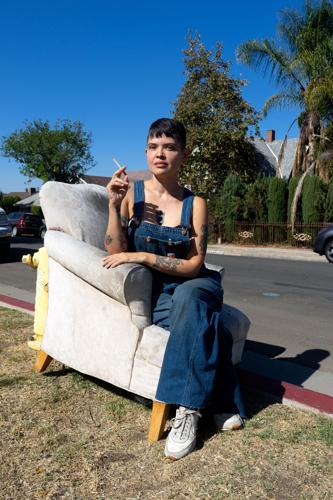
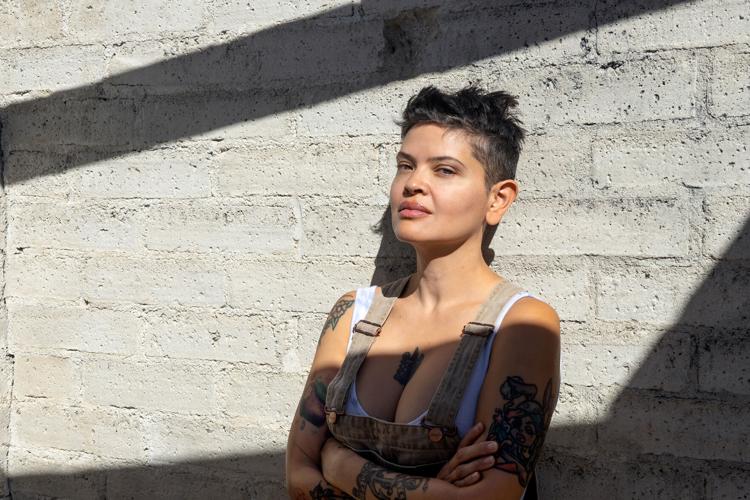
While you can still find Gurba's face plastered on the cover of "Creep," the original idea for the cover was to reference the cover of Joan Didion books. Photo courtesy of Myriam Gurba.
In between explaining why she shows the picture of Miranda in class, Gurba delves into what life was like knowing Richard Ramirez, the serial killer known as Night Stalker, was out there. Gurba's narrative unfolds with her examination of Ramirez’s eventual death and ultimately culminates in Miranda's death, revealing a complex web of interconnected stories.
“Autoethnography is a genre of research, writing, and methodology that positions memoirs as a gateway to examine cultural phenomena often steeped in historical patterns of behaviors and conditions,” said Loretta Victoria Ramirez, assistant professor of Latinx rhetoric and composition in the Chicano & Latino Studies department at California State University, Long Beach.
“Yet even in the sometimes partial, fragmented states of women's stories, Gurba recognizes an impact equal to—if not sometimes greater than—more fully documented male histories,” Ramirez said.
Gurba's attraction to interconnected stories becomes evident throughout “Creep,” but unlike her latest collection of essays, through the recurring frequency of a particular pattern, our interconnected stories begin to meet.
At the same time I was following Gurba’s activism against the book publishing industry in 2020, she was still currently Ms. Gurba to many students in a different Long Beach high school from where she was my teacher.
What eventually happened in the culmination of Gurba’s critique of the publishing industry was an act of extreme actions taken by the high school Gurba was employed by. While in her classroom, Gurba was escorted out of the school’s campus by a group of administrators and guards due to allegedly using her social media to create a disruptive learning environment.
After she was placed on administrative leave from the same high school, a group of students protested their teacher’s displacement by carrying signs and chanting Gurba’s innocence.
After this, Gurba's teaching career ends. The eventual COVID-19 pandemic then puts Gurba out of the news cycle and lays any of her remaining actions against the publishing industry to rest.
“I was extremely frustrated and I was extremely angry at the abuse and the corruption that I witnessed. I, as a matter of conscience, believe that it was part of my pedagogical imperative to speak out and condemn the corruption and abuse that I was witnessing and that I refused to be a part of,” Gurba said about the school district she was working for.
Realization

Unveiling the inspiration to the cover design of "Creep," it traces back to covers of Joan Didion and her posing for her classic covers. Photo courtesy of Myriam Gurba.
Our story reignites years later with the release of “Creep,” a new collection of essays that I know contains content that I expect to see from Gurba since her last book “Mean.”
While reading “Creep,” everything that I have mentioned so far leaves me in a sense of kinship that the book that I hold in my hand was written by a past teacher of mine.
I eventually reach the very last essay of the book. What eventually unfolds is the realization of my role as a spectator in a certain part of Gurba’s life.
In the title essay “Creep” in the book, Gurba details what her life was like living with a violent abuser. Just like the rest of the book, Gurba writes with the purpose to uncover the truth underneath the fog that protects it.
This time the fog is in the form of a person Gurba simply names “Q,” someone she leaves nameless and faceless in her retelling of this part of her story.
“Q” is someone you expect to read about in an essay titled “Creep” but in the eerie truth in Gurba’s writing, “Q” is real and dangerous.
What I eventually began to realize as I reread every word of the essay in the book, that the person Gurba leaves nameless and faceless is a person I can attach a name and face to. It is a person I’ve encountered and it is a person I remember seeing Gurba encountering when she was my teacher.
Thinking nothing of it while I saw these two adults interact when I was young and Gurba’s student, suddenly nothing made sense to me as the last memory I have of Gurba and “Q” is of them smiling at each other.
To learn that Gurba, my teacher, was being raped, harmed and tortured by this person was my realization that the teachings of Gurba was to see and understand the whole picture.
In her attempt to discuss with a class full of students about the death of a fellow student, Gurba’s belief in communal grieving was treated as a way to collectively heal. To know that this is part of the grieving process and a way we say goodbye to the dead.
In showing the picture of Ernesto Miranda in class, Gurba was reacting to her student’s needs, specifically their cultural needs. Finding ways to not only honor historical figures but to still study and understand them.

Joan Didion's appearance on her book covers might have served to establish a visual connection between the author and the reader. Photo courtesy of Myriam Gurba.
Knowing that I would eventually interview Gurba about the release of her new book, I wanted to talk about this part of her life and the crossroads of all our stories.
Question: You talk about your abuser that you leave anonymous and you give the pseudonym “Q” to. You leave this person nameless and faceless. But because I was there in real time as things were unfolding I was able to put a name and face to the person you were writing about. So my only question to you is, does that change anything?
Answer: No. It changes nothing.
The following conversation was off the record. However, once back on the record, where we landed was a place of healing for Gurba. The thought of her students.
“I'm always writing for my former students. And so my students were in mind when I wrote ‘Creep.’ My students were in mind even when I wrote ‘Mean.’ You guys live rent free in my head. Because I think that a teacher is another type of family member,” Gurba said.
“I think that teachers have a lifelong responsibility to the people that they teach. And I don't parent in a traditional way, I don't have children. But that doesn't excuse me from the task of parenting communally or the task of communal care. And so teaching is my way of doing that.”
With the release of “Creep,” Gurba finds herself where she expected to be long ago. Somewhere safe, happy and willing to write about whatever she wants.
In the page of acknowledgements, Gurba lists everyone you expect an author to list, their family, friends, and colleagues. However, the impact of the students Gurba has taught vicariously lives through her. You can find Gurba thanking her students for everything they taught her.
So, in the tricky reverse narration that impels our entwined stories, Gurba’s students were there to teach her too.







(0) comments
Welcome to the discussion.
Log In
Keep it Clean. Please avoid obscene, vulgar, lewd, racist or sexually-oriented language.
PLEASE TURN OFF YOUR CAPS LOCK.
Don't Threaten. Threats of harming another person will not be tolerated.
Be Truthful. Don't knowingly lie about anyone or anything.
Be Nice. No racism, sexism or any sort of -ism that is degrading to another person.
Be Proactive. Use the 'Report' link on each comment to let us know of abusive posts.
Share with Us. We'd love to hear eyewitness accounts, the history behind an article.